ADKINS & PURKEY · LOCUST & ALBEMARLE · NORTH CAROLINA
A practical guide from the firm of Christopher “Chris” Adkins and Christerfer “Chris” Purkey. Explore our practice.

Explore this guide
- Classification comes before division
- Equal division is the starting presumption
- The separation date is financially significant
- Calculate home equity carefully
- A buyout needs a financing and transfer plan
- Retirement division may require additional legal work
- Business interests require more than a bank balance
- Debt allocation does not rewrite the creditor's contract
- Preserve assets and preserve the claim
- Compare proposals on net value and practical use
- Bring the whole financial picture
The question “Who keeps the house?” usually contains several other questions: What is the house worth? How much equity is marital? Can either spouse refinance? What happens to retirement accounts and debt? A fair-looking agreement can fail if it ignores those connections.
Adkins & Purkey, PLLC helps families in Locust, Albemarle, and Stanly County evaluate equitable distribution as an organized financial process. Attorneys Christopher Adkins and Christerfer Purkey can help identify what is owned, how it should be classified, and what a proposed division would require in practice.
Classification comes before division
North Carolina's equitable-distribution statute distinguishes marital, separate, and divisible property. Marital property generally involves property acquired during the marriage and before separation that remains owned, subject to the statutory definitions and exceptions. Separate property can include qualifying premarital property, inheritances, and gifts.
Title alone does not resolve classification. An account held in one spouse's name may contain marital funds. A house may involve a premarital interest, later marital contributions, and valuation issues. Gather acquisition records, deeds, account histories, and documents showing the source of funds before assuming everything belongs in one category.
Equal division is the starting presumption
G.S. 50-20 generally calls for equal division of the net value of marital and divisible property unless equal division would not be equitable. The statute identifies factors the court may consider when deciding whether a different allocation is justified. “Equitable” does not mean a judge simply chooses whichever outcome feels fair.
Equal value also does not require cutting every asset in half. One spouse may retain an asset while the other receives different property or a distributive payment. The complete allocation matters, including debt and any implementation costs or legal limitations affecting particular assets.
The separation date is financially significant
The date of separation helps establish the valuation framework for marital property and debt. Later changes can require separate analysis under the rules for divisible property, including certain passive changes and receipts attributable to pre-separation efforts. Current balances do not necessarily answer the date-of-separation question.
Keep statements from the separation period as well as current statements. Document later payments and significant transactions. If one spouse continues paying a mortgage or maintaining an asset, counsel can evaluate the legal treatment without assuming every payment automatically creates a dollar-for-dollar credit.
Calculate home equity carefully
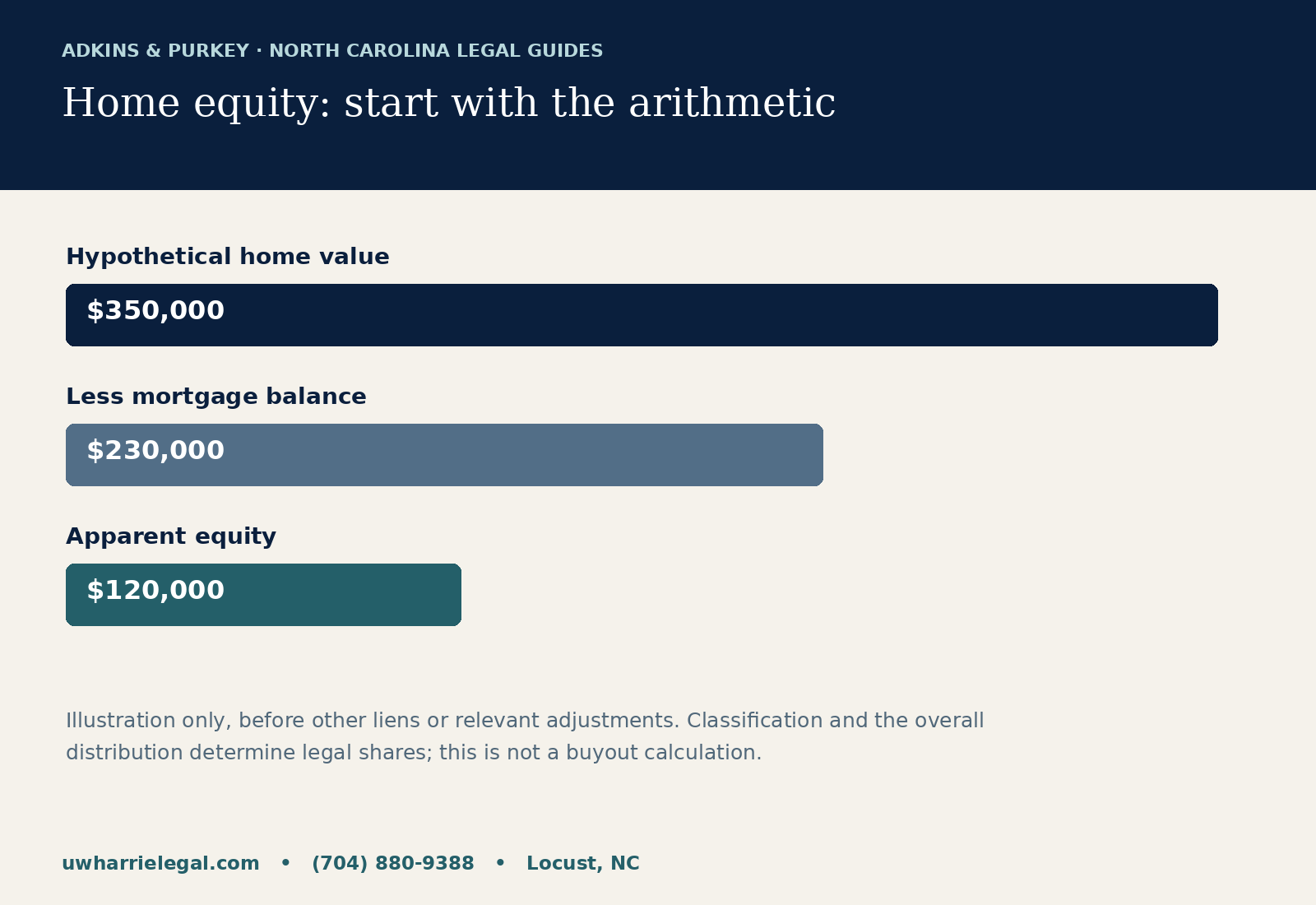
A basic illustration subtracts the mortgage balance from an agreed or supported market value. If a hypothetical home is worth $350,000 and has a $230,000 mortgage, that produces $120,000 of apparent equity before other relevant considerations. It does not establish what either spouse legally receives.
Classification, other liens, valuation evidence, possible separate interests, and the overall distribution can change the analysis. An online estimate may be a starting reference, not a substitute for an appropriate appraisal. Whether sale-related expenses should be considered also depends on the facts and applicable law.
A buyout needs a financing and transfer plan
If one spouse will keep the home, identify the buyout amount, payment source, refinance deadline, title-transfer documents, and fallback if financing fails. Discuss the order in which obligations are performed. Signing over title while remaining responsible on a loan can create significant exposure.
A divorce judgment or private agreement does not force the lender to release a borrower. Obtain information from the lender about available options rather than assuming an assumption or refinance will be approved. If the home must be sold, specify listing procedures, costs, maintenance, offers, and how disagreements are resolved.
Retirement division may require additional legal work
Retirement accounts are not all governed by the same rules. A private employer plan, IRA, government pension, and military retirement benefit may require different instruments and procedures. Tax and withdrawal consequences can also differ from those associated with ordinary cash.
Ask whether a qualified domestic relations order or another specialized order is needed and who will prepare it. Address valuation dates, investment changes, loans, survivor issues when relevant, and plan-administrator requirements. A settlement's promise to divide an account does not guarantee that the administrator can implement it as written.
Business interests require more than a bank balance
A family-owned business may involve tangible assets, receivables, debts, contracts, ownership restrictions, and valuation questions. Personal income and business value are related but not interchangeable. A spouse's ability to continue operating the business can also affect practical settlement options.
Gather ownership documents, financial statements, tax returns, compensation records, and relevant agreements. Avoid transferring assets or changing records to influence the case. Counsel can assess whether a valuation professional or other specialist is needed and how to protect legitimate business operations during the dispute.
Debt allocation does not rewrite the creditor's contract
An agreement may assign a joint credit-card balance to one spouse, but the creditor may still have rights against another person who signed the account agreement. Indemnification between former spouses is different from a creditor's release. Those distinctions matter when evaluating risk.
Document the balance, borrower, purpose, and relevant dates for each debt. A debt's treatment in equitable distribution depends on more than whose name appears on a statement. Closing, refinancing, paying off, or monitoring accounts may require additional steps after settlement.
Preserve assets and preserve the claim
Concerns about disappearing funds, concealed property, or imminent transfers may require prompt advice about discovery or protective relief. Do not respond by hiding assets, draining accounts impulsively, or destroying records. Lawful preservation is more useful than escalating financial conflict.
Equitable-distribution rights generally must be properly preserved before entry of an absolute divorce. If divorce papers have been served, make that clear when calling. A negotiation that remains unfinished when judgment is entered can have consequences that are difficult or impossible to repair.
Compare proposals on net value and practical use
Cash, home equity, retirement benefits, and a business interest are not equally liquid. Two allocations with similar stated values may leave the spouses with very different ability to pay monthly expenses or obtain housing. Review carrying costs, restrictions, timing, and relevant tax questions.
Prepare a side-by-side inventory showing what each spouse would receive and owe. Identify valuations that remain disputed and implementation work still required. A proposal should be evaluated alongside support questions without confusing those separate legal categories.
Frequently asked questions
Is everything divided in half?
The statute generally presumes equal division of the net marital and divisible estate is equitable, but statutory factors can justify another allocation. Separate property and classification must be analyzed first.
Does signing a deed remove me from the mortgage?
No. Transferring ownership does not itself release a borrower from a loan contract. Verify the lender’s actual release or approved financing arrangement.
Does the settlement itself divide a retirement plan?
Not necessarily. A qualified domestic relations order or another specialized instrument may be required, depending on the plan. Confirm implementation and administrator requirements.
Bring the whole financial picture
For a consultation, collect deeds, mortgage records, account statements, retirement information, business documents, debt records, prior agreements, and court papers. Include a short list of priorities, such as remaining near a child's school or maintaining a business. Adkins & Purkey can discuss the next steps from its Locust office, serving Albemarle and surrounding communities.
Meet Chris Adkins and Chris Purkey

North Carolina attorney and certified mediator with a background as a Charlotte-Mecklenburg police officer and Army officer. His work includes family law, criminal defense and civil litigation.
Read the attorney profile →
Attorney whose practice includes family law, DWI and criminal defense, and civil litigation. His approach emphasizes preparation, clear communication and practical decisions based on the record.
Read the attorney profile →Continue with a related guide
- Separation Agreements in Locust & Albemarle: What to Settle Before You Sign
- Served With Divorce Papers in Stanly County? Protect Your Financial Claims
- Alimony and Postseparation Support: A Practical Guide for Locust & Albemarle
Official sources and further reading
- G.S. 50-20: equitable distribution
- G.S. 50-21: procedure and valuation
- NC Judicial Branch: property and divorce
General educational information checked November 2026. Laws and procedures may change. Attorney advertising; no result is guaranteed. This guide is not legal advice and does not create an attorney-client relationship.


Responses
[…] Who Keeps the House in a Stanly County Divorce? Property, Retirement and Debt […]
LikeLike
[…] Who Keeps the House in a Stanly County Divorce? Property, Retirement and Debt […]
LikeLike
[…] Who Keeps the House in a Stanly County Divorce? Property, Retirement and Debt […]
LikeLike