ADKINS & PURKEY · LOCUST & ALBEMARLE · NORTH CAROLINA
A practical guide from the firm of Christopher “Chris” Adkins and Christerfer “Chris” Purkey. Explore our practice.

Explore this guide
- First, identify what you actually received
- An absolute divorce answers a limited question
- Protect equitable distribution before the marriage ends
- Alimony requires its own preservation analysis
- Custody and child support are separate issues
- A response should fit the actual issues
- Gather a focused financial file
- Consider the practical effects of judgment
- Use official court information carefully
- Bring the county and court dates into the plan
- A clear response begins with the documents
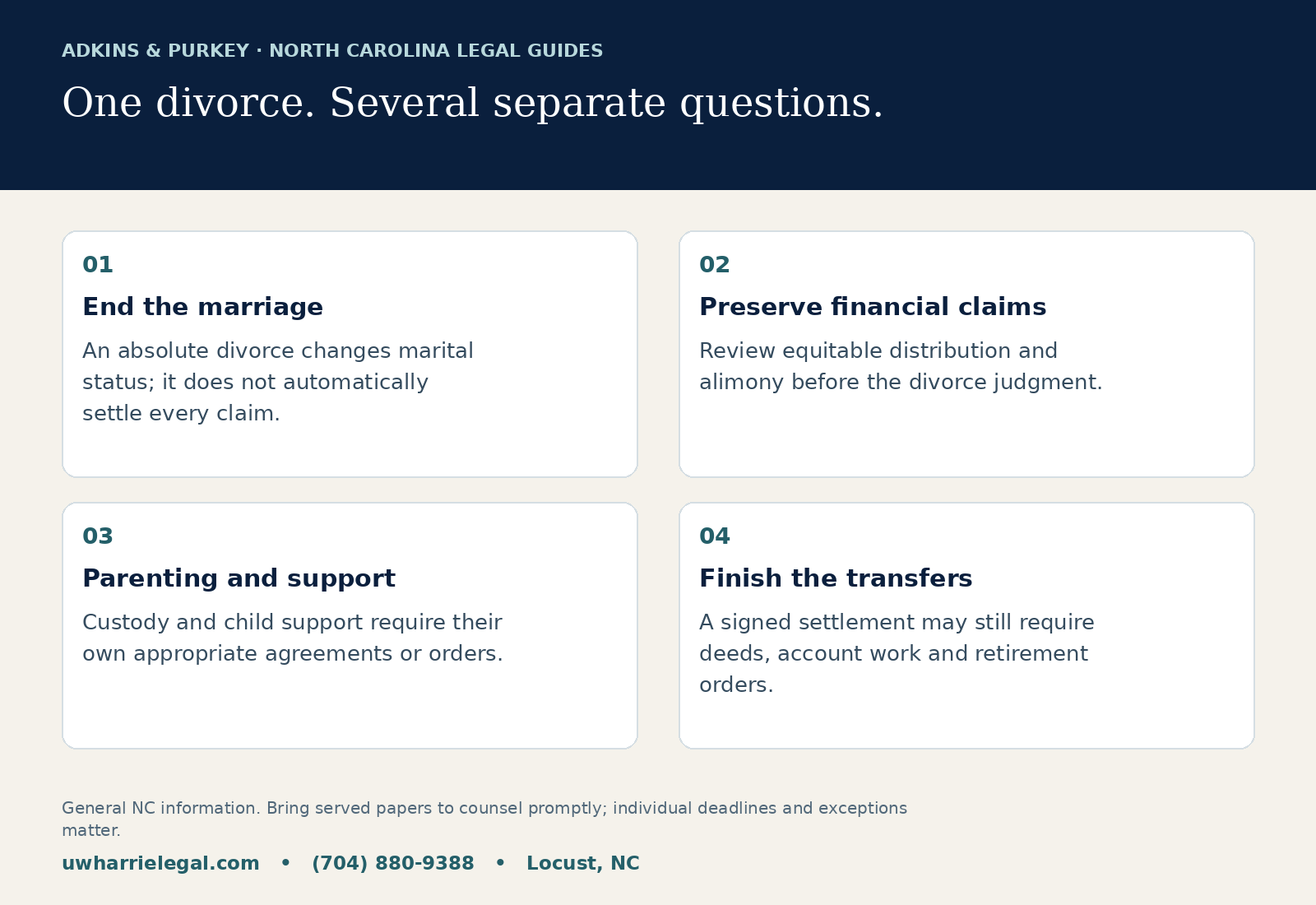
Receiving divorce papers can feel like the end of a long process. Legally, it may be the beginning of a short window to protect important rights. A North Carolina absolute divorce ends the marriage, but it does not automatically divide property, resolve alimony, establish custody, or settle child support. Understanding those differences is essential before signing anything or allowing a judgment to be entered.
For residents of Albemarle, Locust, and Stanly County, Adkins & Purkey, PLLC offers a place to organize the paperwork and identify what remains unresolved. Attorneys Chris Adkins and Chris Purkey can evaluate the claims, the procedural posture, and the decisions requiring prompt attention.
First, identify what you actually received
A civil summons and complaint are different from a proposed consent order, discovery request, notice of hearing, or informal settlement letter. Read the caption, file number, requested relief, and service documents together. Save envelopes, delivery information, and every page, including attachments.
A deadline normally runs from a legally significant event such as service, not from the day a person finally reads the papers. North Carolina civil rules generally provide 30 days to respond after service of a summons and complaint, but exceptions, extensions, and other deadlines can apply. Have the actual documents reviewed rather than relying on a general online deadline.
An absolute divorce answers a limited question
The usual separation-based divorce under G.S. 50-6 requires spouses to have lived separate and apart for one year and requires the applicable six-month North Carolina residency. A spouse does not have to prove the other spouse committed marital fault to obtain this type of divorce.
That limited focus can create a dangerous misunderstanding: an apparently simple divorce may proceed while major financial questions remain untouched. A statement that “we will deal with the money later” is not a substitute for preserving a claim in the required manner. An informal conversation with the other spouse does not stop the court from entering a judgment.
Protect equitable distribution before the marriage ends
Equitable distribution is the process for classifying, valuing, and distributing marital and divisible property and debt. In general, the right must be properly preserved before entry of an absolute divorce or it can be lost. Narrow statutory exceptions exist, but a person should never plan around qualifying for an exception after the fact.
An account being in one spouse's name does not necessarily make it separate property. A marital home, retirement benefits, closely held business, or debt may require investigation even when the parties believe there is “nothing to divide.” Identify the issue while counsel can still assess the available procedural options.
Alimony requires its own preservation analysis
An alimony claim is not automatically included because a complaint asks for a divorce. The dependent spouse's right to seek alimony can be affected by entry of the divorce if the claim has not been properly asserted and preserved. Postseparation support and alimony also have distinct functions and procedural considerations.
If you are unsure whether you need support, seek advice before deciding to waive it. A spouse may be employed and still have a legally relevant support question. Conversely, an income difference alone does not guarantee an award. Review the law, financial records, and particular marital circumstances together.
Custody and child support are separate issues
A divorce judgment does not itself establish a parenting schedule or calculate child support. Those issues may be addressed in separate claims, orders, or agreements. Existing orders remain important after divorce; the change in marital status does not give either parent permission to ignore them.
When children are involved, bring the current parenting arrangement, any signed agreement, and all existing orders. Explain school locations, exchange practices, insurance, child-care expenses, and pending concerns. If there is a safety emergency, tell counsel immediately rather than waiting for a routine divorce hearing.
A response should fit the actual issues
Some clients need to contest allegations. Others may agree that the marriage should end but still need to assert counterclaims, preserve financial rights, or ensure that service and jurisdiction are proper. Agreeing with the idea of divorce does not mean every legal issue has been resolved.
Avoid signing an acceptance, waiver, release, or consent judgment simply because it is described as “standard.” The document's legal effect depends on its language and context. Counsel can explain which facts matter, which claims are already pending, and what must be filed or negotiated before judgment.
Gather a focused financial file
Start with recent tax returns, pay records, bank statements, retirement statements, mortgage information, debt balances, deeds, and business ownership records. Identify prenuptial agreements and prior separation agreements. Preserve the versions you have without modifying originals.
A concise inventory is often more useful than an unorganized collection of screenshots. List each asset or debt, the named owner or borrower, an approximate balance, the date of the information, and the supporting document. Distinguish what you know from what needs to be requested through appropriate discovery.
Consider the practical effects of judgment
Ending a marriage can affect benefits, insurance eligibility, estate planning, and other arrangements. Those effects do not all follow the same rules. A divorce decree does not necessarily remove a former spouse from a mortgage, change retirement beneficiaries, or implement an agreed account division.
Review the completion work required under any settlement. Ask about existing powers of attorney, wills, beneficiary designations, health coverage, and tax questions. Obtain advice specific to the plan or instrument rather than assuming that a court clerk or financial institution will make every change automatically.
Use official court information carefully
The North Carolina Judicial Branch provides divorce information and a self-help divorce packet. Its own instructions warn that the packet does not resolve custody, support, or property division and may be unsuitable for people who want to preserve financial claims.
Official forms are useful resources, but a form cannot decide whether a particular person should assert a claim, seek interim relief, or accept a proposed waiver. Court personnel also cannot serve as either spouse's legal adviser. Before using a simplified packet, understand what it leaves out.
Bring the county and court dates into the plan
Tell the firm whether the matter is filed in Stanly, Cabarrus, Montgomery, or another county. Venue, jurisdiction, existing cases, and the type of hearing matter. Verify court dates through official court resources and counsel; an online listing alone does not answer every appearance question.
For a first consultation, provide the papers, the date and method of service, the next known court date, and a summary of unresolved property or support questions. Call rather than relying on an unread online inquiry when a deadline is approaching.
Frequently asked questions
Does a divorce automatically divide our property?
No. Absolute divorce ends the marriage. Equitable distribution requires its own proper preservation and resolution, and an unpreserved claim can be lost.
Can I ignore the papers if I agree to divorce?
Ignoring service can leave important issues unaddressed. Have the complaint, service date and requested relief reviewed promptly, even if you agree that the marriage should end.
Where can I check official court information?
Use the North Carolina Judicial Branch’s official court and county resources. Confirm appearance instructions and deadlines with counsel; an online case listing is not a complete legal assessment.
A clear response begins with the documents
Do not assume that avoiding the papers will delay the case or preserve your rights. Keep the record intact and get a concrete explanation of the available next step. A timely review can distinguish a straightforward divorce from a divorce that could permanently affect valuable financial claims.
Meet Chris Adkins and Chris Purkey

North Carolina attorney and certified mediator with a background as a Charlotte-Mecklenburg police officer and Army officer. His work includes family law, criminal defense and civil litigation.
Read the attorney profile →
Attorney whose practice includes family law, DWI and criminal defense, and civil litigation. His approach emphasizes preparation, clear communication and practical decisions based on the record.
Read the attorney profile →Continue with a related guide
- Separation Agreements in Locust & Albemarle: What to Settle Before You Sign
- Alimony and Postseparation Support: A Practical Guide for Locust & Albemarle
- Who Keeps the House in a Stanly County Divorce? Property, Retirement and Debt
Official sources and further reading
- NC Judicial Branch: divorce packet warnings
- G.S. 50-6: separation-based divorce
- G.S. 50-11: effects of divorce
- NC Rule 12: responsive pleadings
General educational information checked November 2026. Laws and procedures may change. Attorney advertising; no result is guaranteed. This guide is not legal advice and does not create an attorney-client relationship.


Responses
[…] Served With Divorce Papers in Stanly County? Protect Your Financial Claims […]
LikeLike
[…] Served With Divorce Papers in Stanly County? Protect Your Financial Claims […]
LikeLike
[…] Served With Divorce Papers in Stanly County? Protect Your Financial Claims […]
LikeLike