ADKINS & PURKEY, PLLC · STANLY COUNTY FAMILY LAW
A separation can leave parents asking where their child will sleep next week. Years later, a move, a new school need, or a serious safety concern can make an existing schedule difficult to follow. Both situations involve child custody, but they do not begin with the same legal question.
At Adkins & Purkey, PLLC, our child custody attorneys help parents in Albemarle, Locust, and throughout Stanly County, North Carolina evaluate initial custody arrangements and modifications of existing orders. Start by identifying what already exists: no order, a private agreement, a temporary order, or a permanent custody order. That answer shapes the request, the evidence, and the next court step. This guide explains initial custody issues and custody modification, with practical ways to prepare for each.

The central distinction: An initial custody decision between parents focuses on the child’s best interests. To modify a permanent order over a parent’s objection, the moving party generally must first establish a substantial change in circumstances affecting the child’s welfare, then show that the requested change serves the child’s best interests.
In this guide: Initial custody · Court and mediation · Modification · Evidence chart · Safety and enforcement · FAQs · Consultation checklist
Initial child custody in Albemarle and Locust: start with the child’s needs
In a custody dispute between parents, North Carolina’s governing standard is the child’s best interests and welfare. N.C. Gen. Stat. § 50-13.2 requires consideration of relevant factors, including domestic violence and the safety of the child and parties. Neither parent receives a gender-based preference. Joint custody must be considered when requested, but the statute does not guarantee equal parenting time.
A useful proposal explains ordinary life. Who can get the child to school on time? How will medication, homework, childcare, and bedtime work in each household? What arrangement protects important relationships without exposing the child or a parent to danger? A request for “full custody” communicates a goal; a proposed weekly routine gives counsel and the court something concrete to evaluate.
Legal custody and physical custody answer different questions
Legal custody concerns authority over major decisions, such as education and significant medical care. Physical custody addresses the child’s care and parenting schedule. An order should explain both. Shared decision-making does not itself tell parents which nights the child spends in each home.
Before discussing labels, list the decisions that repeatedly cause conflict. A plan might need clear requirements for sharing school notices, providing appointment information, consulting before major decisions, and resolving an impasse. The appropriate terms depend on the family; a generic label cannot replace a carefully written order.
What if there is no order, or the parents were never married?
Custody is available to parents who were married and parents who were never married. Questions about legal parentage may need attention first. The North Carolina Judicial Branch custody guide explains that legal parents generally have equal rights when no custody order exists. That can leave considerable uncertainty when cooperation breaks down.
Bring any separation agreement, signed parenting agreement, parentage documents, and prior court paperwork to a consultation. A private agreement and a judge-signed order have different enforcement consequences. Do not assume that an arrangement described in text messages can be enforced through contempt, or that a private agreement permanently settles the court’s custody authority.
How an initial custody case moves through Stanly County court
An initial case generally begins with a custody complaint and proper service. Jurisdiction and venue must be checked before filing. Under North Carolina’s initial custody jurisdiction statute, the child’s home state is a central consideration, with exceptions and special rules. A recent move to North Carolina does not automatically give a local court authority to decide custody.
Custody proceedings are heard in district court. County venue rules appear in § 50-13.5, and existing litigation can affect where a claim belongs. For local contacts, calendars, and procedural information, use the official Stanly County court page. Confirm current scheduling requirements rather than relying on another family’s experience.
The court’s custody mediation program generally requires attendance unless a judge grants a waiver. The mediator helps parents explore an agreement and does not decide custody. Court-program mediation addresses custody and visitation rather than child support. An attorney can help you prepare and review proposed terms, although attorneys do not attend those mediation sessions. See the Judicial Branch mediation guide.
Use preparation time to test a proposed schedule against actual obligations. For an Albemarle school morning or a Locust pickup after work, account for travel, dismissal time, and the availability of a responsible caregiver. Write down fallback arrangements for sick days, teacher workdays, and delayed exchanges. Specific terms can prevent an otherwise workable agreement from unraveling.
Temporary orders deserve careful attention
A temporary custody order is binding while the case continues. Changing it or obtaining a permanent order may involve a different procedure from modifying a permanent order. The Judicial Branch warns that an order labeled temporary can become permanent after a prolonged period without another hearing. Have counsel review the actual language and case history before choosing a filing strategy.
A parenting plan should answer the questions parents will actually face
- School weeks: overnight arrangements, school transportation, after-school care, and responsibility when a child is sick.
- Exchanges: exact times, locations, transportation duties, and a process for notifying the other parent of delays.
- Holidays and breaks: a defined rotation, summer arrangements, and which schedule controls when dates overlap.
- Decisions and information: access to records, appointment notices, consultation requirements, and how disagreements are addressed.
- Communication and safety: appropriate parent-to-parent contact, child contact between visits, and any necessary protections.
A plan also needs realistic expectations. Avoid requiring immediate responses during work, vague pickup windows, or repeated direct exchanges when contact creates danger. For more detail, read our school-year parenting plan guide and our broader Albemarle and Locust custody guide.
Custody modification in Stanly County, NC: what must change?
A permanent order provides stability, so a modification case generally requires more than showing that a different schedule would now be preferable. N.C. Gen. Stat. § 50-13.7 authorizes modification on a showing of changed circumstances, subject to jurisdictional rules. North Carolina appellate decisions explain the substantial-change requirement.
In Shipman v. Shipman, 357 N.C. 471 (2003), the Supreme Court explained the sequence: determine whether circumstances substantially changed and affected the child’s welfare; if so, evaluate whether changing custody serves the child’s best interests. The connection to the child matters. A change need not always be harmful, but it must have the required significance and effect.
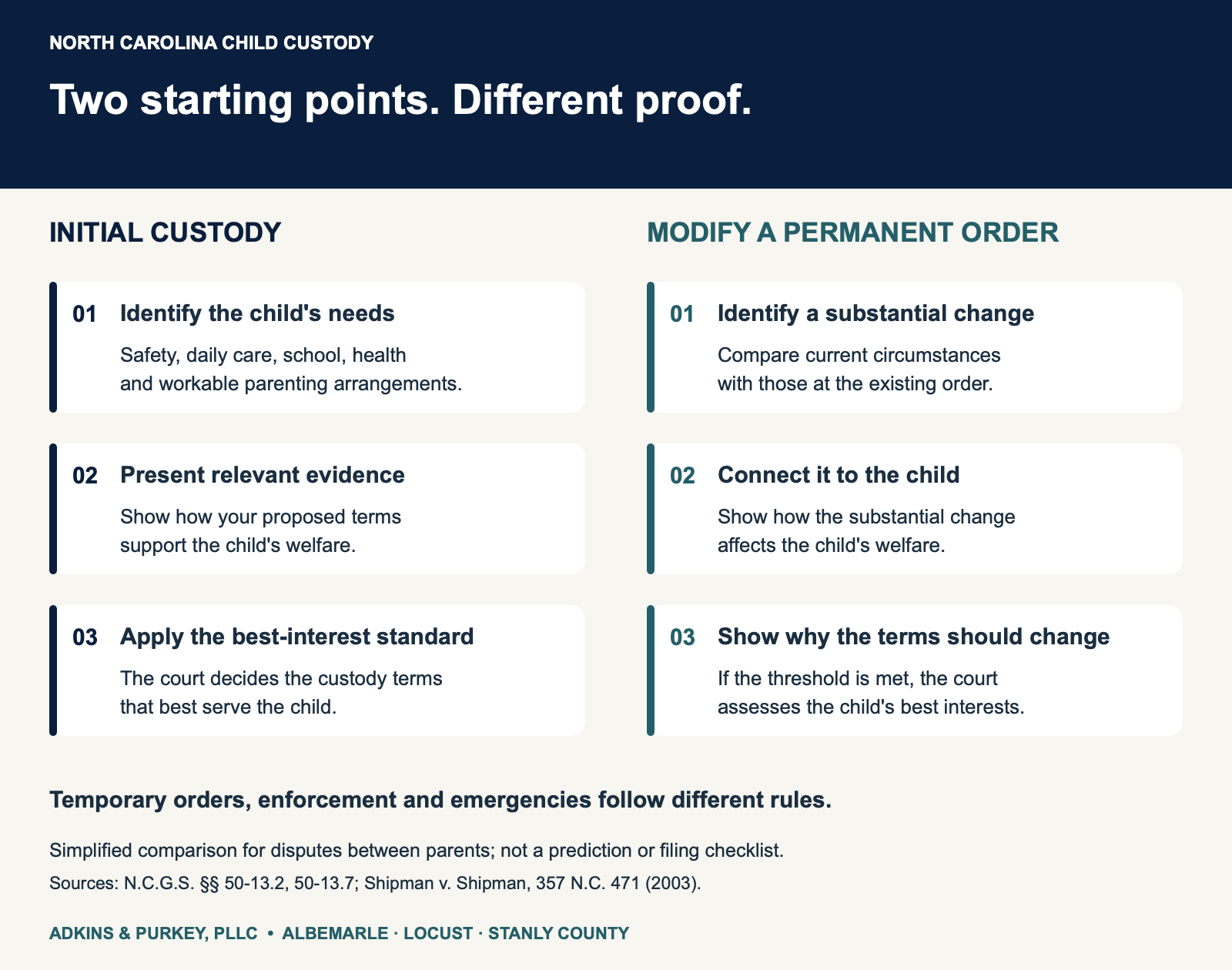
Build a clear comparison between circumstances when the current order was entered and circumstances now. Then identify the specific terms that should change. Asking for a new exchange location, decision-making provision, or school-week arrangement requires explaining why that relief addresses the child’s present needs.
A request to change a permanent order generally proceeds through a motion to modify in the existing custody case, rather than a new initial complaint. Counsel should confirm which court retains authority, prepare the factual grounds and requested relief, and address notice, service, mediation, and hearing requirements. Bring the entire order and subsequent filings so the proposed request fits the case that is already pending.
For example, “the other parent’s job changed” tells only part of the story. A more useful account identifies the new hours, the caregiving gap, the dates it occurred, and its impact on the child. If the concern is school attendance, gather the attendance records and explain how the existing schedule relates to the problem. These are preparation examples, not automatic grounds for modification.
Evidence chart: connect the concern to the child and the requested solution
| Issue to discuss | Useful factual detail | A possible term to evaluate |
|---|---|---|
| School disruption | Attendance records, exchange times, travel demands, and a dated comparison with the prior routine. | A revised school-week schedule or transportation provision. |
| Changed care needs | Relevant medical or educational recommendations and each parent’s ability to carry them out. | Clearer responsibilities, information sharing, or appointment coordination. |
| Repeated missed parenting time | The order’s exact terms, complete communications, dates, and the child’s resulting disruption. | Enforcement, clarification, or modification, depending on the facts. |
| Relocation | The proposed address, school implications, travel arrangements, and practical effect on existing contact. | Revised exchanges, school-week time, holidays, or other appropriate relief. |
Preserve complete records and original files where possible. A short timeline with dates, sources, and the child’s observable experience is more useful than a large folder of unexplained screenshots. Separate what you witnessed from what someone told you. Your attorney can evaluate relevance, admissibility, privacy, and whether witnesses or subpoenas are needed.
Avoid recruiting the child to collect evidence, carry messages, or choose a side. Do not access another person’s accounts or obtain records unlawfully. If communications are relevant, preserve the conversation’s context rather than selecting only the most upsetting sentence.
Relocation and new schedules: plan before making commitments
A proposed move can affect school, travel, childcare, and the frequency of contact with each parent. Start by reading the current order for relocation, notice, school, and transportation provisions. A move does not automatically justify changing custody, and a new address does not erase existing obligations.
Before signing a lease, enrolling the child in a different school, or promising a new routine, discuss the proposed changes with counsel. Prepare a practical alternative schedule, including travel responsibilities and costs. If an order came from another state, jurisdiction must be evaluated separately; moving to Stanly County does not by itself transfer authority to modify it.
Enforcement, emergency relief, and modification serve different purposes
If a parent is violating an existing order, enforcement may be the immediate issue. A modification request instead seeks different terms. Some situations raise both questions. Identify the provision involved and document what happened; do not assume that missed visits alone determine the appropriate remedy. Counsel can evaluate whether contempt, clarification, modification, or another request fits the record.
Emergency custody is narrower than a serious disagreement. Under § 50-13.5(d)(3), an ex parte order changing custody before notice requires specified risks, including substantial risk of bodily injury, sexual abuse, or abduction or removal from North Carolina to evade its courts. Ordinary scheduling conflicts do not, by themselves, satisfy that standard.
If someone is in immediate danger, call 911. Tell counsel promptly about threats, violence, impaired caregiving, or concerns about removal. A safety problem may require urgent court relief or protective proceedings. Do not rely on a blog article to decide whether it is safe to wait for a routine hearing.
Continue treating an existing order as binding unless the court changes it. If parents agree to a lasting revision, ask about properly documenting it and obtaining an appropriate court order. An informal text-message change may leave the old order in place.
Questions Stanly County parents often ask
Do I have to wait until divorce to ask for custody?
No. Custody can be addressed before a divorce is final, and parents who never married can also seek custody. Parentage, jurisdiction, and existing proceedings still matter. Do not confuse divorce timing with the need to address an uncertain parenting arrangement.
Does joint custody mean an automatic 50/50 schedule?
No. Joint legal custody and a physical parenting schedule address different subjects. The order’s actual terms control. Focus on the child’s needs and a workable proposal rather than assuming that a particular label guarantees equal nights.
Can my child decide where to live?
A child does not automatically control custody at a particular age before adulthood. A sufficiently mature child’s preference may be considered, but the judge decides the child’s best interests. Discuss how to handle this sensitively with counsel; avoid coaching the child or making promises about the result.
Is there a waiting period before seeking modification?
There is no universal requirement to wait a set number of months under § 50-13.7. The key questions are the order’s status, jurisdiction, the qualifying changes, and their effect on the child. Filing quickly does not replace the need for legally sufficient facts.
Can parenting time be withheld because support is unpaid?
A support dispute does not authorize ignoring a custody order. Address support through the appropriate legal process and obtain advice about enforcement. A changed parenting schedule may also raise separate support questions; see our guide to child support after job or custody changes.
Stanly County custody help from Adkins & Purkey
Organized preparation helps an attorney distinguish an initial filing from a modification or enforcement problem. Bring these items, and ask the firm how to share sensitive records securely:
- Every custody order and relevant agreement, plus the case number, county, and upcoming court dates.
- A short history of where the child has lived, including any out-of-state proceedings.
- The current parenting schedule and a specific proposal for the terms you want.
- For modification, a dated summary of what changed after the current order and how it affects the child.
- A focused set of supporting records and a list of immediate safety concerns.
From our office in Locust, NC, Adkins & Purkey, PLLC represents parents in child custody matters in Albemarle and throughout Stanly County. Our family-law services include initial custody cases, parenting plans, custody modifications, and enforcement. We help clients organize the facts, evaluate negotiated solutions, and prepare requests for appropriate court relief. Whether you are seeking your first custody order or changes to an existing order, a consultation can help identify the child’s needs and the next steps to evaluate.
Contact our Locust office: 217 W. Main Street, Locust, NC 28097. Call (704) 880-9388 or request a consultation. You can also meet the firm’s attorneys before your visit.
Attorney advertising. This article provides general information about North Carolina law, not legal advice for a specific family. Reading it or contacting the firm does not create an attorney–client relationship. Legal requirements, current orders, and individual circumstances must be evaluated in your case. Hypothetical examples and graphics do not predict outcomes.


Leave a Reply