
Family Law · Locust & Stanly County, North Carolina
In this guide- Start with the existing legal arrangement
- Separate decision-making from the weekly schedule
- Build the plan around real school days
- Give holidays and school closures their own rules
- When the existing order no longer fits
- Safety concerns deserve specific attention
- Questions parents often ask
A parenting schedule can look fair on paper and still fall apart at the school pickup line. One parent works late, a child needs tutoring, the school calendar changes, and a vague promise to “work things out” leaves everyone uncertain. For parents in Locust, Albemarle, and surrounding Stanly County communities, a useful custody plan starts with the child’s actual week.
The goal is a workable arrangement that supports school, health, safety, and relationships. The following questions help turn a general request for shared parenting into specific proposals an attorney can evaluate.
Start with the existing legal arrangement
Bring every custody order and signed agreement to your consultation, including temporary orders, consent orders, and later modifications. A text-message arrangement is not necessarily a modification of a court order. Before changing exchanges, withholding time, or enrolling a child elsewhere, understand what the controlling documents require.
North Carolina’s custody statute directs the court to promote the child’s interests and welfare. It requires consideration of relevant factors, including domestic violence and safety, and does not presume that one parent is better because of the parent’s sex. Joint custody must be considered if either parent requests it. These rules do not automatically require equal overnight time. See N.C. Gen. Stat. § 50-13.2.
Separate decision-making from the weekly schedule
Legal custody addresses decisions such as education and medical care. Physical custody addresses where a child lives and spends time. A proposal should explain both. For example, a schedule could identify school-night overnights while separately describing how parents exchange information and resolve a disagreement about tutoring.
Do not assume that “joint custody” answers every question. Ask who receives school notices, who can authorize routine treatment, how quickly a parent must respond to a proposed activity, and what happens if there is no agreement. A clear process can reduce repeated disputes without promising that conflict will disappear.
Build the plan around real school days
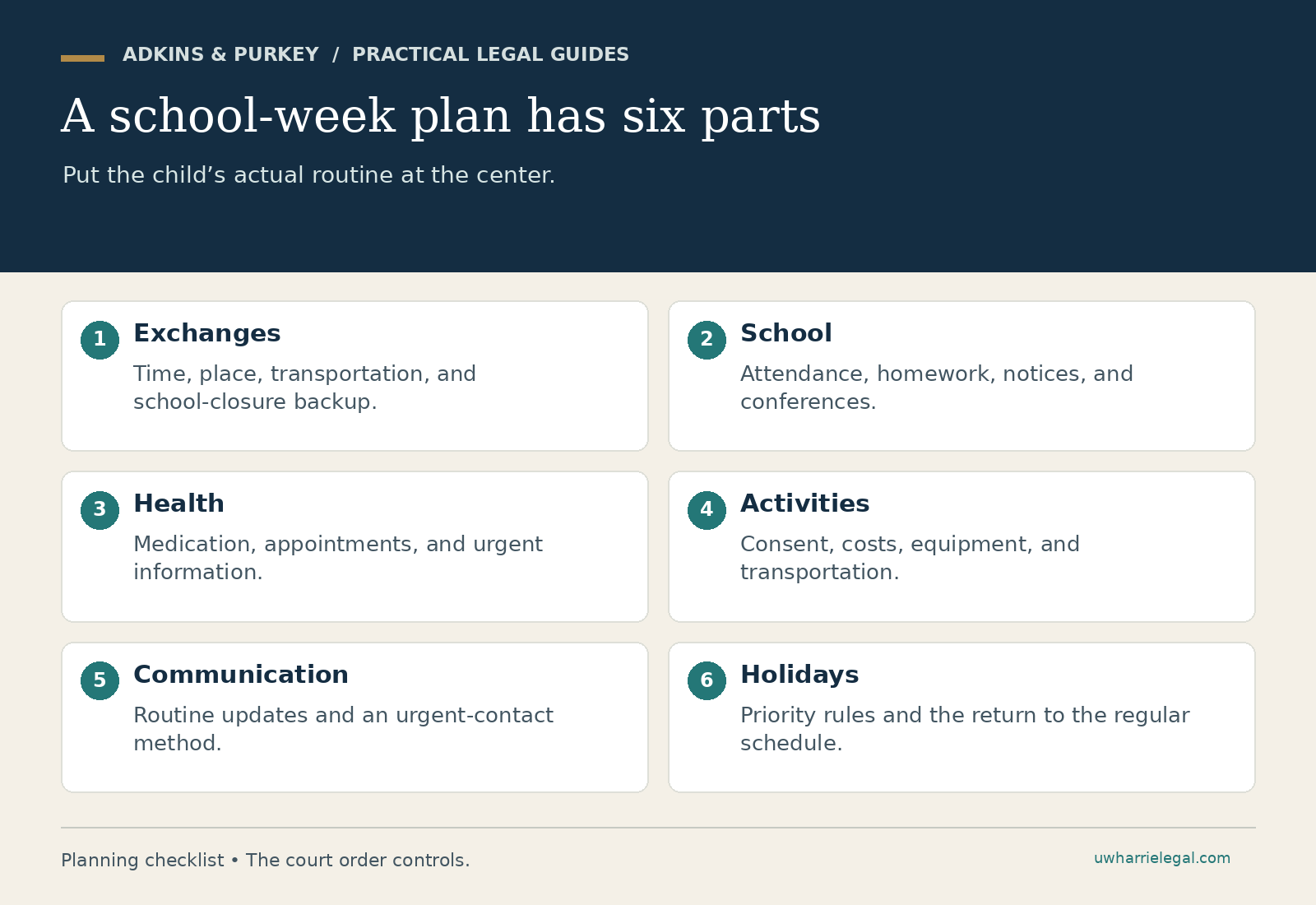
Map an ordinary Monday through Friday before negotiating special occasions. Include work schedules, transportation, bus availability, homework, medication, and bedtime. Test the travel time during the actual school commute. An exchange that is easy on Saturday afternoon may be difficult before an early school start.
- Exchanges: Identify the location, time, transporting parent, and backup if school is closed.
- School information: Address report cards, attendance alerts, teacher conferences, and access to online portals.
- Activities: Explain consent, transportation, costs, and activities that overlap the other parent’s time.
- Belongings: Provide a practical way to move uniforms, devices, sports equipment, and medication.
- Communication: Set reasonable methods and expectations for routine messages and urgent issues.
A short written proposal is often more productive than a long list of complaints. Describe what the child needs and how the proposal addresses it. Preserve disagreements accurately, but distinguish a one-time inconvenience from an ongoing problem.
Give holidays and school closures their own rules
Specify whether a holiday schedule overrides the normal rotation, when each holiday begins and ends, and how the rotation resumes. Include teacher workdays, early release days, spring break, and the transition between summer and the school year. Use the child’s actual school calendar rather than assuming all nearby schools close on the same dates.
For travel, discuss notice, emergency contacts, itinerary information, and any consent required by the existing order. A plan should also account for transportation disruptions. Avoid language that creates an automatic penalty whenever a parent is delayed; discuss proportionate, child-focused solutions with counsel.
When the existing order no longer fits
A permanent custody order generally requires proof of a substantial change in circumstances affecting the child’s welfare before the court considers a modification in the child’s best interests. A new job or a new preference does not automatically establish that standard. Temporary orders, emergency requests, and interstate cases raise different questions. The statutory starting point is § 50-13.7; the Judicial Branch custody guide explains the distinction between temporary and permanent arrangements.
Useful evidence connects the change to the child: attendance records, documented missed exchanges, a changed school schedule, medical recommendations, or a dated communication history. Keep complete conversations and original records. Do not coach a child, ask a child to gather evidence, or access another person’s account without permission.
Safety concerns deserve specific attention
Describe concrete safety concerns to your lawyer promptly. An emergency custody order is available only in limited circumstances; an ordinary scheduling dispute is not automatically an emergency. Where appropriate, counsel can evaluate protected exchanges, supervision, transportation conditions, or other relief. Immediate danger calls for emergency assistance.
If an alcohol-related incident or DWI allegation overlaps with a parenting dispute, the criminal charge and the custody evidence need separate analysis. An allegation is not a finding of guilt. Our firm’s North Carolina DWI guide explains the criminal and license questions that may need coordinated attention.
Questions parents often ask
Can my child choose where to live?
There is no automatic age below 18 at which a child takes over the custody decision. A judge may consider a sufficiently mature child’s wishes, along with the other evidence. Avoid making the child responsible for choosing between parents.
Can I stop exchanges if child support is unpaid?
Custody and support are separate legal obligations. Do not use parenting time as a collection method. Ask counsel about enforcing the relevant order through the proper process.
What should I bring to the first meeting?
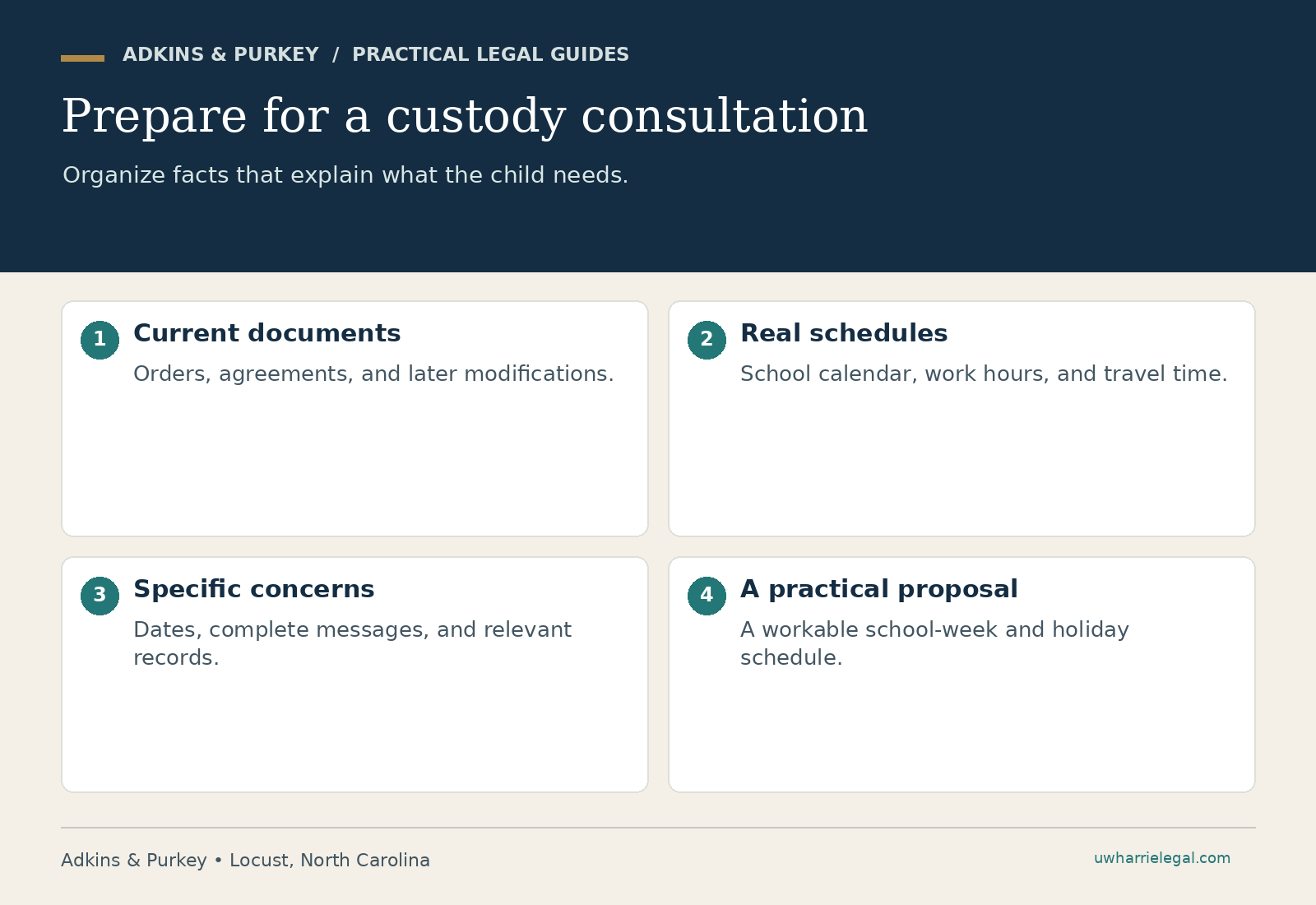
Bring the current orders, the school calendar, work schedules, a concise timeline, relevant records, and a proposed two-week schedule. Mark the provisions that cause recurring problems so the conversation can focus on practical changes.
Attorney advertising. General North Carolina legal information as of September 22, 2026; not legal advice for a particular matter. Laws and procedures can change. Reading this article or contacting the firm does not establish an attorney-client relationship. Please do not send confidential information through an initial inquiry.


Leave a comment