
ADKINS & PURKEY • STANLY COUNTY, NORTH CAROLINA
A clear plan for the next chapter.
A detailed guide to separation, financial claims and divorce planning for families in Albemarle, Locust and across Stanly County. Understand the deadlines, organize the numbers and prepare for informed decisions.

Published September 29, 2026 · A&P Family Law Learning Center
Educational information about North Carolina law, not advice for a particular case. Examples are fictional. Deadlines, orders and individual circumstances matter; reading this guide does not create an attorney–client relationship.
Inside this guide
- Start with separation, safety and a workable plan
- Understand the divorce clock—and its limits
- Protect financial claims before the divorce is final
- Map property and debt before negotiating a split
- A visual example: equal value is not equal cash
- Build a budget for postseparation support and alimony
- Make a separation agreement specific enough to use
- Keep children’s needs on a separate planning track
- Navigate the local process in Stanly County
- Prepare a focused consultation file
- Connect divorce planning with the rest of your legal life
- Answers to common divorce questions
- Talk through the next decision with A&P
CHAPTER 01
Start with separation, safety and a workable plan
For a family in Albemarle or Locust, divorce usually begins with decisions that are far more immediate than a court judgment: where each person will live, how bills will be paid and how children will get to school. A useful plan separates those practical questions from the legal steps required to end the marriage. You can work on financial arrangements and parenting issues during separation; you do not have to wait until you are eligible for an absolute divorce to seek advice about them.
North Carolina generally considers spouses separated when they live in different homes and at least one intends the separation to be permanent. Sleeping in separate bedrooms under one roof ordinarily does not qualify. A written agreement is not required simply to begin a separation, although it can be valuable for documenting obligations. The North Carolina Judicial Branch separation and divorce guide explains these distinctions.
Write down the date separate households began, preserve legitimate records of residence and build a realistic first-month budget. Do not assume that moving out gives up ownership of the house, or that remaining in the house settles who will ultimately receive it. Ownership, occupancy, mortgage responsibility and eventual distribution are separate questions.
CHAPTER 02
Understand the divorce clock—and its limits
For the usual separation-based absolute divorce, North Carolina requires the spouses to have lived separate and apart for at least one year and requires either spouse to have resided in North Carolina for six months before filing. The court’s public guidance describes filing after one year and a day of separation. These are eligibility requirements, not a promise that a divorce will be entered on a particular date. See N.C. Gen. Stat. § 50-6.
| Stage | What it means | What to do |
|---|---|---|
| Separate households | The separation period begins when the legal requirements are met. | Record the facts; address housing, safety, money and children. |
| During the separation year | Financial claims and parenting arrangements may need attention now. | Review agreements and preserve claims before any divorce judgment. |
| Eligible to file | The separation and residency requirements must both be satisfied. | Confirm venue, prepare accurate papers and arrange lawful service. |
| Service and response | The other spouse receives formal notice and has an opportunity to respond. | Read every document and calendar its actual deadline. |
| Judgment | A court ends the marital status if the requirements are established. | Confirm which financial and parenting issues are resolved or remain pending. |
Your spouse’s refusal to sign an agreement does not necessarily prevent an absolute divorce. Proper filing, service and proof still matter. Conversely, an amicable understanding does not replace the court judgment. Uncontested describes the level of dispute; it does not mean there are no legal consequences.
Reconciliation can also affect the timeline. Resuming the marital relationship is assessed from the total circumstances; isolated sexual contact alone does not automatically establish that resumption. If there have been overnight stays or an attempted reconciliation, discuss the actual facts instead of guessing at a new separation date. See § 52-10.2.
CHAPTER 03
Protect financial claims before the divorce is final
The divorce judgment can arrive before the financial work is finished. Ending the marriage does not automatically divide retirement accounts, allocate home equity or create a support award. Equitable distribution and alimony rights can be lost if claims are not properly asserted before the absolute divorce. There are limited statutory exceptions, but an exception is a poor substitute for timely, accurate pleadings. Review § 50-11 with counsel before allowing a judgment to proceed.
A conversation about property, a draft agreement or a statement that you “reserve all rights” in an email is not necessarily a properly pending claim. The exact allegations and requested relief in court filings matter. Existing support orders and properly pending claims require their own analysis. Child custody and child support follow different rules and are not extinguished simply because the marriage ends.
Being served requires prompt attention. An answer is ordinarily due within 30 days after service under Rule 12, but the correct response and deadline depend on the papers and any applicable rule or order. Do not wait until the end of that period to seek advice. For additional questions to ask, read five financial questions to resolve before a North Carolina divorce is final.
CHAPTER 04
Map property and debt before negotiating a split
Equitable distribution begins with identifying and classifying assets and liabilities, valuing them under the applicable rules, and deciding an equitable distribution. North Carolina generally starts from equal division of the net marital and divisible estate unless an equal division would not be equitable after considering the statutory factors. “Equitable” does not mean each person receives half of every account or that the name on an asset decides ownership for divorce purposes. The governing statute is § 50-20.
| Category | Common illustration | Important question |
|---|---|---|
| Marital property | A retirement benefit earned during the marriage before separation. | What portion was earned during the relevant period? |
| Separate property | A premarital asset or qualifying inheritance. | Can its origin and later movement be traced? |
| Divisible property | Certain passive changes in value or income after separation tied to marital property. | What caused the change and when was the underlying right earned? |
| Debt | Mortgage, vehicle loan or other claimed marital obligation. | When was it incurred, for whose benefit, and what balance applies? |
A mixed account needs more than a current balance. An inherited deposit later transferred among accounts, a home purchased before marriage but paid down during marriage, or a business supported by both spouses can require tracing and valuation. Save statements around the marriage, separation and relevant later dates. Missing documentation can make a seemingly simple issue expensive to reconstruct.
Prepare one inventory listing the asset, title holder, account ending digits, estimated value, supporting document and disputed issue. Include retirement plans, pensions, closely held businesses, bonuses, tax refunds, real property and debts. Avoid moving or hiding funds to gain an advantage. Discuss ordinary bill payment and any urgent protective steps with counsel.
CHAPTER 05
A visual example: equal value is not equal cash
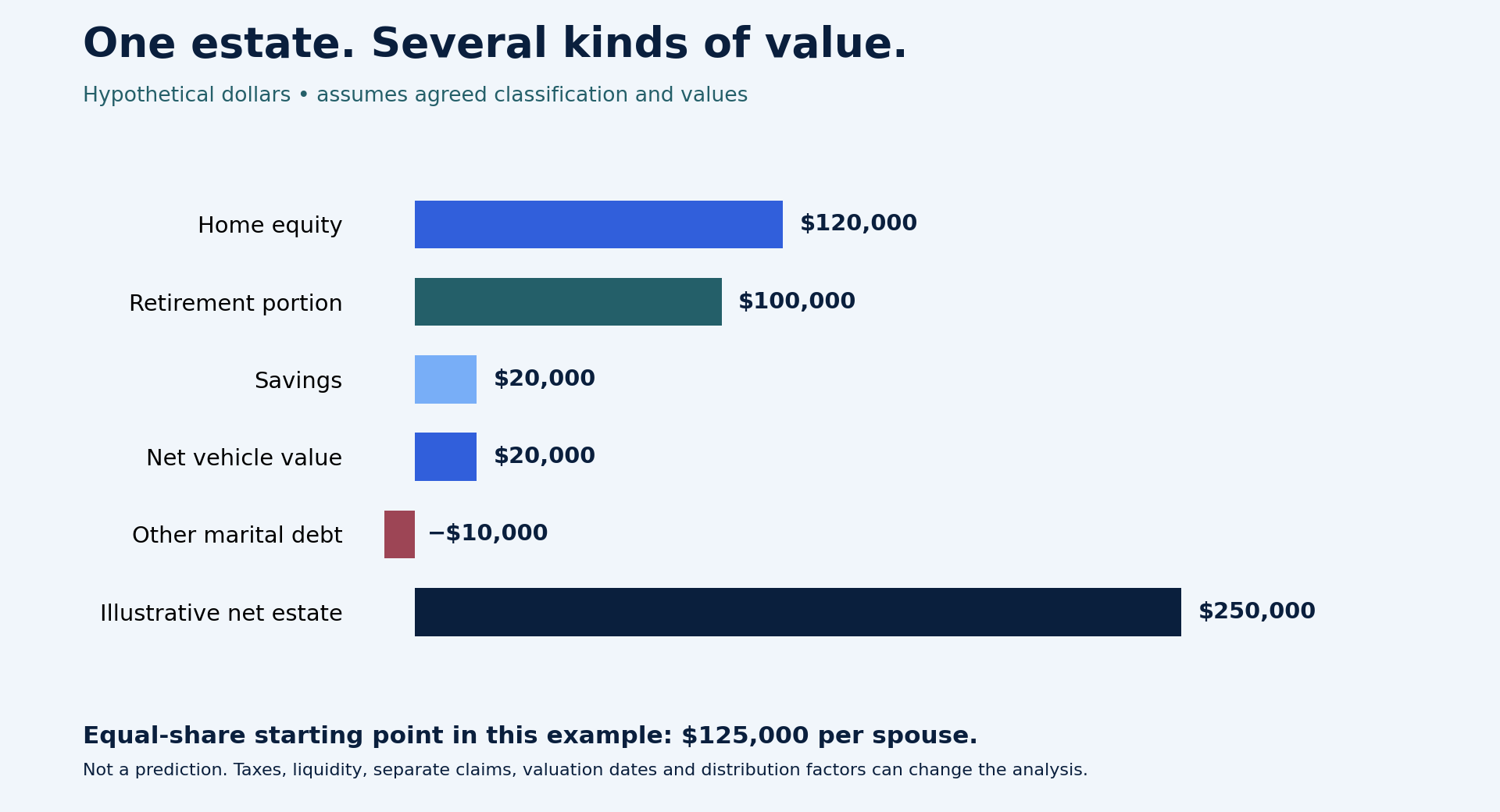
Suppose the hypothetical divisible estate for negotiation consists of $120,000 in home equity, $100,000 in retirement, $20,000 in savings and $20,000 in vehicle equity, offset by $10,000 in other debt. Its net value is $250,000. If equal division is appropriate and those values are accepted, the starting target is $125,000 per spouse.
If one spouse receives only the $120,000 home equity and the other receives all the remaining listed assets and debt, the latter receives $130,000 net. A $5,000 equalization payment would make each side $125,000 in this simplified example. That arithmetic is only the beginning: a retirement dollar may carry different tax consequences from a savings dollar, and home equity is not immediately spendable cash.
| Asset received | Practical concern | Planning question |
|---|---|---|
| Home equity | Mortgage qualification, upkeep and selling costs. | Can the recipient afford the home and obtain any required refinancing? |
| Retirement benefit | Plan rules, tax treatment and required transfer orders. | What document will the plan accept, and when must it be completed? |
| Cash or savings | Liquidity, pending bills and source of funds. | How much remains after transition expenses and agreed payments? |
| Allocated debt | Creditor rights may continue despite the spouses’ agreement. | Is a refinance, payoff or account closure needed to remove exposure? |
A divorce agreement does not, by itself, force a lender to release a borrower. Likewise, a provision awarding retirement funds may require a separate plan-specific order. For a house transfer or sale, coordinate family-law terms with real estate closing requirements rather than assuming the divorce paperwork completes every step.
CHAPTER 06
Build a budget for postseparation support and alimony
Postseparation support and alimony are related but distinct. Postseparation support can address a dependent spouse’s needs while the support dispute is being resolved. Alimony involves the statutory assessment of dependency, the supporting spouse’s position and whether an award is equitable. North Carolina does not use a single statewide percentage formula that determines every alimony award. See § 50-16.2A and § 50-16.3A.
Useful evidence includes reliable income records, ordinary living expenses, earning capacity, health limitations, the duration of the marriage and the marital standard of living. A budget should distinguish recurring needs from one-time transition costs. Housing deposits, replacement furniture and a new insurance premium may affect cash flow differently from a monthly grocery bill. Include variable or seasonal income rather than treating the strongest paycheck as the permanent norm.
Marital misconduct can have significant consequences, and illicit sexual behavior has specific statutory effects and exceptions. Avoid relying on the broad slogan that “fault never matters.” At the same time, anger about the breakup is not a substitute for evidence of the statutory elements. Discuss sensitive facts confidentially before making allegations or signing an agreement.
Modification and termination depend on the type of obligation. Court-ordered support is subject to § 50-16.9, including changed-circumstances rules and specified termination events. A private agreement can raise different contract questions. For a deeper budgeting discussion, see planning for alimony and postseparation support in Locust.
CHAPTER 07
Make a separation agreement specific enough to use
A separation agreement is a contract. Under § 52-10.1, it must be in writing and acknowledged by both spouses before an authorized certifying officer. Having signatures notarized does not establish that the bargain is complete, fair or suited to your circumstances. Each spouse should understand both the legal effect and the practical mechanics.
Strong drafting identifies who does what, by when, with which documents and what happens if the plan cannot be completed. “We will refinance later” leaves unanswered the deadline, responsibility for payments in the meantime, proof of applications, what happens after a denial and whether a sale becomes necessary. A retirement provision should address the actual plan and responsibility for preparing any required order.
| Topic | A vague promise | A useful issue to resolve |
|---|---|---|
| Housing | One spouse keeps the house. | Deed, mortgage, refinance deadline, occupancy, expenses and fallback sale procedure. |
| Debt | Each pays their own bills. | Specific accounts, balances, payment responsibility and continuing creditor exposure. |
| Insurance | Coverage stays the same. | Eligibility, actual termination dates, replacement options and who pays. |
| Taxes | We will split the refund. | Filing decisions, allocation, prior liabilities and professional tax advice. |
| Parenting | We will be reasonable. | A concrete routine, holidays, transportation and a method for resolving disagreements. |
Whether an agreement remains a private contract or is incorporated into a court order affects enforcement and sometimes modification. Child-related terms remain subject to the court’s legal authority; parents cannot contract away the child’s best interests. Have the document reviewed as a whole rather than evaluating one attractive paragraph in isolation.
CHAPTER 08
Keep children’s needs on a separate planning track
Divorce, custody and child support interact, but they answer different questions. Divorce changes marital status. Custody allocates parenting responsibilities and time. Child support addresses financial support for the child. A parent does not automatically win custody by filing first, owning the house or earning more. Nor should support or access be used as a bargaining chip in the property settlement.
During separation, develop a workable school-week routine, a way to exchange information and a method for addressing urgent medical decisions. For families traveling between Locust and Albemarle, test the proposed school-morning trip and after-school arrangements against actual work schedules. If a parent works nights or rotating shifts, a calendar tied to real childcare availability is more helpful than a slogan about equal time.
Our companion complete child custody guide for Albemarle and Locust explains legal and physical custody, schedule examples, mediation, evidence and modification. The Judicial Branch child support resource explains why a shared schedule does not automatically eliminate a payment obligation.
Keep adult allegations and financial negotiations away from children. Avoid asking a child to carry messages or choose sides. Where safety concerns exist, discuss protective arrangements with counsel instead of relying on informal assurances. A workable plan supports the child’s routines while preserving appropriate legal options.
CHAPTER 09
Navigate the local process in Stanly County
Albemarle and Locust families are subject to the same statewide divorce statutes. Local practice still matters: filing, service, required financial documents and calendar procedures can differ from assumptions formed in another county. Divorce venue ordinarily follows the county where either spouse resides under § 50-3; a prior case or unusual circumstances should be reviewed before filing.
Stanly County is in Judicial District 28. The Stanly County Courthouse is at 201 S. Second Street in Albemarle. Use the official Stanly County local rules and forms page for current family-court requirements. A clerk can provide procedural information, but cannot choose your claims or give individualized legal advice.
A typical preparation sequence is to identify the relief needed, gather the supporting records, confirm venue, file the appropriate papers, complete proper service and then follow the required response and scheduling process. A case involving property, support or contested facts may need additional disclosures, negotiation or hearings. The date a complaint is filed does not tell you when every related issue will be resolved.
For residents of Stanfield, Oakboro, Norwood, Badin, New London, Richfield and Misenheimer, the practical questions often involve travel, work leave and access to documents. Arrange copies and a dependable communication method early. Locust extends into more than one county, so verify the relevant residence and case history rather than selecting a courthouse only from the mailing address.
CHAPTER 10
Prepare a focused consultation file
You do not need a perfect binder before speaking with a lawyer, especially when a deadline is approaching. A short chronology and the actual court papers are often more useful than an unorganized collection of screenshots. Keep originals safe and provide organized copies. Access only accounts and records you are legally entitled to access.
- Case basics: marriage date, separation history, addresses, prior court cases and every document served.
- Income: recent pay statements, tax returns, business records and benefit information.
- Assets and liabilities: account statements, deeds, mortgage balances, retirement statements, vehicle loans and credit-card records.
- Agreements: premarital, postmarital or separation documents, including unsigned drafts and the signed final version if one exists.
- Monthly needs: a realistic budget, insurance information and unusual medical or childcare costs.
- Children: present schedule, school and care needs, current orders and significant safety concerns.
Then write three questions: What must be addressed now? What information is still missing? What decisions can wait until the financial picture is clearer? These questions help distinguish urgent claim preservation from choices that benefit from additional investigation.
Avoid draining accounts, deleting messages, transferring property to a friend or posting accusations online. Preserve relevant evidence without guessing about what a judge may want. If there is a concern about concealed assets, lawful discovery and professional valuation may be more useful than confrontation.
CHAPTER 12
Answers to common divorce questions
Can we start the separation year while living in the same house?
Ordinarily, no. Separate bedrooms under one roof do not generally establish the separate residences required for the usual separation-based divorce. Discuss any unusual living arrangement before relying on a date.
Does my spouse have to agree to the divorce?
An absolute divorce does not generally require the other spouse’s consent if the statutory requirements, proper service and required proof are satisfied. Disagreement about property or support is a separate issue that must be addressed appropriately.
Can I divide retirement after the divorce?
A properly preserved claim or enforceable agreement may allow later steps, but waiting to assert the claim until after judgment can create serious problems. Preserving the right and completing the plan’s transfer requirements are different tasks.
Is the person whose name is on the house entitled to keep it?
Title alone does not answer the equitable-distribution question. Acquisition, source of funds, classification, debt and the statutory factors all matter. A spouse may also remain liable to a lender even after an agreement assigns payments to the other spouse.
How long does an uncontested divorce take after filing?
There is no reliable universal completion date. Service, response periods, accuracy of the paperwork and the court’s calendar affect timing. The separation year is an eligibility requirement, not a complete case timetable.
Do I need to wait a year to discuss support or custody?
No. Interim financial needs and parenting arrangements may require attention during separation. Ask which agreement, claim or temporary order fits your circumstances.
Will a divorce automatically update my will and beneficiaries?
Do not rely on that assumption. Different assets, documents and legal rules can produce different results. Have estate documents, insurance and retirement designations reviewed in coordination with the divorce orders and agreement.
CHAPTER 13
Talk through the next decision with A&P
A productive first meeting focuses on your immediate deadline, your financial picture and the outcome you need to make daily life manageable. Bring served papers first, then your chronology, budget and key statements. Tell the attorney about safety concerns, out-of-state connections and any existing orders at the beginning.


Adkins & Purkey, PLLC is located at 217 W. Main Street, Locust, NC 28097. Attorney Chris Adkins and attorney Chris Purkey serve clients in Albemarle, Locust and surrounding Stanly County communities. A consultation can connect the facts of your situation with a practical next step.
Call 704-880-9388 · Request a consultation · Explore our family law practice


Response
[…] the custody issues arise during separation, our Albemarle and Locust divorce planning guide explains the separate financial deadlines that should not be overlooked while parenting questions […]
LikeLike