
Family Law · Locust & Stanly County, North Carolina
In this guide- 1. Have property and support rights been preserved?
- 2. What is the complete property picture?
- 3. Does the settlement explain how ownership will change?
- 4. Are debt and insurance assumptions realistic?
- 5. Is the divorce paperwork itself ready?
- What about custody and child support?
- A useful final-review meeting
A divorce judgment ends a marriage. It does not automatically finish every financial task created by the separation. For a family in Locust, Albemarle, or elsewhere in Stanly County, the final stage should include a careful review of claims, property, debt, and the documents needed to carry out any settlement.
One of the most consequential mistakes is assuming that unresolved financial issues can always be addressed after the divorce. Before a judgment is entered, ask the following five questions and verify the answers against the actual court file and signed documents.
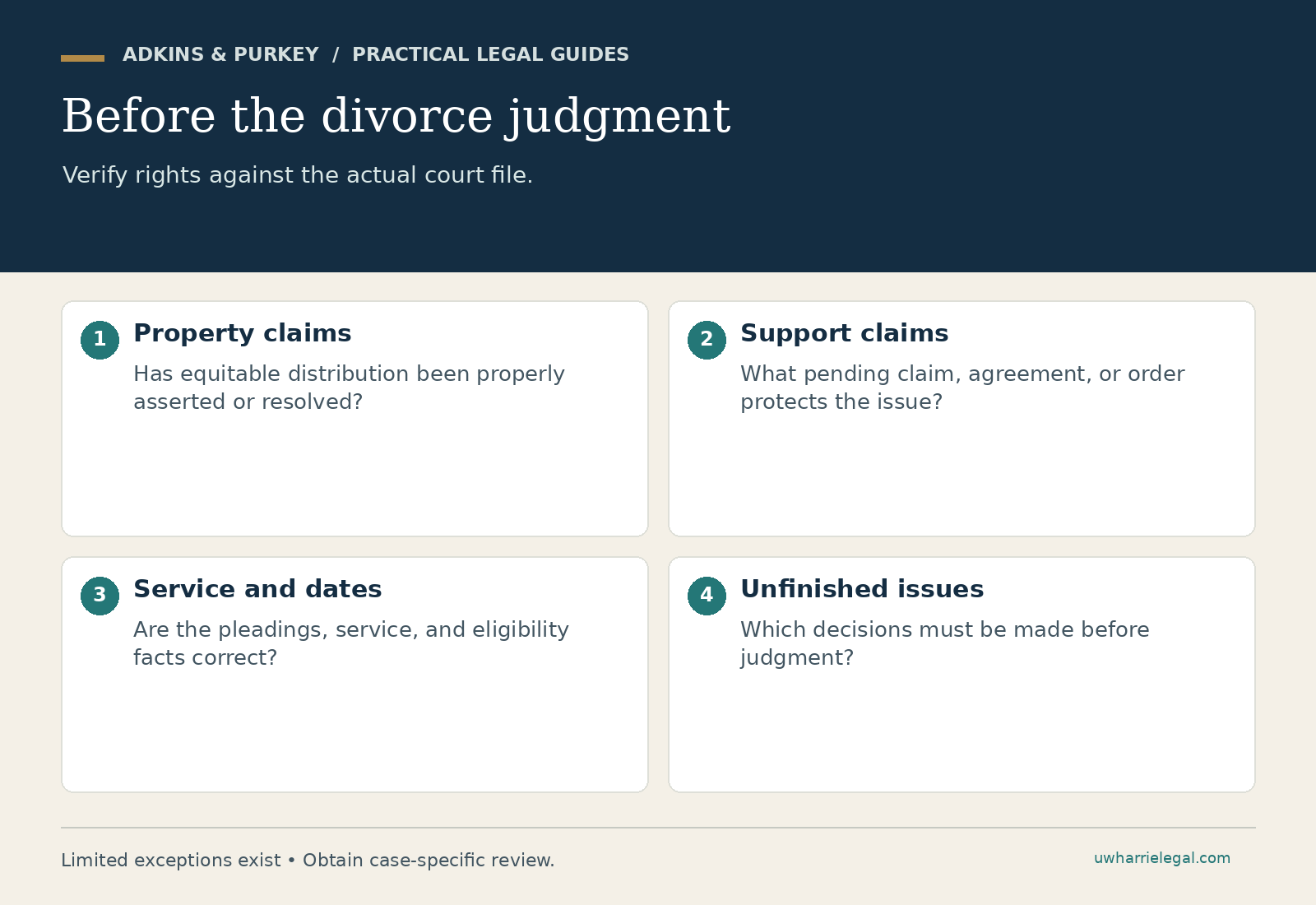
1. Have property and support rights been preserved?
North Carolina law generally requires an equitable distribution claim to be asserted before absolute divorce, or the right is lost. Pending support claims and existing support judgments receive statutory protection; unasserted rights can be extinguished. There are limited exceptions, including certain jurisdiction and service situations, but they are not a reason to postpone review. The controlling provisions include § 50-11 and § 50-6.
“We discussed it,” “the other side knows,” and “we are still negotiating” do not establish that a claim is pending. Ask your attorney to identify the filed pleading, the relief requested, and any agreement or order that already controls. If you have been served with a divorce complaint, deliver the entire packet promptly rather than waiting for a hearing notice.
2. What is the complete property picture?
Make an inventory that includes the home, other real estate, retirement accounts, bank and investment accounts, vehicles, business interests, personal property, and debts. Record whose name appears on each asset, the approximate value, the supporting document, and whether the information is current or historical.
Title alone does not answer every equitable distribution question. North Carolina distinguishes marital, separate, and divisible property. Timing, source of funds, gifts, inheritances, and changes in value can matter. The Judicial Branch separation and divorce guide provides an overview, but mixed assets and businesses often require more detailed analysis.
Preserve statements from around the date of separation as well as current statements. If a significant withdrawal, transfer, loan, or sale occurred, record the date and explanation. Do not empty accounts or conceal property in an attempt to improve negotiating position. Discuss lawful measures to protect assets with counsel.
3. Does the settlement explain how ownership will change?
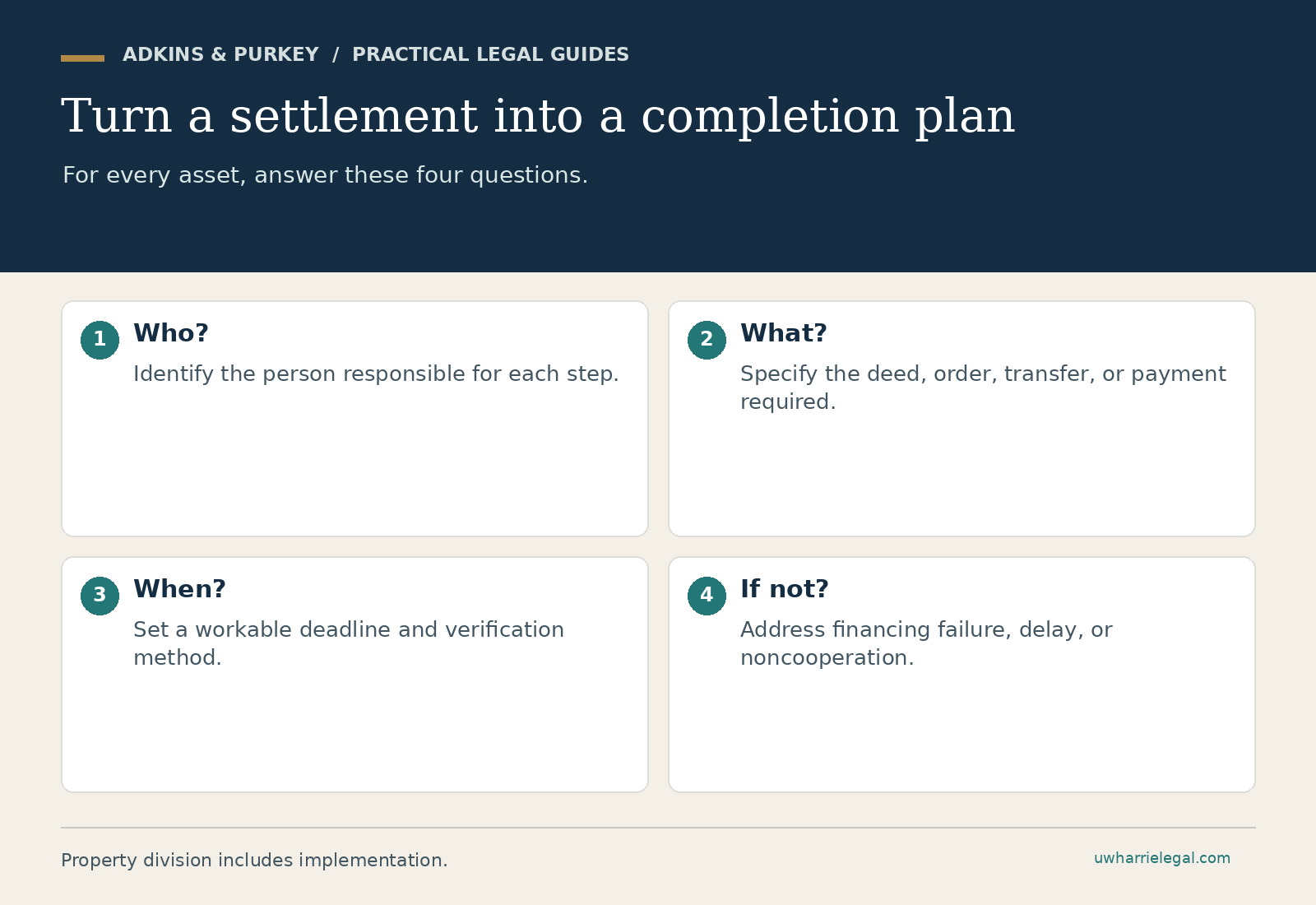
An agreement to divide an asset is only the beginning of implementation. A house may require deed preparation, refinancing, a sale process, or deadlines for cooperation. A retirement account may require plan-specific documentation or a separate court order. The appropriate mechanism depends on the asset and the governing plan or institution.
For every asset, ask who must do what, by when, at whose expense, and what happens if the planned transfer cannot occur. If the agreement assumes a spouse will qualify to refinance, consider a realistic alternative. If a retirement division is deferred, identify who is responsible for preparing and submitting the necessary paperwork.
| Asset or obligation | Implementation question |
|---|---|
| Marital home | What documents, financing, sale terms, and deadlines are required? |
| Retirement account | What does this particular plan require to divide benefits? |
| Vehicle | How will title, loan liability, registration, and insurance be addressed? |
| Joint debt | Who pays, how is payment verified, and what protection is available if payment stops? |
4. Are debt and insurance assumptions realistic?
An allocation between spouses does not necessarily release either spouse from an obligation to a lender. Review the loan documents and creditor requirements. A spouse who agrees to make a payment may still leave the other spouse exposed if both signed the debt and the creditor has not released either borrower.
Health insurance, life insurance, and vehicle coverage should receive their own review. Ask the insurer or plan administrator about the effect of divorce and applicable deadlines. Do not cancel coverage or change beneficiaries contrary to an order or agreement. Changes should be coordinated with the settlement and any legal restrictions.
5. Is the divorce paperwork itself ready?
For the usual divorce based on separation, North Carolina generally requires living separately for at least a year and a day before filing, with the required intent, and at least one spouse meeting the six-month state residency requirement. Proper service and the court process remain necessary even when both spouses want the divorce. Eligibility alone is not a final judgment.
Review the names, dates, service history, pending claims, and proposed judgment carefully. If a document is wrong, identify the error before entry. Keep a complete copy of the judgment and all related orders once entered. Do not assume that a verbal statement in a hallway or an unsigned draft is the final court action.
What about custody and child support?
Custody and child support do not have the same divorce cutoff as unpreserved property and spousal support rights. That does not make them less urgent. Review the existing parenting schedule, support order, insurance provisions, and school arrangements so the transition has a practical plan.
If a pending traffic or DWI matter complicates transportation, work, or exchanges, identify it for coordinated advice. The firm’s North Carolina DWI resource explains the separate court and license issues.
A useful final-review meeting
Bring every pleading and order, the separation agreement, an asset-and-debt inventory, current statements, retirement plan information, and a list of unfinished transfers. Ask your attorney to distinguish what is already resolved, what is preserved for later decision, and what must happen before the divorce. A short written implementation list can prevent a completed divorce from leaving years of avoidable financial confusion.
Attorney advertising. General North Carolina legal information as of September 22, 2026; not legal advice for a particular matter. Laws and procedures can change. Reading this article or contacting the firm does not establish an attorney-client relationship. Please do not send confidential information through an initial inquiry.


Leave a comment