ADKINS & PURKEY · LOCUST & ALBEMARLE · NORTH CAROLINA
A practical guide from the firm of Christopher “Chris” Adkins and Christerfer “Chris” Purkey. Explore our practice.

Explore this guide
- Separation does not require a special filing
- Start with complete financial information
- Make the household transition specific
- Separate parenting terms from adult financial negotiations
- Understand support before waiving it
- Choose deliberately whether the agreement becomes a court order
- Put completion duties on a calendar
- Recognize when negotiation needs a different approach
- Prepare for a consultation in Locust
- Questions to resolve before the final signature
Separation often begins with practical questions: Who will pay the mortgage? Where will the children sleep? Can either spouse use the joint savings? For families in Locust, Albemarle, and across Stanly County, a carefully prepared separation agreement can turn those questions into a workable plan. The value lies in the details, especially what happens after the document is signed.
Adkins & Purkey, PLLC helps clients identify the issues that need attention before they commit to terms. Christopher “Chris” Adkins and Christerfer “Chris” Purkey approach these agreements as decisions about a family's finances, parenting, and future obligations. An agreement should fit the actual household rather than force the household into a generic form.
Separation does not require a special filing
North Carolina generally considers spouses separated when they live in different homes and at least one intends the separation to be permanent. A separation agreement is not required to start that separation. Remaining under one roof ordinarily does not establish the separation needed for an absolute divorce, even if spouses maintain separate bedrooms.
An agreement serves a different purpose: it records enforceable promises about the consequences of separation. Under G.S. 52-10.1, a qualifying separation agreement must be written and acknowledged by both spouses before a certifying officer. Signing a document without understanding it can create obligations that are difficult to unwind. Have counsel review the complete document, including incorporated schedules and exhibits.
Start with complete financial information
Before discussing a buyout or support amount, assemble a financial picture. Include real estate, bank accounts, retirement benefits, vehicles, business interests, credit cards, loans, tax liabilities, insurance, and any property claimed as separate. Identify when assets were acquired and how they were paid for.
Account balances alone can be misleading. A retirement account may include marital and separate components. A business may have value beyond its checking account. A house's mortgage balance does not establish its market value. Useful negotiations distinguish an agreed fact, a preliminary estimate, and an issue requiring an appraisal or other professional analysis.
Make the household transition specific
If one spouse remains in the marital home, identify responsibility for principal, interest, taxes, insurance, utilities, repairs, and association charges. Address access to personal belongings and the timing of moving out. A promise to “handle the house” does not answer whether the parties expect a sale, refinance, or permanent transfer.
If refinancing is contemplated, discuss a deadline, reasonable cooperation, proof of progress, and a fallback if financing is unavailable. A private agreement does not release a borrower from a lender's contract. The departing spouse may remain liable to the mortgage company until the lender actually releases that obligation.
Separate parenting terms from adult financial negotiations
Parenting provisions should address the child's ordinary week, holidays, summer, transportation, school information, health care, activities, and communication. Specify exchange locations and what happens when school is closed. A schedule that looks balanced on paper may become difficult when a parent commutes from Locust to Concord or works rotating shifts.
Parents cannot conclusively contract away a child's welfare. A court may decide custody differently under the applicable best-interests standard. Child support also remains subject to judicial authority. Do not treat access to a child as a bargaining chip for a property concession or assume a private agreement permanently prevents a later support claim.
Understand support before waiving it
Alimony and postseparation support require separate analysis from child support. Relevant questions include each spouse's income, earning capacity, reasonable needs, available resources, and the facts bearing on entitlement. There is no universal North Carolina alimony calculator that reliably answers every case.
If an agreement includes a waiver, understand its scope before signing. If support will be paid, address amount, due dates, duration, termination events, security, and whether the obligation can change. Tax treatment depends on applicable law and the instrument's circumstances; assumptions based on an older relative's divorce may be wrong.
Choose deliberately whether the agreement becomes a court order
An unincorporated separation agreement is generally enforced through contract remedies. Incorporating an agreement into a judgment changes the legal framework and may affect enforcement and modification. Neither option is automatically better for every family.
Ask which provisions are intended to remain contractual, which should become judicial obligations, and how future disputes would be handled. Boilerplate about incorporation can have consequences long after the divorce. The agreement should also explain how amendments are made; casual text messages may not accomplish what either spouse thinks they accomplish.
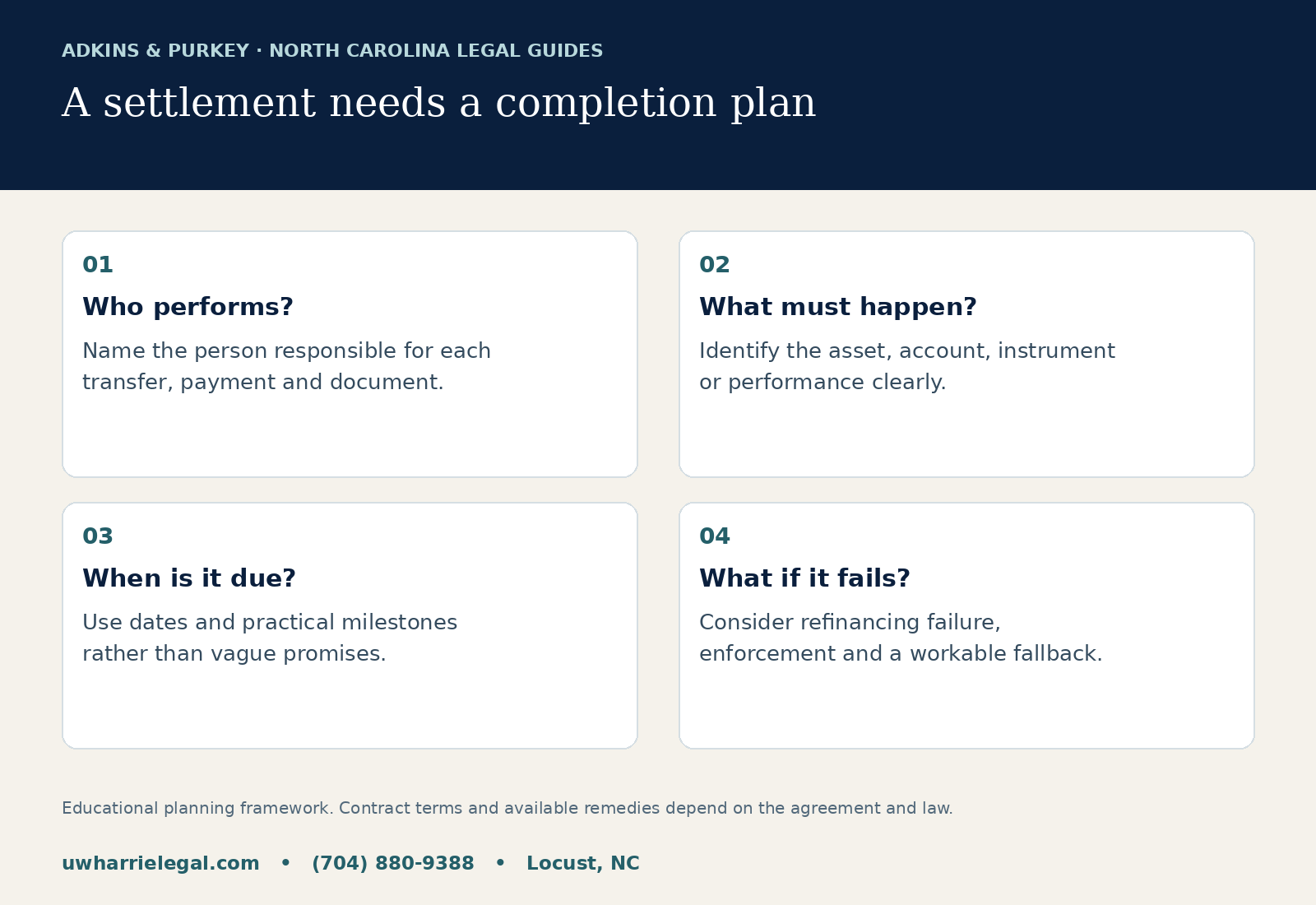
Put completion duties on a calendar
Signing does not transfer every asset. A deed, title document, beneficiary change, account division, or qualified domestic relations order may still be necessary. Some retirement plans require specialized orders and administrator review. A settlement that divides retirement “equally” may leave important valuation and implementation questions unanswered.
Create a completion list naming the responsible person, required document, deadline, and evidence of completion. Consider who pays preparation or transfer costs. Keep confirmation of completed steps with the agreement. This is especially useful when property or accounts involve institutions outside Stanly County.
Recognize when negotiation needs a different approach
Domestic violence, coercion, concealed assets, imminent transfers, or pressure to sign immediately may require protective measures rather than a routine negotiation. If there is immediate danger, call 911. Explain safety concerns privately to counsel before proposing joint meetings or shared financial access.
Do not secretly enter accounts, remove records unlawfully, or destroy communications. Preserve materials you may lawfully possess. The right response to a concern about hidden money is a lawful evidence and preservation strategy, not an improvised investigation that creates additional legal problems.
Prepare for a consultation in Locust
Bring proposed agreements, existing orders, recent income records, account statements, a property-and-debt inventory, and a short list of priorities. Identify whether divorce papers have already been served. Financial claims can be lost when an absolute divorce is entered without proper preservation, so the divorce timeline matters even during productive negotiations.
Clients from Albemarle, Locust, Oakboro, Norwood, Stanfield, and nearby Cabarrus and Montgomery County communities can contact the firm to discuss their circumstances. The goal of the first conversation is to identify the decisions, missing information, and deadlines that should guide the work.
Frequently asked questions
Do I need an agreement to be legally separated?
No. North Carolina generally requires living in separate homes with an intent by at least one spouse that the separation be permanent. An agreement addresses the consequences of separation rather than creating every separation.
Can we change our agreement by text?
Do not assume a text exchange makes an enforceable amendment. The agreement, statutory formalities, and nature of the proposed change require review.
Does the agreement bind a mortgage lender?
A private allocation between spouses does not itself release a borrower from the lender’s contract. Refinancing, a lender-approved assumption, or another actual release may be necessary.
Questions to resolve before the final signature
Read the agreement as if an important promise has not been performed. Can you identify what was required and when? Does the document address refinancing failure, a late payment, missed exchanges, and unfinished transfers? Are any blanks, schedules, or account identifiers missing? Do both spouses understand the releases?
A useful agreement creates a clear next step for ordinary life and a clear reference when disagreement returns. Ask about the relationship between the proposed contract, existing court orders, and the divorce judgment. That review is usually more valuable before signing than after a problem has developed.
Meet Chris Adkins and Chris Purkey

North Carolina attorney and certified mediator with a background as a Charlotte-Mecklenburg police officer and Army officer. His work includes family law, criminal defense and civil litigation.
Read the attorney profile →
Attorney whose practice includes family law, DWI and criminal defense, and civil litigation. His approach emphasizes preparation, clear communication and practical decisions based on the record.
Read the attorney profile →Continue with a related guide
- Served With Divorce Papers in Stanly County? Protect Your Financial Claims
- Alimony and Postseparation Support: A Practical Guide for Locust & Albemarle
- Who Keeps the House in a Stanly County Divorce? Property, Retirement and Debt
Official sources and further reading
- NC Judicial Branch: separation and divorce
- G.S. 52-10.1: separation agreements
- G.S. 50-11: effects of divorce
General educational information checked November 2026. Laws and procedures may change. Attorney advertising; no result is guaranteed. This guide is not legal advice and does not create an attorney-client relationship.


Responses
[…] Separation Agreements in Locust & Albemarle: What to Settle Before You Sign […]
LikeLike
[…] Separation Agreements in Locust & Albemarle: What to Settle Before You Sign […]
LikeLike
[…] Separation Agreements in Locust & Albemarle: What to Settle Before You Sign […]
LikeLike