ADKINS & PURKEY · LOCUST & ALBEMARLE · NORTH CAROLINA
A practical guide from the firm of Christopher “Chris” Adkins and Christerfer “Chris” Purkey. Explore our practice.

Explore this guide
- The hearing date matters for the 2027 revision
- What the guideline update changes
- Start with gross income rather than take-home pay
- Choose the worksheet that fits the actual arrangement
- Include appropriate child-related costs
- Shared custody can still produce a payment
- Job changes call for review rather than self-help
- Distinguish arrears from a new calculation
- A guideline deviation needs evidence
- Prepare for a support consultation
- Make the calculation understandable
Child support is a financial commitment to a child's needs, but the calculation can become confusing when income changes, parents share time, or a new set of guidelines is approaching. For families in Stanly County and nearby Cabarrus and Montgomery Counties, the right starting point is the applicable guideline version and accurate financial information.
This guide distinguishes the rules in effect in November 2026 from revisions effective for child-support actions heard on or after January 1, 2027. Adkins & Purkey attorneys Christopher Adkins and Christerfer Purkey can help evaluate which rules and documents matter to a particular case.
The hearing date matters for the 2027 revision
The Conference of Chief District Court Judges adopted revised North Carolina Child Support Guidelines in October 2026. The revisions take effect January 1, 2027, for actions heard on or after that date. A filing date in 2026 does not necessarily mean a later hearing will use the older schedule.
The revision also does not automatically rewrite every existing order. A parent must follow the existing order unless it is lawfully modified or otherwise ends under applicable law. Before relying on a calculator, identify its guideline version, the relevant hearing date, and whether the issue is an initial order, modification, prior support, or arrears.
What the guideline update changes
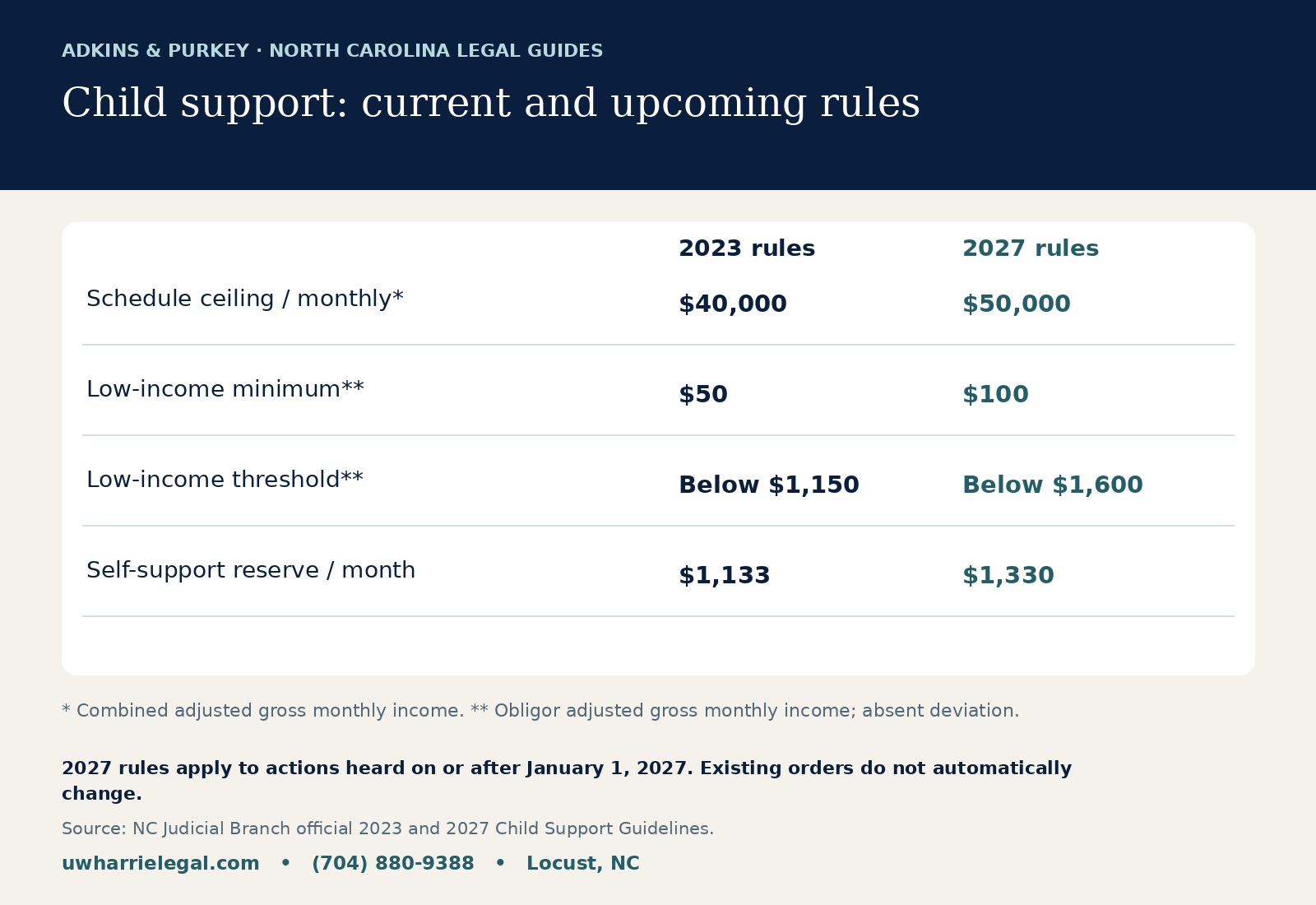
Under the currently effective 2023 guidelines, the schedule extends to combined adjusted gross income of $40,000 per month. The 2027 schedule increases that ceiling to $50,000. Above the applicable ceiling, the court evaluates the child's reasonable needs and the parties' circumstances instead of simply extending the table mathematically.
The low-income provisions also change. The 2023 guidelines provide, absent deviation, a $50 minimum for an obligor with adjusted gross income below $1,150 monthly. Beginning with the applicable 2027 cases, the stated minimum is $100 below $1,600. These are provisions for particular circumstances, not a promise that every low-income case will have the same result.
Start with gross income rather than take-home pay
The guidelines consider income from many sources, including wages, commissions, bonuses, business income, and certain benefits or investment receipts. Payroll deductions do not necessarily reduce income for guideline purposes. Bring the underlying records rather than only the amount deposited after deductions.
For a self-employed parent, taxable income may differ from guideline income. Business receipts, ordinary and necessary expenses, reimbursements, and personal expenses paid through a business can require careful review. A tax return is useful evidence, but it does not end the inquiry into the resources available for support.
Choose the worksheet that fits the actual arrangement
North Carolina uses different worksheets for primary, shared, and split custody. Worksheet B generally requires at least 123 overnights annually with each parent and that each parent assume financial responsibility during that time. The overnight number is not the only requirement.
An order saying “joint custody” does not automatically establish the correct support worksheet. Identify actual overnights, who pays relevant expenses, and whether the arrangement concerns the same children or a split arrangement involving different children. Do not negotiate artificial overnight counts solely to manipulate a calculation.
Include appropriate child-related costs
Work-related child care, the child's health-insurance premium, and qualifying extraordinary expenses can affect support. The cost attributable to the child may differ from the full family insurance premium. Obtain an employer or insurer breakdown where possible.
Avoid double counting expenses already incorporated into the schedule or treating every optional purchase as an additional court obligation. Keep invoices, payment records, and explanations of recurring needs. Where parents disagree about an expense, identify whether it is governed by the current order, the guidelines, an agreement, or a separate factual determination.
Shared custody can still produce a payment
Equal or near-equal parenting time does not necessarily mean zero support. Different incomes, child-care payments, insurance costs, and worksheet adjustments can produce an obligation even when both parents are deeply involved. The calculation concerns financial responsibility as well as time.
For illustration only, parents with adjusted monthly incomes of $6,000 and $4,000 have a combined $10,000, with income shares of 60% and 40%. Those percentages are only one component of a calculation. They do not establish a support amount without the applicable schedule, worksheet, and other required information.
Job changes call for review rather than self-help
An involuntary layoff, substantial income change, altered custody arrangement, or changed child-related costs may justify evaluating a modification. A parent should not simply reduce a court-ordered payment based on a personal estimate. Existing installments can continue to accrue.
The guidelines provide a modification presumption when an order is at least three years old and a current calculation differs by 15% or more. That rule does not mean a parent must always wait three years. Other changed circumstances may matter, and the procedure and timing of a modification request can affect available relief.
Distinguish arrears from a new calculation
Past-due support under an existing order is not the same as prospective support or a claim for a period before a support action was filed. Vested installments generally cannot be retroactively erased simply because a later calculation would be lower, subject to statutory exceptions.
Maintain a payment ledger supported by bank records, official payment histories, and receipts. Cash payments and purchases made instead of the ordered payment can create disputes about credit. Use the method required by the order and obtain advice before assuming that an informal substitution satisfies it.
A guideline deviation needs evidence
The guidelines create a rebuttable presumption, not a complete answer to every family's circumstances. A court may deviate when the legal requirements are met and appropriate findings support a different amount. The child's reasonable needs and the parents' ability to provide support remain central.
An argument that the formula feels unfair is less useful than specific evidence explaining the claimed problem. Bring a realistic child-expense budget, financial records, and documentation of the circumstances said to justify deviation. Counsel can evaluate whether the facts support that request.
Prepare for a support consultation
Gather income records, tax returns, business records if relevant, insurance information, child-care invoices, a parenting calendar, existing orders, and the official payment history. Identify the court, upcoming hearing, and any pending Child Support Services involvement. Ask which guideline version applies before accepting a proposed number.
Frequently asked questions
Will my existing order change automatically in January 2027?
No. The new guidelines apply to actions heard on or after January 1, 2027. An existing order remains controlling unless lawfully modified or otherwise terminated.
Must I wait three years to seek a modification?
Not in every case. The three-year and 15% guideline rule creates a particular presumption; other changed circumstances may support review earlier.
Can I stop paying if the other parent refuses visits?
No. Custody and support are separate legal obligations. Seek appropriate relief for denied parenting time and continue complying with the support order.
Make the calculation understandable
The strongest support discussion is one both parents and the court can follow: correct inputs, correct worksheet, correct guideline version, and a clear record. Adkins & Purkey serves Locust and surrounding communities from its downtown office. Contact the firm to discuss the records and deadlines affecting your child-support question.
Meet Chris Adkins and Chris Purkey

North Carolina attorney and certified mediator with a background as a Charlotte-Mecklenburg police officer and Army officer. His work includes family law, criminal defense and civil litigation.
Read the attorney profile →
Attorney whose practice includes family law, DWI and criminal defense, and civil litigation. His approach emphasizes preparation, clear communication and practical decisions based on the record.
Read the attorney profile →Continue with a related guide
- Fathers’ Rights in North Carolina: Custody, Parenting Time and Support
- Alimony and Postseparation Support: A Practical Guide for Locust & Albemarle
- When a Custody or Support Order Is Violated: A Stanly County Enforcement Guide
Official sources and further reading
- Official currently effective 2023 guidelines
- Official guidelines effective January 1, 2027
- NC Judicial Branch: adoption announcement
- G.S. 50-13.7: modification
General educational information checked November 2026. Laws and procedures may change. Attorney advertising; no result is guaranteed. This guide is not legal advice and does not create an attorney-client relationship.


Responses
[…] North Carolina Child Support in 2026–2027: What Stanly County Parents Should Know […]
LikeLike
[…] North Carolina Child Support in 2026–2027: What Stanly County Parents Should Know […]
LikeLike