ADKINS & PURKEY · LOCUST & ALBEMARLE · NORTH CAROLINA
A practical guide from the firm of Christopher “Chris” Adkins and Christerfer “Chris” Purkey. Explore our practice.

Explore this guide
- A practical book from Chris Adkins and Chris Purkey
- What North Carolina must prove in a DWI case
- Your first steps after release
- Begin the evidence review before the arrest
- DWI checkpoints and roadblocks: two separate inquiries
- What G.S. 20-16.3A requires
- What records can clarify a checkpoint's operation?
- A checkpoint stop can develop into an individual investigation
- Roadside exercises are different from a breath test
- Horizontal gaze nystagmus: examine foundation and execution
- Walk-and-turn and one-leg stand: conditions matter
- Portable roadside breath screening has limited uses
- Evidentiary breath testing involves a different record
- Blood testing raises collection and laboratory questions
- Chemical-test refusal can create a separate DMV case
- Civil revocation is not the same as a conviction suspension
- Limited driving privileges require more than a form
- Sentencing depends on the case, not a generic prediction
- Trial decisions require a complete consequences discussion
- Employment, commercial licenses, and family responsibilities
- Admissibility and weight are different evidence questions
- Preserve recordings through the proper process
- Local DWI defense: Stanly County and Albemarle
- Locust, Cabarrus County, and the importance of exact location
- Montgomery County, Troy, and surrounding communities
- Statistics provide context, not a prediction about your case
- Explore the educational BAC estimator
- Use interactive preparation tools without sharing private facts
- What to bring to a DWI consultation
- Questions worth asking before hiring counsel
- Read, organize, and get a concrete next step
A DWI charge can interrupt a person's work, family responsibilities, finances, and ability to drive before the first meaningful court hearing. The citation is only part of the picture. The stop, roadside investigation, chemical testing, release paperwork, civil license action, and any separate DMV proceeding may each raise different questions. Getting organized early helps prevent one process from being mistaken for another.
Christopher “Chris” Adkins and Christerfer “Chris” Purkey wrote Charged with DWI in North Carolina?: A Practical Guide to the Stop, the Science, the DMV, and the Defense to help readers understand that broader picture. Their book is available through Barnes & Noble. This companion article develops the practical subjects identified in the book's published description and the firm's books page, while adding local resources and educational tools for Stanly County, Cabarrus County, and Montgomery County readers.
If you were charged in Albemarle, Locust, Concord, Troy, or a nearby community, start with the actual papers. Keep the citation, court information, release conditions, testing documents, and every license notice together. Call Adkins & Purkey at (704) 880-9388 to discuss the charge, county, and any immediate deadline. An online inquiry does not extend a deadline or establish representation.
A practical book from Chris Adkins and Chris Purkey
The book's subject is not limited to what happens inside a courtroom. Its published materials describe the stop, testing science, DMV consequences, and defense process as connected parts of a North Carolina DWI case. Those are useful organizing categories because a reader may otherwise focus on a future court date while overlooking a license notice that requires immediate action.
Chris Adkins's background includes more than six years as a Charlotte-Mecklenburg police officer before practicing law, along with military service. Chris Purkey's practice includes criminal defense, DWI, family law, and civil matters. Their professional backgrounds explain the firm's emphasis on records, chronology, practical consequences, and informed decisions. They do not guarantee a particular result or imply influence with officers, prosecutors, or judges.
This article is an educational companion, not a reproduction of the book or a claim to summarize unreviewed chapters. The book provides context; a consultation applies current law to the individual record. Use the Barnes & Noble listing for current formats, availability, and pricing, rather than relying on a price quoted in an older article.
What North Carolina must prove in a DWI case
G.S. 20-138.1 addresses driving a vehicle on a highway, street, or public vehicular area while under the influence of an impairing substance; having an alcohol concentration of 0.08 or more at a relevant time after driving; or having a Schedule I controlled substance or its metabolites in the blood or urine. Each statutory theory requires careful attention to its elements and the evidence.
The familiar 0.08 number is therefore not the only route to a charge. A person may face an impairment-based prosecution below that concentration. Prescription status does not create a general defense to impairment. Commercial driving and driving after consuming alcohol while under 21 involve additional statutes and consequences that should be examined separately.
The location also matters. A public vehicular area is a legal category that can include places beyond an ordinary public road. Whether the State can establish driving, the relevant location, impairment, or a testing theory depends on the record. A defense review should identify the charged offense and prosecution theory before assuming the case is solely a dispute over one test number.
Your first steps after release
Start a folder for the citation, release order, test papers, license seizure or revocation material, bond information, and notices received later. Save envelopes because mailing dates may matter. Identify the next court date without assuming it is the only date requiring attention. Follow release conditions exactly and arrange transportation if driving privileges are uncertain.
Write a private, accurate chronology for counsel while events are fresh. Include the route, location of contact, timing, people present, statements you remember, physical conditions, and any relevant medical or mobility issues. Record uncertainty honestly. A recollection is more useful when it distinguishes what you observed from what someone later told you.
Preserve lawfully available receipts, messages, photographs, and recordings. Do not delete material because it seems unfavorable or ask someone else to change their account. Avoid posting a detailed explanation online or contacting witnesses in a way that could be misunderstood as pressure. Discuss evidence preservation and communication with counsel rather than trying to conduct a public defense through social media.
Begin the evidence review before the arrest
A DWI investigation can begin with a moving violation, collision, checkpoint, parked vehicle, citizen report, or another lawful encounter. Different legal questions apply to different beginnings. An ordinary traffic stop generally requires a legally sufficient basis; a properly operated checkpoint is analyzed under a different constitutional framework.
Counsel may compare the officer's reported reason with recordings, dispatch information, photographs, and witness accounts. The question is not simply whether the driver disagrees with the accusation. It is whether the encounter and any later detention satisfy the applicable legal standards on the facts the court can consider.
The timeline matters. When did the vehicle stop? What did the officer observe? When were documents requested? When did additional questioning or testing begin? What facts supported extending the encounter or making an arrest? A useful defense review follows those events in sequence and identifies the legal issue at each stage. An inconsistency may matter, but it must be connected to the governing standard and a potentially available remedy.
DWI checkpoints and roadblocks: two separate inquiries
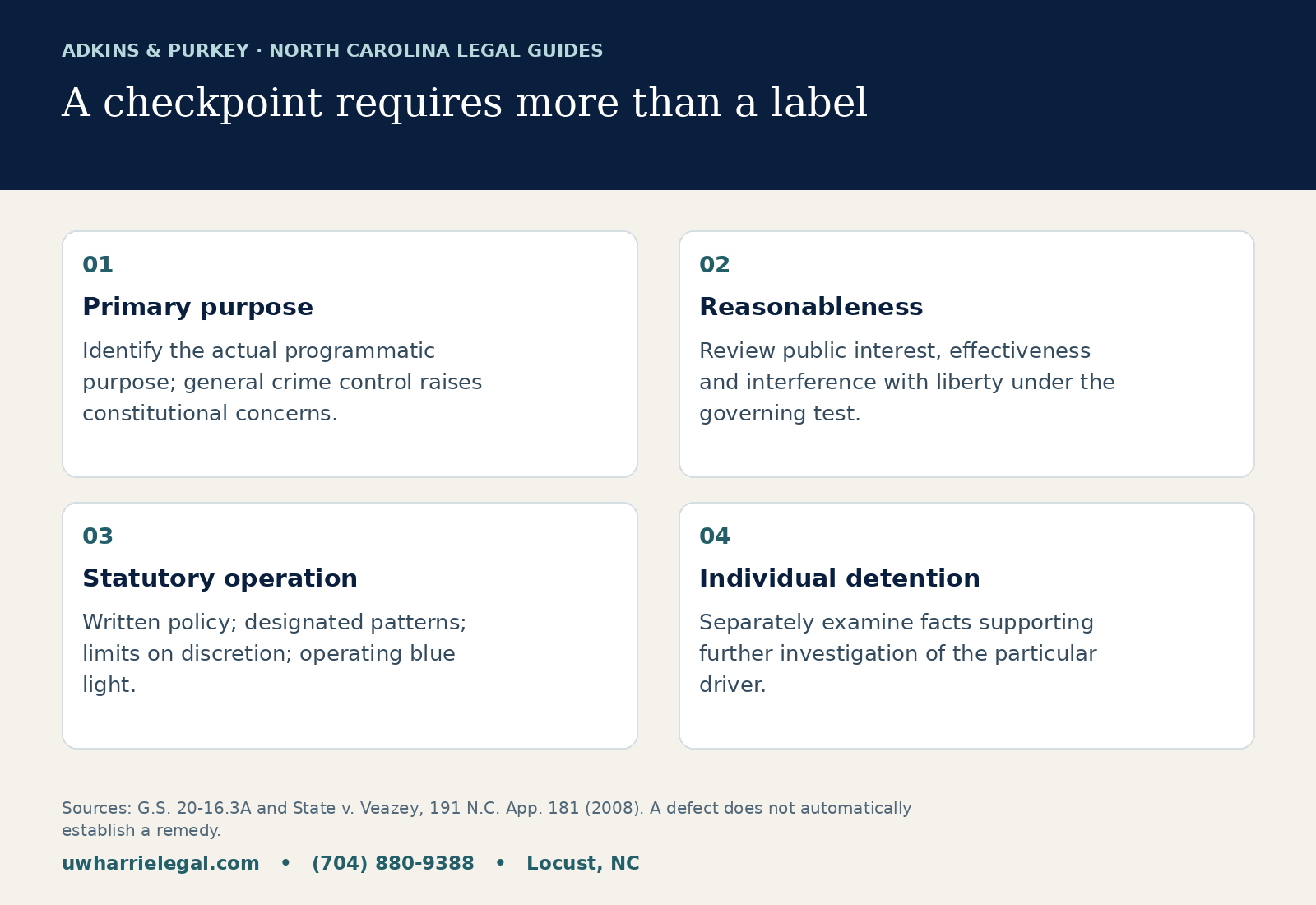
A checkpoint is a seizure for constitutional purposes even when every vehicle is briefly stopped. North Carolina courts therefore examine more than whether officers were courteous or the detention was short. The analysis includes the checkpoint's primary programmatic purpose and, when that purpose is lawful, whether the operation was reasonable under the applicable balancing test.
The published decision in State v. Veazey, 191 N.C. App. 181, 662 S.E.2d 683 (2008), explains this two-step framework. A general interest in detecting ordinary criminal activity cannot automatically be converted into a lawful checkpoint by adding a secondary license or sobriety purpose. The actual programmatic purpose requires evidence and findings, rather than an assumption based on the checkpoint's label.
Reasonableness then involves the public interest served, the degree to which the seizure advances that interest, and the interference with individual liberty. Location, duration, supervision, officer discretion, notice, and traffic interference can inform the totality. No short online checklist can replace the factual record. A checkpoint does not require the same individualized suspicion as an ordinary traffic stop, but it still must satisfy constitutional and statutory requirements.
What G.S. 20-16.3A requires
For checking stations conducted under the statute, the agency must designate in advance the pattern for stopping vehicles and requesting the specified license, registration, or insurance information. The governing written policy must provide guidelines for the pattern. An important distinction is that the specific pattern itself need not be written, even though a written governing policy is required.
The policy can include contingency provisions for traffic conditions different from those anticipated. Individual officers cannot be given discretion to choose which vehicles within the pattern are stopped or which stopped drivers are asked for the specified documents. If an agency operates under another agency's policy, that arrangement must be stated in writing.
The public must be advised of the authorized checkpoint through at least one law-enforcement vehicle with an operating blue light. The statute does not impose a universal requirement for advance newspaper publication or a warrant authorizing the checkpoint. A defense should address the requirements that actually apply instead of relying on a supposed defect that the law does not recognize.
What records can clarify a checkpoint's operation?
Relevant material can include the governing policy, operational plan if one exists, supervisory instructions, checkpoint reports, participating-agency information, dispatch records, and available recordings. Counsel may seek evidence showing when the pattern was selected, who authorized changes, what officers actually did, and why the location and operation were chosen.
A written plan is not self-proving. The operation may differ from the document. Conversely, the absence of a document a person expected to exist does not automatically establish a legal violation. Testimony, recordings, and other records can help determine the facts and whether the State has established the necessary foundation.
G.S. 20-16.3A(d) addresses checkpoint placement and repeated use of a location, but expressly states that this subsection alone is not grounds for suppression or a defense to an offense arising from the checkpoint. That limitation matters. Counsel should distinguish a statutory observation from a legally sufficient basis for relief, while examining any related constitutional issue under the appropriate authority.
A checkpoint stop can develop into an individual investigation
An initially brief checkpoint encounter can develop further when an officer identifies facts supporting additional investigation. Under G.S. 20-16.3A, reasonable suspicion of a violation can justify further detention in accordance with law. The statute also addresses requests for an alcohol screening test when the officer determines that the driver previously consumed alcohol or has an open container during the encounter.
That development should be reviewed separately from the checkpoint's overall validity. What facts concerned the particular driver? What observations were made before the driver was directed elsewhere? How long did later steps take? What did recordings show about speech, movements, instructions, and conditions?
A challenge to the checkpoint and a challenge to the individual investigation may involve different evidence. Neither should be assumed to succeed because the other exists. Avoid unsafe maneuvers, confrontation, or attempts to improvise an escape from a checkpoint. This guide explains legal review after an encounter; it is not advice about evading law enforcement.
Roadside exercises are different from a breath test
Officers may use physical and observational exercises during a roadside investigation. The commonly discussed standardized field sobriety tests include horizontal gaze nystagmus, walk-and-turn, and one-leg stand. These involve observations, instructions, and performance rather than a laboratory measurement of a person's blood alcohol concentration.
Counsel may examine training, administration, environmental conditions, the recorded observations, and whether the officer's conclusions are supported. A physical limitation or environmental problem may affect interpretation, but the presence of any one issue does not automatically invalidate the entire investigation.
Tell your attorney about injuries, balance conditions, vision issues, footwear, fatigue, medications, language barriers, and difficulties hearing instructions. Do not invent an explanation or assume every medical detail is relevant. The useful question is how a documented circumstance affected what the officer observed and what the evidence can reliably establish.
Horizontal gaze nystagmus: examine foundation and execution
Horizontal gaze nystagmus involves observations of eye movement as an officer moves a stimulus. A proper review may include the officer's qualifications, preliminary checks, instructions, stimulus positioning, timing, and the observations actually documented. Video may capture some aspects of the procedure while failing to show others clearly.
Medical conditions and other factors can require attention. Those possibilities should be evaluated with appropriate evidence rather than used as a generic explanation for every result. Counsel may need to determine what foundation is required for testimony and how the officer's observations fit within current North Carolina evidentiary law.
An officer's label is not the same as an unquestionable scientific conclusion. At the same time, a defense should not promise that the evidence is inadmissible simply because a client remembers the procedure differently. The goal is to compare instructions, performance, documentation, and legal foundation in an organized way.
Walk-and-turn and one-leg stand: conditions matter
These exercises involve divided attention and physical performance. Instructions, demonstrations, the surface, available space, lighting, footwear, traffic, and the person's physical condition can matter. A recording may show whether an instruction was interrupted, a question was answered, or the person appeared to understand what was requested.
Avoid assuming that a single misstep proves impairment or that a single explanation defeats the allegation. The officer's observations are evaluated with the other evidence. A person may perform poorly for multiple reasons, and the legal significance depends on the circumstances and admissible testimony.
For a consultation, explain the conditions specifically: uneven gravel rather than merely a “bad surface,” a documented knee limitation rather than a general reference to health, or an instruction that could not be heard over traffic. Specific facts make it possible to identify useful records, witnesses, or questions for cross-examination.
Portable roadside breath screening has limited uses
G.S. 20-16.3 governs approved alcohol screening devices used in specified circumstances. These portable tests are different from an evidentiary chemical breath analysis administered under the implied-consent framework. A driver may refer to both as “the breath test,” but counsel needs to identify which device and procedure were involved.
The statute limits the uses of screening evidence. A positive or negative result, or a refusal, can be relevant to reasonable grounds and related determinations. The numerical screening reading is not used as proof of a particular alcohol concentration under this provision. Approval of the device and compliance with the governing manner-of-use rules also matter.
Do not assume that declining a portable screening test erases the officer's other observations or prevents an arrest. Equally, do not assume that a handheld number resolves the criminal case. The legal analysis must distinguish roadside screening, observational evidence, and a later evidentiary chemical result.
Evidentiary breath testing involves a different record
After an implied-consent offense is charged or otherwise within the applicable statutory circumstances, chemical testing can involve notices, an authorized operator, approved equipment, prescribed procedures, and statutory admissibility requirements. The device printout is one part of that record.
Counsel may review the rights notification, timing, observation-related procedures, operator authorization, instrument and maintenance records, test sequence, and reported results. The question is whether a particular issue affects admissibility, reliability, or the weight of the evidence under applicable law. Not every documentation question leads to exclusion.
Keep the actual printout and rights form if provided. If testing occurred more than once or at different locations, identify the sequence accurately. Explain any medical event or interruption you recall. A review based on the original records is more useful than a recollection that every test involved the same machine or legal procedure.
Blood testing raises collection and laboratory questions
A blood-based case may involve a warrant, consent, or another asserted legal basis for collection. Counsel can review that basis separately from collection, handling, laboratory analysis, and interpretation. A legally obtained sample and a reliable analysis are related but distinct subjects.
Relevant records can include the collection documentation, container information, chain of custody, laboratory reports, analytical records, and witness qualifications. Timing matters, particularly when a result is used to draw conclusions about a different point in time. Any retrospective opinion needs an appropriate scientific and evidentiary basis.
Drug-related testing also requires careful interpretation. Detection of a substance does not answer every legal question in every case. Some statutory theories focus on impairment, while the Schedule I provision in G.S. 20-138.1 has its own terms. Discuss the actual allegation, prescription information where relevant, and what the laboratory result does and does not establish.
Chemical-test refusal can create a separate DMV case
Refusal of an evidentiary chemical test can carry a 12-month license revocation and can become relevant evidence under applicable law. It does not necessarily prevent testing through a warrant or another lawful procedure. A refusal determination is therefore not simply a choice about whether the State receives a number.
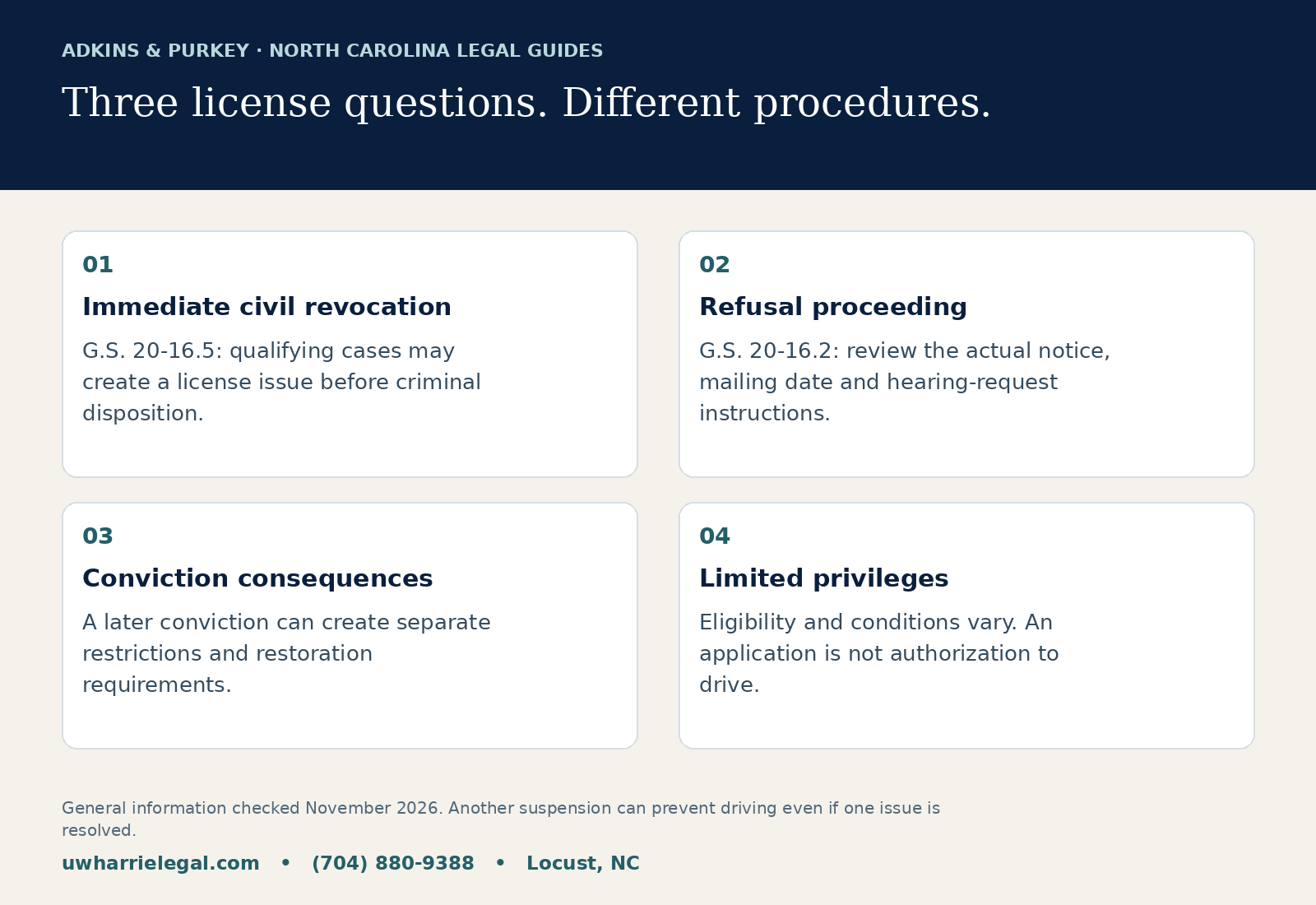
Under the current text of G.S. 20-16.2(d), the refusal revocation takes effect on the thirtieth calendar day after mailing unless a written hearing request is made before the effective date. Do not rely on a blanket “16-day” deadline found on an older website. Have the actual notice reviewed immediately, including its mailing date and stated instructions.
The statutory right to call an attorney and select a witness before testing does not require an unlimited delay. G.S. 20-16.2(a)(6) provides that testing need not be delayed more than 30 minutes after notification of rights. Whether rights were properly given and honored depends on the record. A timely DMV hearing request also does not undo an independent civil revocation.
Civil revocation is not the same as a conviction suspension
G.S. 20-16.5 provides an immediate civil license process in qualifying cases, commonly involving a period of at least 30 days. Surrender timing, pending offenses, mailed orders, and other license actions can change the practical result. A future criminal court date does not itself authorize driving during that period.
The statute provides procedures for challenging the validity of a qualifying revocation, including a request at the initial appearance or within 10 days of its effective date. A limited privilege after 10 days may be available in qualifying circumstances, but it is conditional rather than automatic. Eligibility and required documents must be evaluated individually.
A separate update matters for restoration costs: the statutory fee under G.S. 20-16.5(j) increases from $100 to $200 for fees assessed on or after December 1, 2026, under S.L. 2026-41. That scheduled change does not make all other fees or restoration requirements disappear. Verify the current amount, payment process, and actual license status before driving.
Limited driving privileges require more than a form
A limited driving privilege is a court-authorized exception within a particular statutory framework. It may limit purposes, hours, vehicles, or other conditions. The rules for a civil-revocation privilege are not identical to every privilege available after conviction or in a refusal-related situation.
Counsel may need information about the charge, prior history, license eligibility, assessment, insurance, employment schedule, and any ignition-interlock requirement. An out-of-state license or commercial driving status can introduce additional limitations. Do not assume a form used by a friend fits your case.
Read the signed order and comply with its exact terms. Possessing an application, proof of insurance, or a receipt is not the same as having a valid privilege. Ask who will verify entry of the order, any necessary DMV steps, and whether another suspension still prevents lawful driving.
Sentencing depends on the case, not a generic prediction
G.S. 20-179 provides North Carolina's DWI sentencing framework, including Aggravated Level One and Levels One through Five. Grossly aggravating, aggravating, and mitigating factors can affect the level and available sentence. Relevant prior convictions, injury, license status, and other circumstances may materially change exposure.
The existence of sentencing levels does not mean counsel can responsibly promise the lowest level before reviewing the facts. Nor does a first charge guarantee a dismissal, a particular privilege, or no incarceration. Ask for an individualized explanation of the alleged factors, available evidence, and potential consequences.
An assessment, education or treatment, community service, probation, monitoring, or ignition interlock may be part of the applicable requirements or strategy. Some steps can be useful before disposition, but they do not automatically resolve the charge. Confirm the provider, purpose, and legal effect before spending money on a program based only on general advertising.
Trial decisions require a complete consequences discussion
A decision about a plea or trial should account for the evidence, legal issues, sentencing exposure, license consequences, costs, and personal priorities. The analysis is not complete if it discusses only the criminal fine while ignoring the ability to work or drive.
Counsel can explain which issues may be addressed through motions, what testimony or records are available, and what uncertainty remains. A motion to suppress challenges evidence under the applicable legal rules; it is not a promise that a case will be dismissed. A trial evaluates the State's proof under the relevant burden and procedure.
Ask what decisions belong to you, what preparation is needed, and which appearances are required. Keep contact details current and confirm instructions. Do not assume a continuance has been granted or an appearance excused because a request has been made or because a prior hearing was handled differently.
Employment, commercial licenses, and family responsibilities
A DWI charge can affect jobs requiring driving, professional reporting obligations, military responsibilities, insurance, and travel. Commercial-driver rules can differ sharply from ordinary-license rules. Inform counsel about a commercial license even if the incident involved a personal vehicle.
Avoid making unsupported assurances to an employer or regulator. Review the actual reporting language, deadlines, and relevant policies. A charge and a conviction are different events, and different obligations may be triggered by each. Additional advice may be appropriate when licensing, immigration, or another specialized area is involved.
For parents, transportation and release conditions may affect exchanges or school routines. Follow existing family-court orders and seek advice if a practical adjustment is needed. Do not assume that a pending charge automatically changes custody, and do not conceal a safety concern that requires immediate attention.
Admissibility and weight are different evidence questions
An objection to admissibility asks whether the court may consider particular evidence under the governing rules. A challenge to weight asks how persuasive the evidence should be once considered. A procedural issue, inconsistent description, or scientific limitation may affect one question, both, or neither, depending on the facts and applicable authority.
This distinction helps explain why a defense cannot be reduced to a list of “automatic dismissals.” A recording might undermine part of an officer's account without requiring exclusion of every observation. A testing defect might require a particular foundation or remedy rather than ending the entire prosecution. Counsel must connect the issue to the relevant legal standard and the remaining evidence.
Ask for an explanation of what a proposed motion would accomplish if granted and what questions would remain. That conversation makes it easier to understand the difference between identifying an issue, proving the supporting facts, obtaining a ruling, and deciding the next step after the ruling.
Preserve recordings through the proper process
Dash-camera, body-camera, dispatch, booking, and private-business recordings can have different custodians, retention practices, and access rules. North Carolina law also distinguishes law-enforcement recordings from ordinary public records. A routine request to a records desk does not necessarily create a right to receive every recording.
Tell counsel promptly about potentially relevant video and its likely source. The appropriate route may involve a preservation request, discovery, a court order, or another authorized procedure. The fact that a recording has not been voluntarily provided does not prove it never existed or was improperly destroyed.
If you already possess a recording lawfully, preserve the original file and identify how it was obtained. Do not trim away context, alter the sound, or add annotations to the only copy. A working copy can help organize questions, but the underlying original is important when authenticity or completeness is disputed.
Local DWI defense: Stanly County and Albemarle
The incident location, charging agency, court file, and court date help identify the records and procedures relevant to the case. A charge associated with Albemarle may involve Albemarle Police, the Stanly County Sheriff's Office, the State Highway Patrol, or another agency. Read the actual citation rather than assuming the nearest department made the charge.
Stanly County's official sheriff's directory identifies municipal departments in Albemarle, Badin, Locust, Misenheimer, Norwood, Oakboro, and Stanfield, along with State Highway Patrol contact information. Their records and policies are not interchangeable. A checkpoint involving multiple agencies may require identifying which agency's policy governed the operation.
Adkins & Purkey's office is at 217 W. Main Street, Locust, NC 28097. When calling about an Albemarle or Stanly County DWI, provide the incident date, agency shown on the paperwork, file number if available, next court date, and any license notice. The firm can discuss representation and the information needed for a meaningful review.
Locust, Cabarrus County, and the importance of exact location
Locust spans a local area where county and agency details deserve careful attention. A mailing address or the city name alone may not resolve which county's court is handling a particular charge. Use the citation, charging documents, and official court record to confirm the case.
For Cabarrus County matters, Concord and Kannapolis have their own police departments. The Cabarrus County Sheriff's Office describes contracted law-enforcement services for Harrisburg, Midland, and Mount Pleasant as well as service in unincorporated areas. Do not assume each community has a separate municipal department or that every nearby officer operates under the same checkpoint policy.
Clients should identify the agency and court shown on their actual documents. That information helps counsel evaluate preservation requests, recordings, policy material, and scheduling. Local context makes an article useful, but no county name creates an automatic legal result or establishes a relationship between the firm and a law-enforcement agency.
Montgomery County, Troy, and surrounding communities
For a charge arising in Montgomery County, identify whether the papers name the Sheriff's Office, State Highway Patrol, or a municipal department. Communities including Troy, Biscoe, Candor, Star, and Mount Gilead have local law-enforcement resources that may be relevant to identifying the record. The exact agency remains a document-based question.
The Montgomery County Sheriff's Office publishes official contact information and county resources. Court information should be checked through the North Carolina Judicial Branch's Montgomery County pages and official case services. A law-enforcement office and a courthouse serve different functions; contacting one does not necessarily satisfy a requirement imposed by the other.
When contacting Adkins & Purkey from Montgomery County, explain any immediate driving or appearance issue and send documents only through the method the firm provides. Representation, travel, fees, and scope should be confirmed. Never assume a website inquiry means that an attorney will appear at the next setting.
| Area | Local context and official resources |
|---|---|
| Stanly County | Albemarle, Badin, Locust, Misenheimer, Norwood, Oakboro and Stanfield police departments; Stanly County Sheriff; State Highway Patrol. Official Stanly agency directory → |
| Cabarrus County | Concord and Kannapolis police; Cabarrus County Sheriff. Sheriff’s contracted services include Harrisburg, Midland and Mount Pleasant. Official Cabarrus patrol information → |
| Montgomery County | Identify the agency named on the citation, including the Sheriff, State Highway Patrol or municipal department. Local communities include Troy, Biscoe, Candor, Star and Mount Gilead. Official Montgomery Sheriff resources → |
These agencies are identified for geographic and records context. Adkins & Purkey is independent of law-enforcement agencies and does not imply endorsement, affiliation or influence.
Statistics provide context, not a prediction about your case
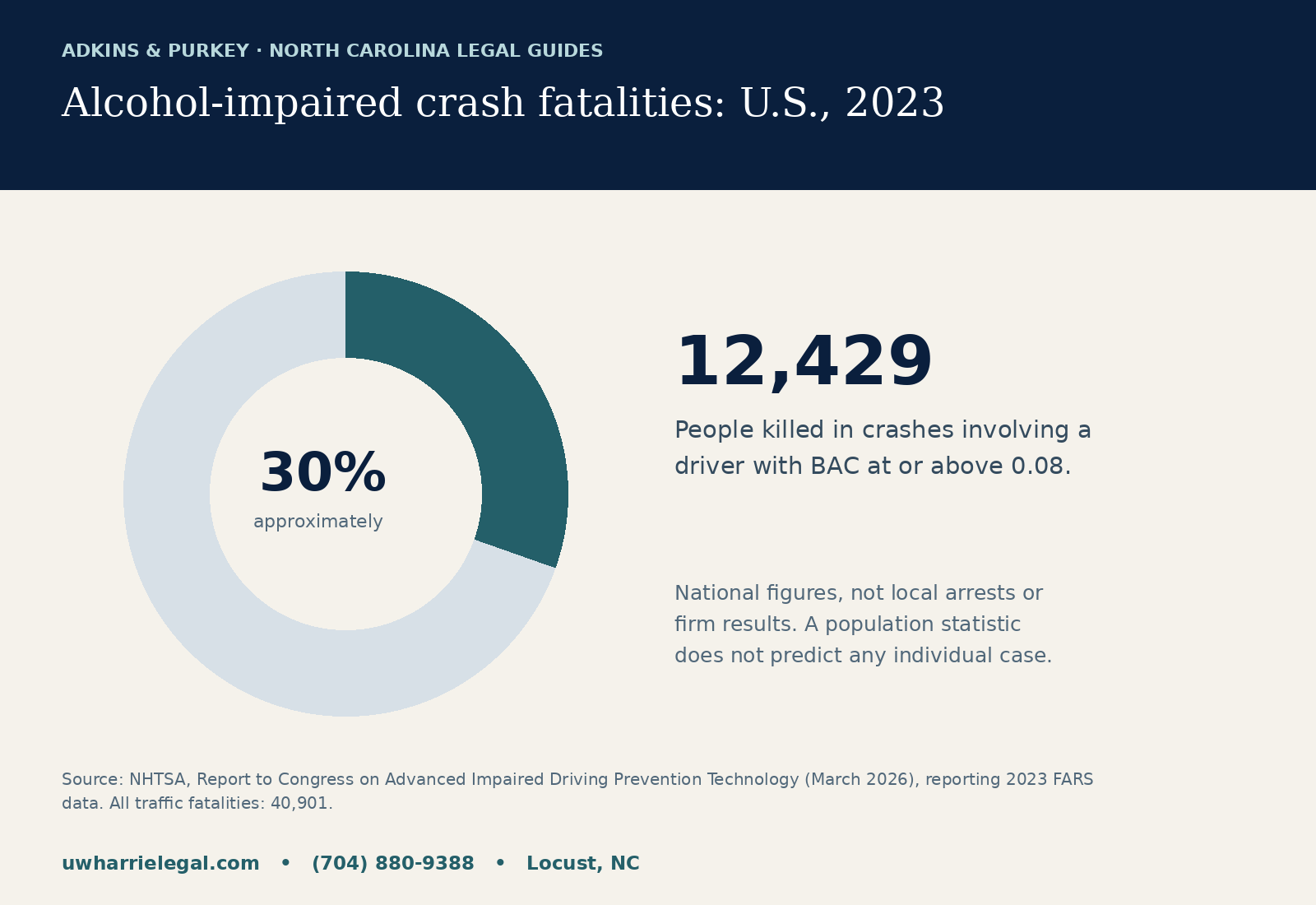
NHTSA reports 12,429 deaths in U.S. traffic crashes involving a driver with a blood alcohol concentration of at least 0.08 in 2023, approximately 30% of all traffic fatalities that year. These are national fatality figures, not Stanly County arrest counts, firm results, or the probability of a conviction in an individual case.
Those numbers explain the public-safety importance of impaired-driving enforcement. They do not replace constitutional safeguards, reliable testing, or the State's burden of proof. A responsible defense resource can recognize the seriousness of impaired driving while explaining why the evidence in each prosecution still requires careful review.
No general statistic can establish what happened during a particular stop. For that, counsel needs the recordings, documents, testimony, and applicable law. The chart below identifies its year and definition so the reader can understand what is being counted.
Explore the educational BAC estimator
Our linked learning tool uses a simplified alcohol-distribution model to illustrate how assumptions about alcohol consumed, body weight, distribution, elapsed time, and elimination can change a calculated value. It is a mathematical demonstration, not a breath test, blood test, medical evaluation, or forensic reconstruction.
A standard U.S. drink contains about 14 grams of pure alcohol. Typical examples are 12 ounces of 5% beer, 5 ounces of 12% wine, or 1.5 ounces of 40% spirits. Larger pours and stronger beverages can contain more than one standard drink. The estimator lets a reader explore that difference without treating a drink's container as proof of its alcohol content.
For estimation, education, and entertainment only. Never use the estimator to decide whether to drive, whether you are below a legal threshold, or when alcohol has cleared. Absorption, food, health, medications, body composition, drink measurement, and many other factors can make actual concentrations differ substantially. Even a displayed zero is not proof of sobriety. If drinking, arrange a sober ride; do not rely on a calculation.
Use interactive preparation tools without sharing private facts
The companion tool also provides a preparation checklist and a checkpoint learning section. Readers can explore the categories of records to discuss with counsel and distinguish the stop, testing, license, and court processes. The tool runs in the browser without asking for a name, case number, or confidential narrative.
The atmospheric effects are optional. A small, slow blue-light glow and a glass-like mist treatment provide visual context; a pause control and reduced-motion support allow the effects to be disabled. There is no siren, rapid strobe, or suggestion that the visual effect is a real recording of a local enforcement operation.
Use the tools to identify questions, not to diagnose a defense or determine a filing deadline. A checklist cannot decide whether evidence is admissible, whether a checkpoint was lawful, or whether a person may drive. Bring the underlying documents to an attorney who can evaluate those issues.
What to bring to a DWI consultation
Bring the citation, court and release documents, test printouts or rights forms, every DMV notice, available license information, and a concise chronology. Identify prior DWI convictions or license actions accurately, including events outside North Carolina. Tell counsel about commercial driving, professional licensing, and essential employment travel.
Include relevant medical or mobility information and the names of potential witnesses. Preserve lawfully available recordings and receipts without editing them. If you know that a business or another source may have a recording, identify it promptly so counsel can evaluate an appropriate preservation request before routine deletion occurs.
Ask about the scope of representation. Does the proposed engagement address only the criminal case, or also a DMV hearing, privilege application, or related matter? What fees and additional costs may apply? Who will communicate deadlines and obtain records? Clear engagement terms are as important as an initial discussion of the charge.
Questions worth asking before hiring counsel
A useful consultation should leave you with a clearer understanding of the immediate tasks and the review still required. Ask how the attorney will evaluate the stop, roadside evidence, chemical testing, and license situation. Ask which documents are missing and which deadlines require action first.
Discuss communication expectations, anticipated stages, and responsibility for court appearances. An honest explanation includes uncertainty. No attorney should promise a dismissal, claim a special relationship with a judge or officer, or offer a reliable outcome prediction without understanding the evidence and applicable law.
The book by Chris Adkins and Chris Purkey is a starting point for informed questions. The next step is a conversation about your actual case. Call or text (704) 880-9388, visit the firm's contact page, or learn more about both attorneys through their profiles. Adkins & Purkey serves clients from Locust, Albemarle, and surrounding communities, with representation determined through an agreed engagement.
Frequently asked questions
Is DWI different from DUI in North Carolina?
DWI is the familiar name of the North Carolina impaired-driving offense. Readers may search for DUI, but the charge, statutory theory and exact allegations should be identified from the papers.
Can I be charged below 0.08?
Yes. G.S. 20-138.1 includes an impairment theory as well as the alcohol-concentration theory. Other statutes can apply to commercial drivers or drivers under 21.
Does every checkpoint need a warrant?
No. Checkpoints have their own constitutional and statutory framework. Counsel reviews the primary purpose, reasonableness, operation and individual detention rather than assuming a warrant is always required.
Is the roadside handheld number the same as an evidentiary breath test?
No. G.S. 20-16.3 limits the use of portable screening evidence. A positive or negative result or refusal can be relevant to reasonable grounds, but the screening number is not proof of a particular alcohol concentration under that provision.
Are physical roadside exercises the same as implied-consent chemical testing?
No. Observational exercises, portable alcohol screening and evidentiary chemical analysis involve different evidence and rules. Describe each event separately to counsel rather than treating every procedure as one test.
Can I drive because my court date is months away?
Not necessarily. Civil revocation, a refusal proceeding or another suspension may already affect your privilege. Have the actual notices and current status checked before driving.
What deadline applies to a refusal hearing request?
Under the current text of G.S. 20-16.2(d), refusal revocation takes effect on the thirtieth calendar day after mailing unless a written hearing request is made before the effective date. Have the actual notice reviewed immediately.
Does a BAC estimator tell me when I am safe to drive?
No. The linked tool is for estimation, education and entertainment only. It cannot measure your concentration, establish a legal threshold, predict safe driving or provide a clearance time. Arrange a sober ride if drinking.
Where can I buy the book?
Use the Barnes & Noble link in the book feature above. Current formats, availability and pricing are controlled by the retailer.
How do I contact the authors about my case?
Call or text Adkins & Purkey at (704) 880-9388 or use the firm’s contact page. Identify the county, charge, court date and urgent license notice. Representation requires an agreed engagement.
Read, organize, and get a concrete next step
A DWI case is easier to understand when the separate processes are placed in order. Identify why the encounter began, what evidence was developed, what testing occurred, which license actions apply, and what the criminal court will decide. Then identify the documents and deadlines connected to each question.
For Stanly County, Cabarrus County, and Montgomery County readers, the combination of a locally grounded guide, official source links, the published book, and a prepared consultation provides a practical starting point. Keep the actual paperwork, arrange transportation when license status is uncertain, and seek advice before assuming a deadline or driving restriction has passed. The aim is an informed plan based on the record and current law.
Meet Chris Adkins and Chris Purkey

North Carolina attorney and certified mediator with a background as a Charlotte-Mecklenburg police officer and Army officer. His work includes family law, criminal defense and civil litigation.
Read the attorney profile →
Attorney whose practice includes family law, DWI and criminal defense, and civil litigation. His approach emphasizes preparation, clear communication and practical decisions based on the record.
Read the attorney profile →Continue with a related guide
- Child Custody Evidence in Stanly County: Build a Record That Focuses on Your Child
- When a Custody or Support Order Is Violated: A Stanly County Enforcement Guide
- Served With Divorce Papers in Stanly County? Protect Your Financial Claims
Official sources and further reading
- G.S. 20-138.1: impaired driving
- G.S. 20-16.3A: checkpoints
- G.S. 20-16.3: portable alcohol screening
- G.S. 20-16.2: implied consent and refusal
- G.S. 20-16.5: civil revocation
- G.S. 20-139.1: chemical analysis
- G.S. 20-179: DWI sentencing
- G.S. 20-179.3: limited driving privileges
- State v. Veazey, official published opinion
- NCGA: December 2026 civil-revocation fee amendment
- NHTSA: 2023 fatality context, March 2026 report
- NIAAA: standard drink definition
- Official Stanly County court resources
- Official Cabarrus County court resources
- Official Montgomery County court resources
General educational information checked November 2026. Laws and procedures may change. Attorney advertising; no result is guaranteed. This guide is not legal advice and does not create an attorney-client relationship.

