ADKINS & PURKEY · LOCUST & ALBEMARLE · NORTH CAROLINA
A practical guide from the firm of Christopher “Chris” Adkins and Christerfer “Chris” Purkey. Explore our practice.

Explore this guide
- Understand the court program's purpose
- Know what needs to be decided
- Build the ordinary week before the holiday calendar
- Address holidays and summer with clear priority rules
- Plan decision-making before an impasse happens
- Make communication useful and manageable
- Prepare priorities and possible alternatives
- Recognize when mediation may be inappropriate
- Understand what an agreement can become
- Keep financial settlement in its proper process
- Bring a proposal you can explain
Custody mediation gives parents an opportunity to make practical decisions about their child's future without asking a judge to choose every term after a contested hearing. Preparation matters. A parent who arrives with a workable proposal and clear priorities is better positioned to evaluate an agreement than a parent relying only on a wish for “fairness.”
Adkins & Purkey, PLLC assists families in Locust, Albemarle, and surrounding counties with custody negotiations and parenting plans. Attorneys Chris Adkins and Chris Purkey can help clients understand the legal setting, prepare proposals, and review the consequences of proposed terms.
Understand the court program's purpose
Many contested North Carolina custody cases are referred to the court's custody mediation program before a contested hearing, unless mediation is waived. The program focuses on custody and visitation arrangements. It is not a general settlement conference for every financial issue arising from a divorce.
A mediator is neutral. The mediator does not decide who wins, represent either parent, or provide one parent's legal advice. Court-program sessions generally take place without attorneys participating in the room, although parents can consult their attorneys outside the session. Private mediation arrangements may differ, so identify which process is scheduled.
Know what needs to be decided
Separate legal custody from physical custody. Major decisions about education and health may require different provisions from the weekly residential schedule. An agreement should also address transportation, communication, holidays, and information sharing rather than stopping at the phrase “joint custody.”
Read existing orders first. If an order already governs the family, clarify what is being changed and what remains in effect. If the request concerns modification of a permanent order, the governing legal standard still matters even when parents hope to resolve the issue voluntarily.
Build the ordinary week before the holiday calendar
Map the child's school day, transportation, activities, homework, appointments, and bedtime. Add each parent's work schedule and realistic travel times. A plan that works on a quiet weekend may be difficult during school mornings or a parent's overnight shift.
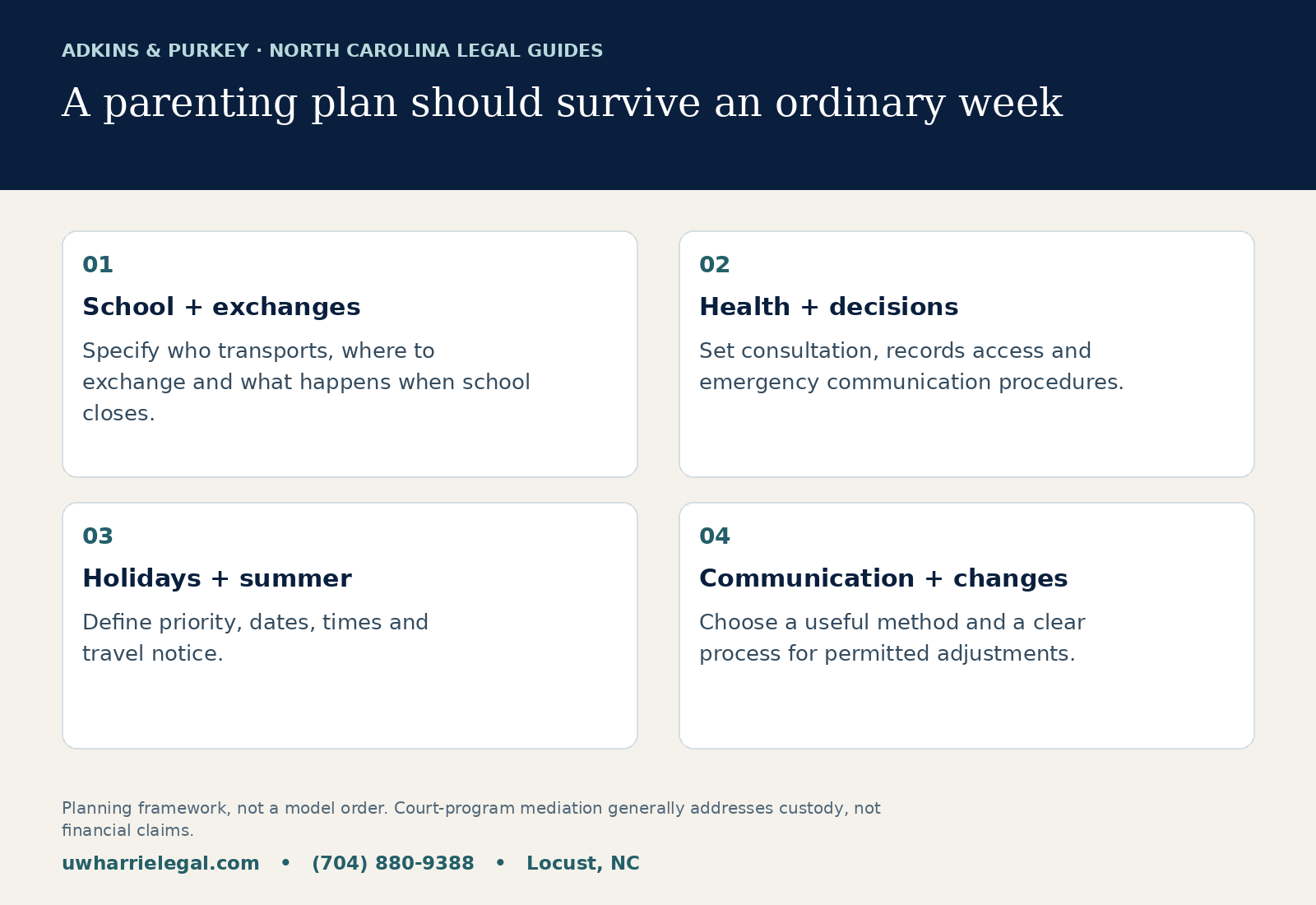
Families moving between Locust, Albemarle, and Concord should examine the actual route and exchange point. Decide who transports, whether exchanges occur at school, and what happens when school is closed. Predictable details can prevent small logistical disagreements from becoming repeated court disputes.
Address holidays and summer with clear priority rules
State whether holiday schedules override the ordinary rotation. Define start and end times, pickup locations, school-break boundaries, and any alternation between odd and even years. A term such as “Christmas with Dad” can leave significant uncertainty about dates and transportation.
For summer travel, consider notice periods, itinerary information, communication, and conflicts with activities. Discuss passports and international travel when relevant. A broad right to vacation time should fit the child's age and the parents' practical ability to arrange care.
Plan decision-making before an impasse happens
Parents who share legal custody need a method for meaningful communication. Identify how proposals are sent, what information accompanies them, and how much time is available to respond when a decision is not urgent. Emergency treatment should be addressed separately from routine consultation.
If parents cannot agree, a provision may need to identify a lawful decision-making process or the route for returning to court. Do not assume that a sentence requiring agreement resolves a recurring impasse. Have counsel explain any proposed final-decision authority and its limits.
Make communication useful and manageable
Agree on a reliable method for child-related communication and a reasonable expectation for response. Consider a parenting application or designated email when it improves clarity. The plan should distinguish routine updates from emergencies and allow important information to reach both households.
Keep communication focused on the child. A plan should not require constant reporting about every ordinary choice or permit harassment through repeated messages. School portals, medical access, and notice of activities may reduce conflict when the responsibilities are stated clearly.
Prepare priorities and possible alternatives
Identify the issues essential to safety or the child's needs, the matters where flexibility is possible, and the questions requiring more information. Draft more than one workable option when possible. This makes it easier to evaluate a proposal without treating every difference as a complete failure.
Do not agree to terms you do not understand simply to finish the session. Ask for clarification and use available opportunities to consult counsel. Consider how the language would function during disagreement, not only while both parents are cooperating.
Recognize when mediation may be inappropriate
Domestic violence, coercive control, serious safety concerns, distance, or other circumstances may support a waiver or different arrangements under applicable rules. Explain these concerns to counsel and the program through appropriate channels before assuming an ordinary joint session is suitable.
If someone is in immediate danger, call 911. Mediation does not replace protective relief or emergency intervention. A parent should not feel required to negotiate away safety because the case has been referred to a mediation program.
Understand what an agreement can become
A parenting agreement reached through the court program may be submitted for judicial approval and become a court order. Read the complete written terms. Confirm that they reflect the actual agreement, including transportation, decision-making, communication, and any restrictions.
Once an agreement becomes an order, the parties must comply unless it is lawfully changed. Casual departures can create disputes about what was agreed and what remains enforceable. If the plan later stops meeting the child's needs, seek advice about the proper modification process rather than simply replacing it informally.
Keep financial settlement in its proper process
Child support, property division, and alimony may require separate negotiation or mediation. Do not assume a custody session resolves those claims or preserves financial rights before divorce. A parenting arrangement can affect support calculations, but custody and support remain different legal issues.
Tell counsel about all pending claims and proposed agreements. When several subjects are being negotiated, coordinate the work so one settlement does not create an unintended conflict with another. Clear scope helps everyone understand what has actually been resolved.
Frequently asked questions
Does court custody mediation decide support and property?
The court custody mediation program focuses on parenting arrangements. Financial claims may need separate negotiation or proceedings.
Will the mediator give me legal advice?
No. The mediator is neutral and does not represent either parent. Consult your own attorney about your rights and the effect of proposed terms.
What if there is domestic violence?
Tell counsel and the program through appropriate channels. Safety concerns can require consideration of waiver or different arrangements. Call 911 for immediate danger.
Bring a proposal you can explain
For your preparation meeting, bring existing orders, the child's calendar, both parents' known work schedules, transportation information, and a list of recurring disagreements. Christopher Adkins's background as a certified mediator informs a practical focus on clear terms and implementation. Contact Adkins & Purkey in Locust to discuss custody planning and the legal advice appropriate to your case.
Meet Chris Adkins and Chris Purkey

North Carolina attorney and certified mediator with a background as a Charlotte-Mecklenburg police officer and Army officer. His work includes family law, criminal defense and civil litigation.
Read the attorney profile →
Attorney whose practice includes family law, DWI and criminal defense, and civil litigation. His approach emphasizes preparation, clear communication and practical decisions based on the record.
Read the attorney profile →Continue with a related guide
- Child Custody Evidence in Stanly County: Build a Record That Focuses on Your Child
- Fathers’ Rights in North Carolina: Custody, Parenting Time and Support
- When a Custody or Support Order Is Violated: A Stanly County Enforcement Guide
Official sources and further reading
- NC Judicial Branch: custody mediation
- G.S. 50-13.1: custody action and mediation
- NC Judicial Branch: custody information
General educational information checked November 2026. Laws and procedures may change. Attorney advertising; no result is guaranteed. This guide is not legal advice and does not create an attorney-client relationship.


Responses
[…] Custody Mediation in Stanly & Cabarrus Counties: Prepare a Parenting Plan That Works […]
LikeLike
[…] Custody Mediation in Stanly & Cabarrus Counties: Prepare a Parenting Plan That Works […]
LikeLike