ADKINS & PURKEY · LOCUST & ALBEMARLE · NORTH CAROLINA
A practical guide from the firm of Christopher “Chris” Adkins and Christerfer “Chris” Purkey. Explore our practice.

Explore this guide
- Begin with the legal question
- Build a timeline around the child's experience
- Preserve messages in context
- School and medical records can answer focused questions
- Choose witnesses for what they personally know
- Show the court a workable parenting proposal
- Treat safety concerns with appropriate urgency
- Keep children out of evidence collection
- Prepare for mediation as well as litigation
- Bring an organized consultation packet
- Focus the record on a solution
Parents often arrive at a custody consultation with hundreds of messages and one urgent question: How do I show the court what is really happening? A strong presentation begins with relevant facts about the child, reliable records, and a practical parenting proposal. It rarely improves when every disagreement between adults is treated as equally important.
Adkins & Purkey, PLLC assists parents in Locust, Albemarle, and surrounding Stanly County communities with custody questions. Attorneys Christopher Adkins and Christerfer Purkey can help distinguish evidence that supports the legal issue from information that mainly reflects the strain of separation.
Begin with the legal question
For an initial custody determination between parents, North Carolina courts focus on the child's best interests and welfare under G.S. 50-13.2. Relevant considerations can include safety, caregiving, stability, school needs, health, and the parents' ability to meet those needs. There is no presumption between parents that one gender better promotes the child's welfare.
If a permanent custody order already exists, changing it ordinarily requires a substantial change in circumstances affecting the child before a revised arrangement is considered. Temporary orders and emergency requests involve different issues. Bring every order so counsel can identify the correct standard before selecting evidence.
Build a timeline around the child's experience
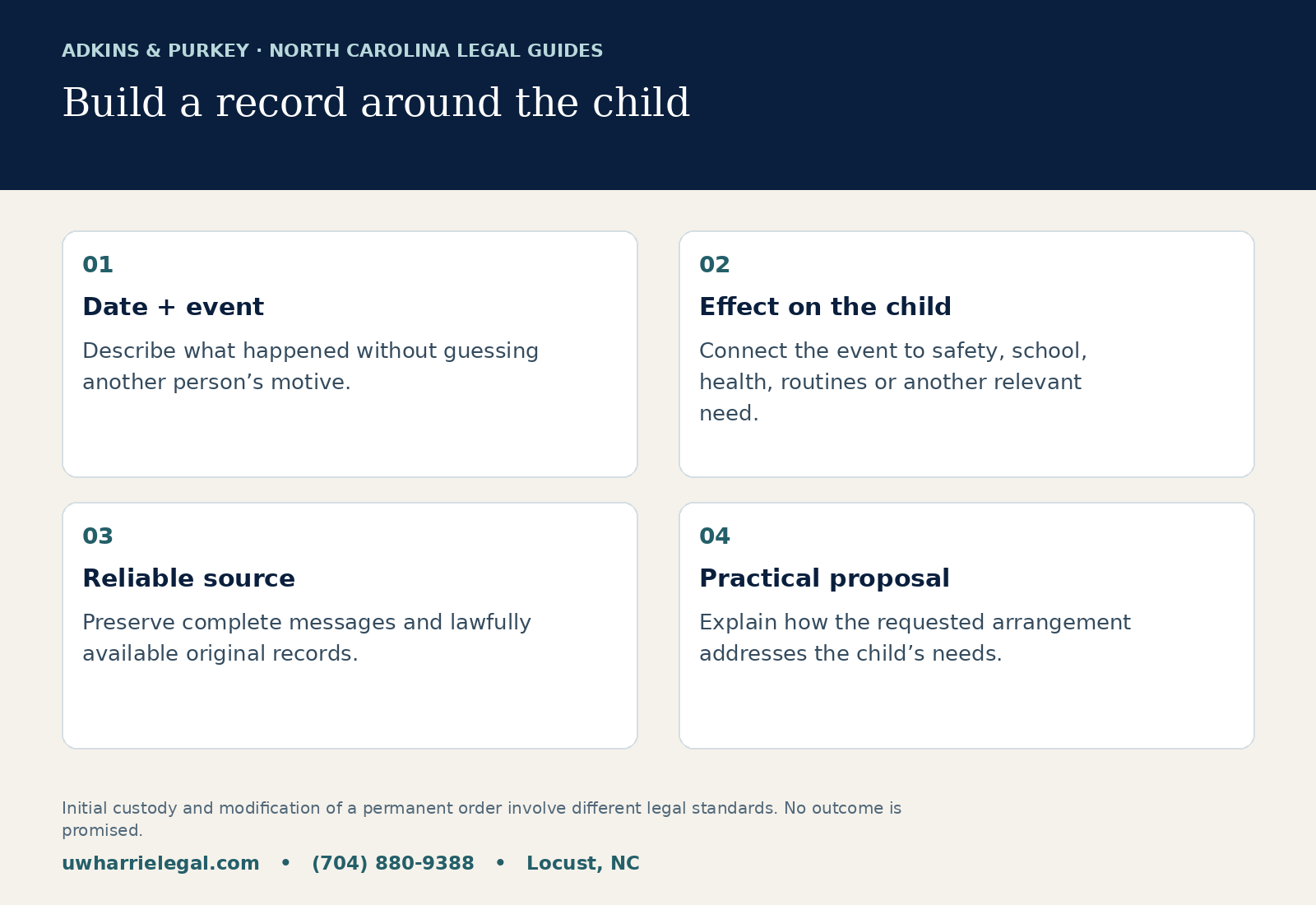
A useful timeline identifies the date, event, effect on the child, and source. For example: an exchange did not occur, the child missed a scheduled appointment, and the school attendance record confirms the consequence. Keep your observations separate from conclusions about another person's motives.
Describe both concerning events and ordinary caregiving. School attendance, homework help, medical appointments, transportation, meals, and consistent routines can illustrate how parenting works in practice. A parent who documents only conflict may leave the court with little information about the child's actual daily life.
Preserve messages in context
Save complete conversations with dates and participants rather than only the most provocative sentence. A cropped screenshot may omit an explanation, response, or agreed change. Retain original devices and available exports where appropriate, and follow counsel's instructions about organizing copies.
Do not edit messages, delete unfavorable material, or manufacture a cleaner version of the record. Discoverable information can include material that does not help your position. Authentication, hearsay, relevance, and other evidentiary rules still apply even when a message appears persuasive on a phone screen.
School and medical records can answer focused questions
An attendance history, teacher communication, treatment recommendation, or appointment record may help establish a concrete concern. The record should be connected to the issue before the court. A missed appointment needs context: why was it missed, who was responsible, and what happened afterward?
Use lawful access methods and respect privacy requirements. A parent should not impersonate another person, guess passwords, or enter protected accounts without authority. Your attorney can evaluate consent, releases, subpoenas, and other lawful routes for obtaining material that is not already available.
Choose witnesses for what they personally know
A witness who directly observed an exchange or regularly sees the child's routine may contribute more than a friend who has heard only one parent's account. Identify the person's relationship to the child, firsthand knowledge, contact information, and the particular event or pattern the witness can describe.
Avoid coaching witnesses or asking them to adopt labels such as “unfit” without factual support. Teachers, caregivers, relatives, and other witnesses may have different perspectives. Counsel can determine whether their testimony is necessary, how it can be obtained, and what limits apply.
Show the court a workable parenting proposal
Evidence should support a practical request. Explain school-night routines, transportation, holiday arrangements, medical coordination, communication, and decision-making. A proposed schedule should account for distance, work hours, the child's age, and the child's actual activities.
For a family dividing time between Locust and Albemarle, commuting and exchange logistics may matter differently than for parents living near the same school. Shared time is not a substitute for a transportation plan. Identify who picks up, where the exchange occurs, and what happens on teacher workdays or when a child is sick.
Treat safety concerns with appropriate urgency
Domestic violence, substance-related danger, threatened removal, or abuse requires an individualized response. North Carolina emergency custody relief has specific statutory requirements, including certain risks of bodily injury, sexual abuse, or removal to evade jurisdiction. Ordinary disagreement does not automatically satisfy those standards.
If someone is in immediate danger, call 911. Keep relevant reports, photographs, medical records, and existing protective orders. Explain the source and timing of the risk to counsel. Avoid using an emergency allegation simply to gain an advantage in an ordinary scheduling dispute.
Keep children out of evidence collection
Do not ask a child to investigate the other household, record private conversations, choose a litigation side, or repeatedly rehearse allegations. These practices can harm the child and complicate the case. Communicate age-appropriate reassurance and use professional guidance when the child needs support.
If the child makes a concerning statement, write down the words and circumstances accurately without pressing for a preferred answer. Ask counsel how the issue should be handled. A child's preferences may matter in some circumstances, but the child does not acquire an automatic right to choose custody at a particular age.
Prepare for mediation as well as litigation
Many contested custody cases are referred to the court's custody mediation program unless waived. An organized record can clarify what needs to be resolved, but mediation is also an opportunity to design workable terms. It is not simply a rehearsal of every accusation that might appear at trial.
Prepare a short statement of the child's needs and a proposal that addresses them. If domestic violence, distance, or another circumstance raises a concern about mediation, discuss waiver or appropriate arrangements with counsel. The mediator is neutral and does not replace independent legal advice.
Bring an organized consultation packet
Include existing orders and agreements, a one-page chronology, the child's current schedule, key school and medical information, relevant messages, and your proposed changes. Flag urgent dates and identify where the child has lived during the preceding months. Interstate residence can raise separate jurisdictional issues.
Do not postpone calling until the file is perfect. Start with the most important documents and follow the firm's instructions about providing sensitive material securely. Parents in Stanly, Cabarrus, and Montgomery Counties should also identify where any existing case is pending.
Frequently asked questions
Can my child choose which parent to live with?
There is no automatic age at which a minor child simply chooses custody in an ordinary North Carolina custody case. Preferences and how they may be considered require an individualized assessment.
Is changing a permanent order the same as an initial case?
No. Modification ordinarily requires a substantial change in circumstances affecting the child before the court considers an appropriate revised arrangement. Bring every existing order.
Should I bring every message to the first meeting?
Preserve the complete record, but organize a focused selection of relevant events for the consultation. Follow counsel’s instructions about securely providing sensitive material.
Focus the record on a solution
The most useful custody evidence helps answer what arrangement will serve this child under the applicable legal standard. Clear dates, complete records, and a realistic plan make that question easier to evaluate. They also help counsel explain what can be established, what remains uncertain, and what additional information would make a meaningful difference.
Meet Chris Adkins and Chris Purkey

North Carolina attorney and certified mediator with a background as a Charlotte-Mecklenburg police officer and Army officer. His work includes family law, criminal defense and civil litigation.
Read the attorney profile →
Attorney whose practice includes family law, DWI and criminal defense, and civil litigation. His approach emphasizes preparation, clear communication and practical decisions based on the record.
Read the attorney profile →Continue with a related guide
- Fathers’ Rights in North Carolina: Custody, Parenting Time and Support
- Custody Mediation in Stanly & Cabarrus Counties: Prepare a Parenting Plan That Works
- When a Custody or Support Order Is Violated: A Stanly County Enforcement Guide
Official sources and further reading
- G.S. 50-13.2: child custody standard
- G.S. 50-13.5: procedure and emergencies
- NC Judicial Branch: custody information
General educational information checked November 2026. Laws and procedures may change. Attorney advertising; no result is guaranteed. This guide is not legal advice and does not create an attorney-client relationship.


Responses
[…] Child Custody Evidence in Stanly County: Build a Record That Focuses on Your Child […]
LikeLike
[…] Child Custody Evidence in Stanly County: Build a Record That Focuses on Your Child […]
LikeLike
[…] Child Custody Evidence in Stanly County: Build a Record That Focuses on Your Child […]
LikeLike