ADKINS & PURKEY · LOCUST & ALBEMARLE · NORTH CAROLINA
A practical guide from the firm of Christopher “Chris” Adkins and Christerfer “Chris” Purkey. Explore our practice.

Explore this guide
- Postseparation support and alimony serve different roles
- There is no automatic percentage formula
- Build a budget the records can support
- Review income beyond the paycheck
- Misconduct can materially affect entitlement
- Explain health, work, and caregiving realities
- Coordinate support with property decisions
- Understand modification and termination
- Preserve the claim before absolute divorce
- Prepare for a useful consultation
- Evaluate a proposal through the life it must support
When a marriage ends, two households may have to operate on income that previously supported one. A spouse may need help meeting reasonable expenses, while the other worries about what a support obligation would leave available each month. North Carolina addresses those concerns through distinct rules for postseparation support and alimony.
Adkins & Purkey, PLLC helps clients in Locust, Albemarle, and Stanly County evaluate support questions using records, realistic budgets, and the facts affecting entitlement. Attorneys Chris Adkins and Chris Purkey can explain what needs to be established before discussing a proposed amount or duration.
Postseparation support and alimony serve different roles
Postseparation support generally addresses financial need during the period before a final alimony determination or another terminating event. G.S. 50-16.2A directs the court to consider needs, resources, earnings, earning abilities, debt obligations, and reasonable expenses. The supporting spouse's ability to pay is part of the analysis.
Alimony is a separate determination under G.S. 50-16.3A. The court considers whether one spouse is dependent, the other supporting, and an award equitable under the applicable factors and misconduct rules. A temporary arrangement should not be mistaken for a final answer about alimony.
There is no automatic percentage formula
North Carolina does not prescribe a universal statewide alimony percentage or a fixed rule awarding support for half the marriage's length. A calculator copied from another state cannot decide a North Carolina case. Amount, duration, and payment structure require consideration of the relevant circumstances.
Income differences matter, but so do needs, assets, earning capacity, health, age, the length of the marriage, and contributions during the marriage. A spouse with a job may still present a dependency question. A substantial salary difference does not by itself establish every element required for an award.
Build a budget the records can support
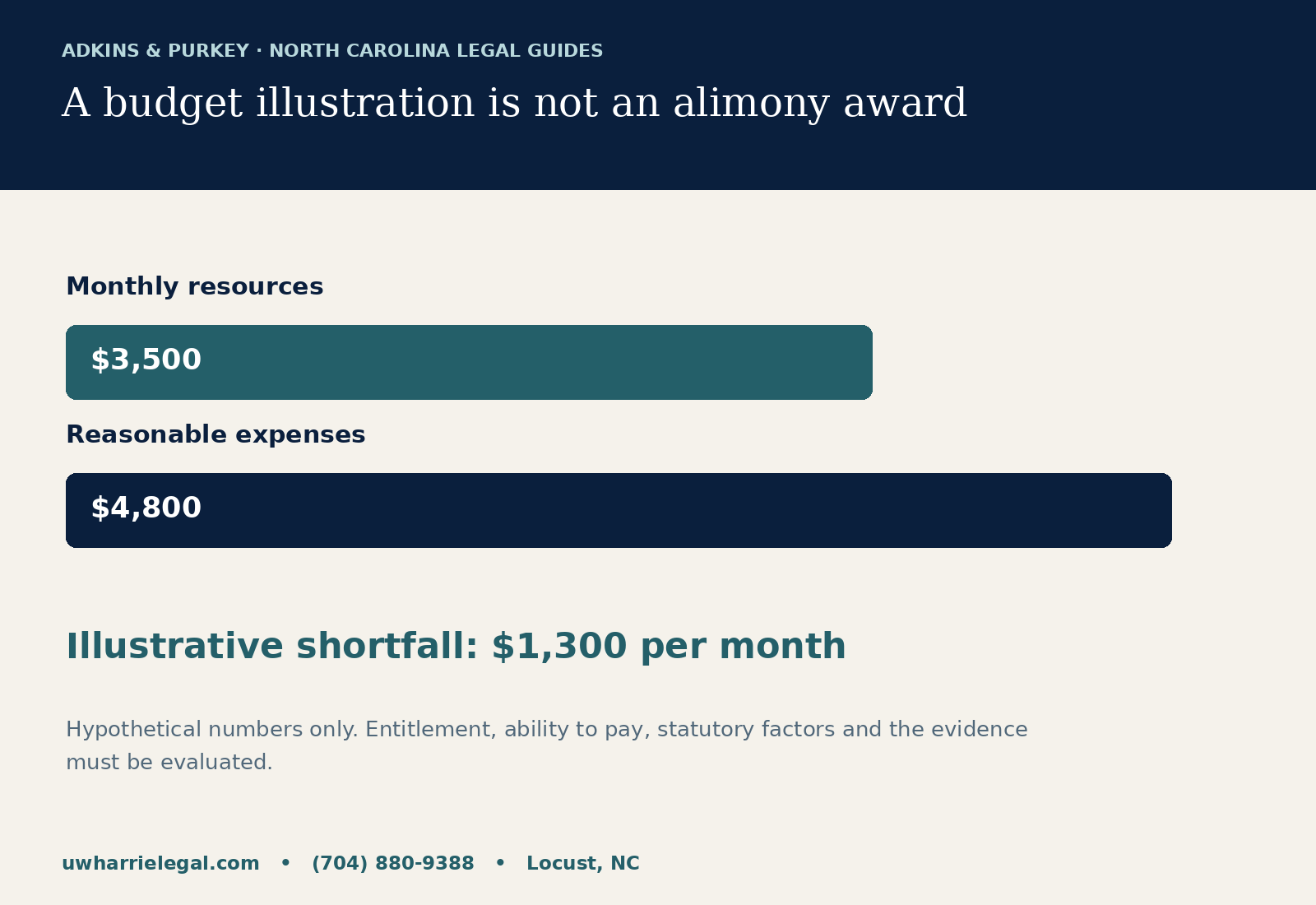
Separate recurring expenses from irregular costs. Identify housing, utilities, insurance, transportation, health care, groceries, and debt service. Explain which figures come from actual payments and which are reasonable estimates for a separate household. A projected expense should have an understandable basis.
Avoid counting the same cost twice or including the full cost of a child-related expense already addressed elsewhere without explanation. Distinguish personal costs from business expenses. A court or negotiating spouse should be able to trace significant numbers to statements, invoices, policies, or other records.
Review income beyond the paycheck
Bonuses, commissions, business distributions, rental receipts, investments, and other resources can complicate the analysis. A recent pay stub may not reflect ordinary annual earnings. Conversely, a one-time receipt may not support the same recurring obligation as a dependable monthly salary.
For business owners, review how the business pays expenses and whether particular payments reduce personal living costs. Financial statements and tax returns may need context. The goal is to understand actual resources rather than select whichever document produces the most favorable isolated number.
Misconduct can materially affect entitlement
North Carolina's alimony statute contains specific rules concerning illicit sexual behavior during the marriage and before or on the date of separation. Conduct by a dependent spouse can bar alimony; conduct by a supporting spouse can require an award when the statutory requirements are met. When both spouses engaged in qualifying conduct, discretion and the circumstances matter. Condonation can also affect the analysis.
Other statutory misconduct factors may influence the court's determination. Do not assume every painful marital event has the same legal significance. Share accurate facts privately with counsel, preserve lawfully available evidence, and avoid accessing accounts or recording communications without considering the law.
Explain health, work, and caregiving realities
Earning capacity is not always identical to current wages. Education, job history, available employment, health limitations, and caregiving responsibilities may require documentation. A statement that a spouse “could earn more” needs a factual basis.
Likewise, a plan for education or reentry into employment should identify time, cost, feasibility, and interim needs. The court may consider contributions to the other spouse's education or earning power. Discuss the household's history in concrete terms rather than relying on general labels about who worked harder.
Coordinate support with property decisions
Equitable distribution and support address different questions, but a proposed settlement should be evaluated as a whole. Keeping an asset with high carrying costs can affect monthly needs. Accepting an illiquid asset is not the same as receiving cash for living expenses.
A settlement exchanging support rights for property should be reviewed carefully. Consider valuation, liquidity, tax consequences, implementation, and the effect of a waiver. Do not compare two proposals solely by headline dollar amounts when their timing and legal consequences differ substantially.
Understand modification and termination
Court-ordered support and contractual support can operate under different legal rules. G.S. 50-16.9 permits modification of qualifying support orders upon the required showing of changed circumstances. It also provides for termination upon specified events, including death and the recipient's remarriage or statutory cohabitation.
Cohabitation has a legal meaning; dating or occasional visits do not automatically answer the question. An unincorporated agreement may contain its own negotiated provisions. Before stopping a payment or assuming an obligation has ended, have the governing document and relevant facts reviewed.
Preserve the claim before absolute divorce
An absolute divorce can cut off an unpreserved alimony claim. Negotiations, a verbal assurance, or an expectation that the issue will be addressed later may not protect the right. Bring pending divorce papers to counsel even if support discussions appear cooperative.
If you are being asked to sign a waiver, understand what is being released and what information supports the decision. If support is agreed, specify the payment method, due dates, duration, and any security or enforcement provisions. Clear drafting reduces uncertainty for both spouses.
Prepare for a useful consultation
Bring income records, recent tax returns, a monthly budget, important account and debt statements, existing agreements or orders, and any served papers. Identify the date of separation, marriage length, current employment, and urgent financial concerns. Explain safety issues that might affect negotiation or access to funds.
Clients throughout Locust, Albemarle, and nearby Cabarrus and Montgomery County communities can contact Adkins & Purkey about the scope of representation. Ask about consultation arrangements and fees before assuming the firm has undertaken work or agreed to a court appearance.
Frequently asked questions
Is alimony always a percentage of the other spouse’s pay?
No. North Carolina has no universal alimony percentage formula. Entitlement, amount and duration depend on the applicable legal factors and evidence.
Does dating automatically terminate alimony?
Not necessarily. Court-ordered termination for cohabitation requires the statutory analysis, and an unincorporated contract may have its own terms. Review the governing document before stopping payment.
Can I decide about alimony after divorce?
An unpreserved alimony claim can be lost upon absolute divorce. Get advice about preservation before judgment rather than assuming negotiations protect the right.
Evaluate a proposal through the life it must support
A useful support plan is understandable, evidence-based, and realistic about both households. Review the legal basis for entitlement, the numbers supporting the amount, and the events that could change the obligation. Those questions help turn a stressful financial dispute into decisions that can be evaluated with greater clarity.
Meet Chris Adkins and Chris Purkey

North Carolina attorney and certified mediator with a background as a Charlotte-Mecklenburg police officer and Army officer. His work includes family law, criminal defense and civil litigation.
Read the attorney profile →
Attorney whose practice includes family law, DWI and criminal defense, and civil litigation. His approach emphasizes preparation, clear communication and practical decisions based on the record.
Read the attorney profile →Continue with a related guide
- Separation Agreements in Locust & Albemarle: What to Settle Before You Sign
- Served With Divorce Papers in Stanly County? Protect Your Financial Claims
- Who Keeps the House in a Stanly County Divorce? Property, Retirement and Debt
Official sources and further reading
- G.S. 50-16.2A: postseparation support
- G.S. 50-16.3A: alimony
- G.S. 50-16.9: modification and termination
General educational information checked November 2026. Laws and procedures may change. Attorney advertising; no result is guaranteed. This guide is not legal advice and does not create an attorney-client relationship.


Responses
[…] Alimony and Postseparation Support: A Practical Guide for Locust & Albemarle […]
LikeLike
[…] Alimony and Postseparation Support: A Practical Guide for Locust & Albemarle […]
LikeLike
[…] Alimony and Postseparation Support: A Practical Guide for Locust & Albemarle […]
LikeLike
[…] Alimony and Postseparation Support: A Practical Guide for Locust & Albemarle […]
LikeLike