
ADKINS & PURKEY • STANLY COUNTY, NORTH CAROLINA
Build the plan around the child.
A practical, illustrated guide to custody decisions, parenting schedules and court procedures for Albemarle, Locust and Stanly County families. Turn broad intentions into a routine that can work in real life.

Published September 29, 2026 · A&P Family Law Learning Center
Educational information about North Carolina law, not advice for a particular case. Examples are fictional. Deadlines, orders and individual circumstances matter; reading this guide does not create an attorney–client relationship.
Inside this guide
- Begin with the child’s ordinary day
- Distinguish legal custody from physical custody
- Translate “best interests” into useful evidence
- Compare schedules by rhythm, not just percentages
- Write a parenting plan that answers predictable questions
- Understand the Stanly County custody process
- Use custody mediation thoughtfully
- Know the difference between urgent and emergency relief
- Keep support, parenting time and records distinct
- Handle relocation, enforcement and changed circumstances
- Plan for Albemarle, Locust and surrounding communities
- Answers to common custody questions
- Arrive at a consultation with a clear picture
CHAPTER 01
Begin with the child’s ordinary day
A useful custody plan starts with a child’s actual life: waking up, getting to school, finishing homework, taking medication, seeing friends and going to sleep. For parents in Albemarle and Locust, the important question is how the plan will work on an ordinary Tuesday, as well as on holidays and difficult days. Labels such as “joint custody” do not supply those details.
North Carolina custody decisions between parents focus on the child’s best interests and welfare. The court considers relevant circumstances, including domestic violence and the safety of the child and parties. There is no presumption that a mother or father is better entitled to custody merely because of gender. Joint custody must be considered if requested, but that does not guarantee an equal-time schedule. See § 50-13.2.
Start by writing a neutral description of the current routine and the child’s needs. What is working? Where are missed exchanges, school disruptions or unresolved decisions occurring? A child with a medical condition, an early school start or a parent who works rotating shifts may need more specific provisions than a generic form provides.
CHAPTER 02
Distinguish legal custody from physical custody
| Term | What it addresses | Questions the plan should answer |
|---|---|---|
| Legal custody | Authority over major decisions such as education and medical care. | Who decides? What information is shared? What happens after a disagreement? |
| Physical custody | Where the child lives and the parenting-time schedule. | Which nights, exchanges, holidays and transportation responsibilities apply? |
| Joint custody | Shared rights or responsibilities as defined by the order. | Exactly what is shared, and does the order assign specific decision authority? |
| Sole custody | Rights allocated to one parent as specified by the order. | What contact or information rights remain for the other parent? |
A parent can have substantial parenting time without every major decision being allocated identically. Likewise, joint legal custody does not automatically create a seven-nights-each arrangement. Carefully read the actual order: it may define consultation, deadlines for responding, a dispute-resolution method or authority over a particular issue. The Judicial Branch custody guide explains the basic categories.
A practical decision-making clause addresses access to information before the decision is made. For example, a proposal about tutoring should identify the school concern, the provider, the schedule and the cost. A parent cannot meaningfully participate if the first notice arrives after enrollment. Emergency care needs its own rule so necessary treatment is not delayed while parents debate routine decision procedures.
School and medical records should be addressed clearly. State law generally provides both parents equal access to the child’s records absent a contrary court order. That access does not, by itself, settle which parent has authority to make a particular decision. Keep those two issues distinct when drafting the plan.
CHAPTER 03
Translate “best interests” into useful evidence
The best-interests standard is broad because children’s circumstances differ. A court may need to understand stability, caregiving history, safety, school performance, health needs, relationships and each parent’s ability to meet the child’s needs. There is no universal points system in which a larger home or higher salary automatically wins.
| Child-centered question | Useful supporting material | Avoid |
|---|---|---|
| Who manages daily care? | Calendars, school communications and records of appointments. | A list of insults or unsupported claims about character. |
| How is school going? | Attendance, relevant teacher communications and documented support needs. | Using a single grade as proof of every alleged problem. |
| Are exchanges workable? | Dated records of actual delays and their effect on the child. | Inflating minor inconveniences or omitting your own changes. |
| Is there a safety concern? | Specific incidents, available records and firsthand witnesses. | Diagnoses, rumors or speculation presented as facts. |
| Can the plan meet special needs? | Treatment instructions and care schedules from appropriate professionals. | Expecting a generic schedule to answer every medical issue. |
A helpful timeline separates observation from inference. “The child missed school on these dates; the attendance record is attached” is more precise than “the other parent never cares about school.” Preserve the context of messages and complete conversations where relevant. Do not edit a screenshot to remove information that changes its meaning.
Children should not be coached, rehearsed or pressured to take sides. A mature child’s preference may be considered, but there is no automatic age at which a child simply chooses the custody arrangement. The judge remains responsible for the legal decision. Cases involving grandparents or other nonparents also involve threshold legal questions beyond the ordinary dispute between two parents; obtain advice specific to that situation.
CHAPTER 04
Compare schedules by rhythm, not just percentages
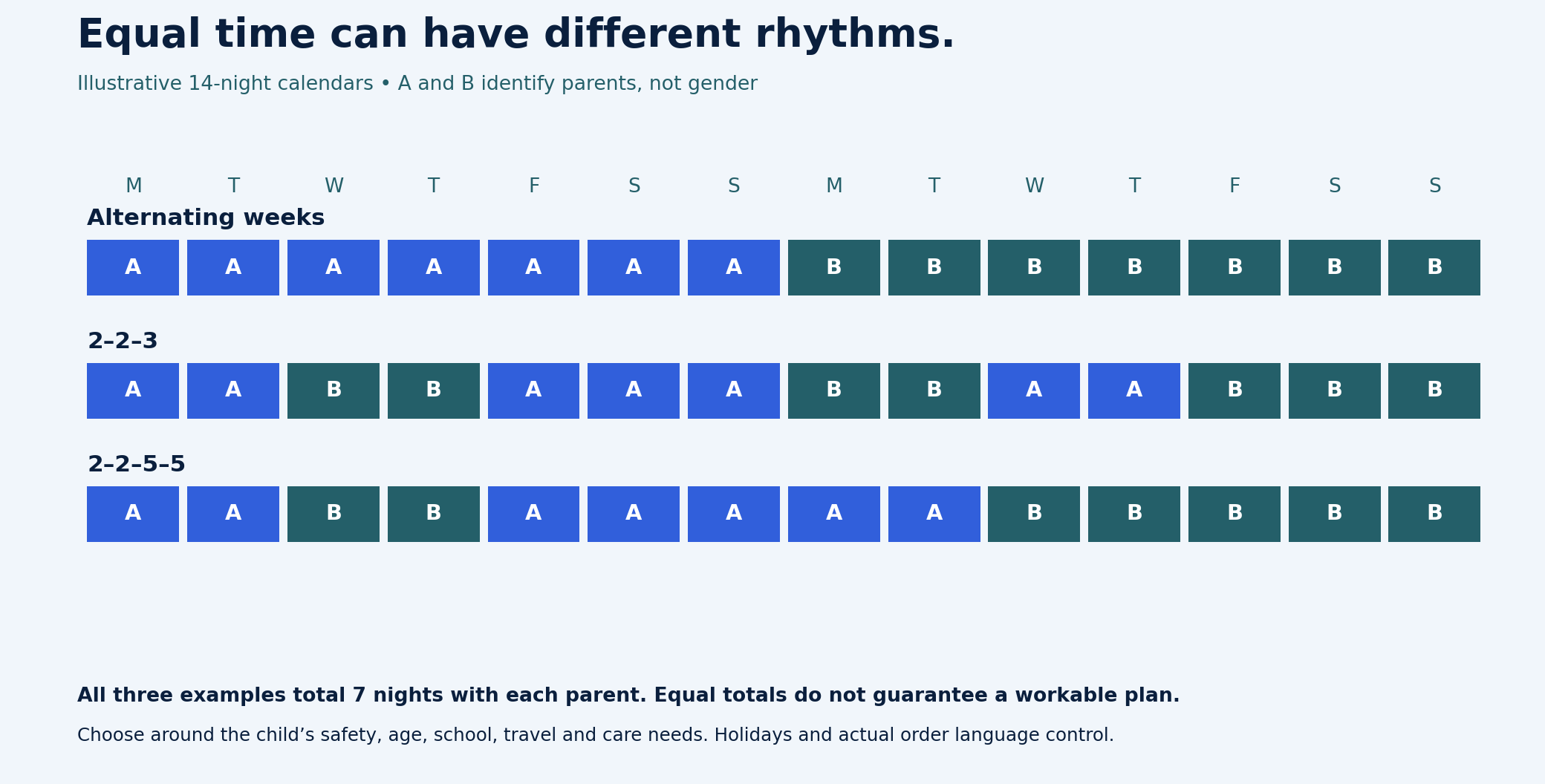
The chart shows three arrangements with the same overnight total and very different rhythms. Alternating weeks offers longer uninterrupted blocks. A 2–2–3 rotation creates shorter gaps between time with each parent but more frequent transitions. A 2–2–5–5 arrangement can give each parent consistent weekdays while alternating the longer weekend blocks. None is automatically the right choice for a particular child.
| Illustration | Potential advantage | Question to test |
|---|---|---|
| Alternating weeks | Fewer routine transitions and longer blocks. | Can the child handle the longer gap, and can both homes cover a full school week? |
| 2–2–3 | Frequent contact with both parents. | Do frequent exchanges create travel, belongings or communication problems? |
| 2–2–5–5 | Predictable weekday responsibilities. | Do fixed weekdays fit work schedules, activities and the child’s needs? |
| Another tailored schedule | Can address distance, age, safety or caregiving constraints. | Are the reasons tied to the child rather than an adult’s preferred label? |
Test any proposal against the school calendar, actual commute, childcare coverage and sleep routine. If one parent lives in Locust and the other in Albemarle, use realistic departure times and after-school pickup arrangements. Count the transitions as well as the nights. A mathematically balanced calendar can still be exhausting or unworkable.
Also consider how the plan changes over time. A preschool child, a teenager with activities and a child receiving ongoing treatment may have different needs. Avoid vague automatic changes that cannot be implemented without further decisions. If a future adjustment is contemplated, define its trigger and the process for addressing disagreements.
CHAPTER 05
Write a parenting plan that answers predictable questions
A parenting plan is most valuable when it resolves foreseeable points of friction before they become repeated disputes. “Reasonable visitation” or “holidays by agreement” may work while relations are easy, but offers little guidance after communication breaks down. Specificity should make the child’s life more predictable without turning every minor adjustment into a conflict.
| Provision | Details to address |
|---|---|
| Regular week | Exact start and end times, school-day exchanges and the rule when school is closed. |
| Holidays and breaks | Defined holiday periods, odd/even-year rotation and whether holidays override the normal week. |
| Summer and vacations | Notice deadlines, itinerary information, competing requests and travel-document issues. |
| Transportation | Who drives, approved pickup adults, exchange location and procedures for lateness. |
| School and activities | Enrollment decisions, attendance at events, information sharing and transportation commitments. |
| Medical care | Routine providers, emergency notification, medication transfer and necessary consent procedures. |
| Communication | A reliable channel, reasonable response expectations and child-parent calls that fit the routine. |
| Changes and disputes | How temporary swaps are confirmed, what the existing order still requires and how unresolved issues are addressed. |
Decide which rule takes priority when two provisions overlap. For example, a spring-break schedule may conflict with a regular weekend or a holiday. A clear priority clause can prevent the same dispute every year. For exchanges at school, include a fallback if the child is absent or school closes unexpectedly.
A right-of-first-refusal clause—offering the other parent care before using a sitter—can help some families and create frequent conflict for others. If considered, define the duration that triggers it, response time, transportation and exceptions. Do not add a provision simply because it appears in someone else’s agreement.
For more school-specific ideas, see our Stanly County school-year parenting-plan checklist.
CHAPTER 06
Understand the Stanly County custody process
Custody disputes are handled in district court. Where to file depends on both North Carolina venue rules and, where relevant, interstate jurisdiction. A prior custody case can be especially important. Bring every existing order to counsel before starting a new case. The venue provisions in § 50-13.5 should be read together with the jurisdiction rules discussed below.
Stanly County belongs to Judicial District 28. The Stanly County Courthouse is at 201 S. Second Street, Albemarle. The official local rules and forms page includes family-court resources and custody-mediation materials. Check the current requirements for filings, service, orientation and scheduling; they are not all accomplished simply by filing the complaint.
There is no dependable universal promise about how quickly a contested custody case will finish. Service problems, emergency issues, information gathering, mediation and the court’s calendar can affect timing. Ask what the next procedural step is and who is responsible for completing it.
A temporary arrangement and a permanent custody order may involve different later standards. The label alone may not resolve the legal classification. Have counsel explain whether an existing order is temporary or permanent and what must be shown to change it.
CHAPTER 07
Use custody mediation thoughtfully
North Carolina’s court custody-mediation program helps parents develop a parenting agreement with a neutral mediator. In cases subject to the program, contested custody issues are generally referred unless the court grants a waiver. The program is free to the parties. The mediator does not decide who wins, represent either parent or determine child support. See the Judicial Branch custody mediation guide and § 50-13.1.
Prepare by identifying the child’s needs, bringing a realistic schedule proposal and distinguishing essential protections from preferences. Think through school closures, holidays and transportation before the session. A proposal is easier to evaluate when it includes dates and logistics rather than broad promises to “be flexible.”
Attorneys do not ordinarily attend the court-program mediation session, but legal advice before mediation and review of a proposed agreement are valuable. Do not sign language you do not understand. If an agreement is signed by the judge, it becomes a court order with legal consequences. Ask about the review process and time available before signing.
Domestic violence, abuse, substance-abuse concerns and other statutory circumstances may support a request to waive mediation. A waiver requires the appropriate process and judicial decision; simply preferring court does not automatically excuse participation. Tell counsel and the program about safety concerns early, and ask how to communicate without exposing yourself or the child to risk.
If mediation does not resolve the case, the remaining issues can proceed through the court process. Participation does not mean you must accept an unsafe or unworkable plan. Follow the current District 28 procedures for the next scheduling step.
CHAPTER 08
Know the difference between urgent and emergency relief
A disagreement can feel urgent without meeting the legal standard for an order entered without the other parent receiving notice. North Carolina places strict limits on ex parte orders that change custody. Under § 50-13.5(d)(3), the statutory grounds include a substantial risk of bodily injury, sexual abuse, or abduction or removal from North Carolina for the purpose of evading the court’s jurisdiction.
Missed calls, an unpleasant exchange or a routine scheduling disagreement does not automatically satisfy that standard. Other legal options may still be available. Give counsel specific facts: what happened, when, who observed it, where the child is now and what evidence is available. The distinction between firsthand knowledge and what someone else reported matters.
A domestic violence protective order is a separate legal tool with its own requirements. It may intersect with custody and contact restrictions. The court’s protection-order information is a starting point, but overlapping orders need coordinated advice. Do not assume that an informal agreement changes an existing no-contact or custody order.
CHAPTER 09
Keep support, parenting time and records distinct
A parent’s failure to pay support does not ordinarily authorize the other parent to deny court-ordered parenting time. Problems with access likewise do not authorize a parent to stop paying ordered support. The obligations have distinct enforcement mechanisms. Document the issue and seek appropriate relief instead of creating a second violation.
Equal parenting time does not automatically mean that no child support is owed. The applicable guidelines and facts can take account of income, the actual custody arrangement and qualifying expenses such as childcare or health coverage. Avoid selecting a custody schedule solely to reach a hoped-for support result. The official child support guide explains the general framework.
Keep a clear record of reimbursements, insurance information and shared expenses. An order should explain what expenses are covered, what documentation is required, when notice must be given and how payments are made. An invoice sent without context can create a dispute even where both parents agree the child needs the service.
If employment, income or the child’s schedule changes, review whether a support modification is appropriate. Do not simply substitute your own calculation for the existing order. Read our guide to child support after job, income or custody changes for questions to bring to a consultation.
Preserve relevant messages, calendars and payment records in a secure location. Access only accounts and devices you are legally entitled to use. Secretly entering another person’s account, tracking a person without lawful authority or deleting inconvenient messages can create problems beyond the custody dispute.
CHAPTER 10
Handle relocation, enforcement and changed circumstances
Life changes after an order is entered. A new work schedule, a proposed move, a child’s developing needs or persistent problems following the order may require legal review. For a permanent custody order, modification generally requires a substantial change in circumstances affecting the child’s welfare and a determination that the modification serves the child’s best interests. The governing statute is § 50-13.7; temporary orders require separate analysis.
A parent’s move does not automatically decide custody. Review the existing order, the reason for the move, its effects on the child, school and caregiving continuity, travel costs and realistic alternatives. Give counsel time to evaluate the issue before accepting a job, signing a lease or promising the child a new schedule. A mailing-address change and a relocation that alters parenting time can have very different consequences.
Interstate cases are governed by the Uniform Child-Custody Jurisdiction and Enforcement Act. Initial jurisdiction often depends on the child’s home state, generally based on the preceding six-month period, with special rules for a child younger than six months and temporary absences. Other statutory provisions address existing orders and continuing jurisdiction. Moving to North Carolina does not automatically make a North Carolina court the right court. See § 50A-102 and § 50A-201.
Enforcement is a different question from changing the order. A motion seeking compliance or contempt is not interchangeable with a motion requesting a different schedule. Keep a factual log of alleged violations, the relevant order language and the child-related impact. Seek advice about the appropriate remedy rather than responding through self-help or withholding the child.
Confirm agreed one-time swaps in writing and distinguish them from a permanent modification. Repeated informal departures can produce confusion about expectations even if the written order remains in effect.
CHAPTER 11
Plan for Albemarle, Locust and surrounding communities
A parenting plan for Stanly County should account for the places a child actually needs to be: school, childcare, medical appointments, activities and each home. Families in Stanfield, Oakboro, Norwood, Badin, New London, Richfield and Misenheimer may face different travel and work patterns even though the same state custody framework applies. There is no special town-by-town best-interests rule.
Before proposing an exchange point, consider the child’s age, accessibility, daylight, transportation reliability and any safety restrictions. School exchanges can reduce direct interaction for some families, but require a clear fallback when school is closed. If a parent works rotating law-enforcement, health-care or other shifts, define notice and backup-care arrangements instead of assuming every week looks the same.
Related legal concerns sometimes need their own attention. Police Attorneys resources address issues affecting law-enforcement professionals. If a DWI allegation affects transportation or alleged impairment, LKN-DWI’s North Carolina DWI guide provides criminal-law context. An allegation and a conviction are different, and neither should replace a careful assessment of the evidence and the child’s needs in the custody case.
For further local information, explore Albemarle legal resources and Stanly County legal resources. Parents whose households or work extend toward Lake Norman can also consult Lake Norman legal information and Huntersville family law resources. These legal-information sites are separate from the official court resources linked in this guide.
If the custody issues arise during separation, our Albemarle and Locust divorce planning guide explains the separate financial deadlines that should not be overlooked while parenting questions are being resolved.
CHAPTER 12
Answers to common custody questions
Does North Carolina require 50/50 custody?
No automatic equal-time rule decides every case. Joint custody must be considered when requested, and the court applies the child’s best-interests standard. The order should reflect the child’s circumstances, not just an overnight percentage.
Can a child choose where to live at 12 or 14?
There is no automatic age at which a child chooses the custody outcome. A sufficiently mature child’s views may be considered, but the judge decides the legal arrangement. Do not pressure the child to select a parent.
What if there is no custody order?
The rights of legal parents and the facts of the family relationship matter. The Judicial Branch explains that legal parents generally have equal custody rights absent an order. That does not make every proposed action wise or legally risk-free; paternity, existing proceedings, safety and interstate issues require individual review.
Can we change the schedule just by agreeing over text?
Parents may agree to a practical one-time adjustment, but should document it and understand what the existing order permits. A text exchange is not a dependable substitute for a properly entered permanent modification when one is needed.
Will mediation decide child support too?
The court custody-mediation program addresses parenting arrangements, not child support or property division. Those financial issues need their own process, even when the same family is involved.
Is a parent’s new relationship enough to change custody?
Not automatically. A modification analysis focuses on the applicable legal standard and effects on the child. Specific evidence of relevant changes matters more than disapproval of a relationship.
Should I stop parenting time if support is unpaid?
Do not treat support nonpayment as permission to disregard a custody order. Seek the proper enforcement remedy. If there is an immediate safety concern, obtain prompt advice about protective relief rather than treating it as an ordinary payment dispute.
CHAPTER 13
Arrive at a consultation with a clear picture
- Bring every current order, pending pleading and notice of a hearing or deadline.
- Prepare a short timeline of residences, caregiving and significant events.
- Provide the child’s school, health and care needs, together with the current schedule.
- Identify the specific provision that is not working and offer a realistic alternative.
- Bring relevant records in context, with dates and a brief explanation of why they matter.
- Disclose safety concerns, prior proceedings and any connection to another state at the start.
Attorney Chris Adkins and attorney Chris Purkey can help connect those facts to questions about jurisdiction, temporary relief, mediation, a negotiated plan or a contested hearing. The goal of the consultation is to identify the next useful step and the information needed to support it.


Adkins & Purkey, PLLC is located at 217 W. Main Street, Locust, NC 28097. Attorney Chris Adkins and attorney Chris Purkey serve clients in Albemarle, Locust and surrounding Stanly County communities. A consultation can connect the facts of your situation with a practical next step.
Call 704-880-9388 · Request a consultation · Explore our family law practice


Response
[…] companion complete child custody guide for Albemarle and Locust explains legal and physical custody, schedule examples, mediation, evidence and modification. The […]
LikeLike