
Estate Planning · Locust & Stanly County, North Carolina
In this guide- Financial authority and health-care authority are different
- Choose the person before choosing the form
- Decide when financial authority should begin
- Review sensitive powers explicitly
- Give the health-care agent useful direction
- Make the plan available without exposing sensitive information
- Revisit the plan when life changes
- Prepare for the appointment
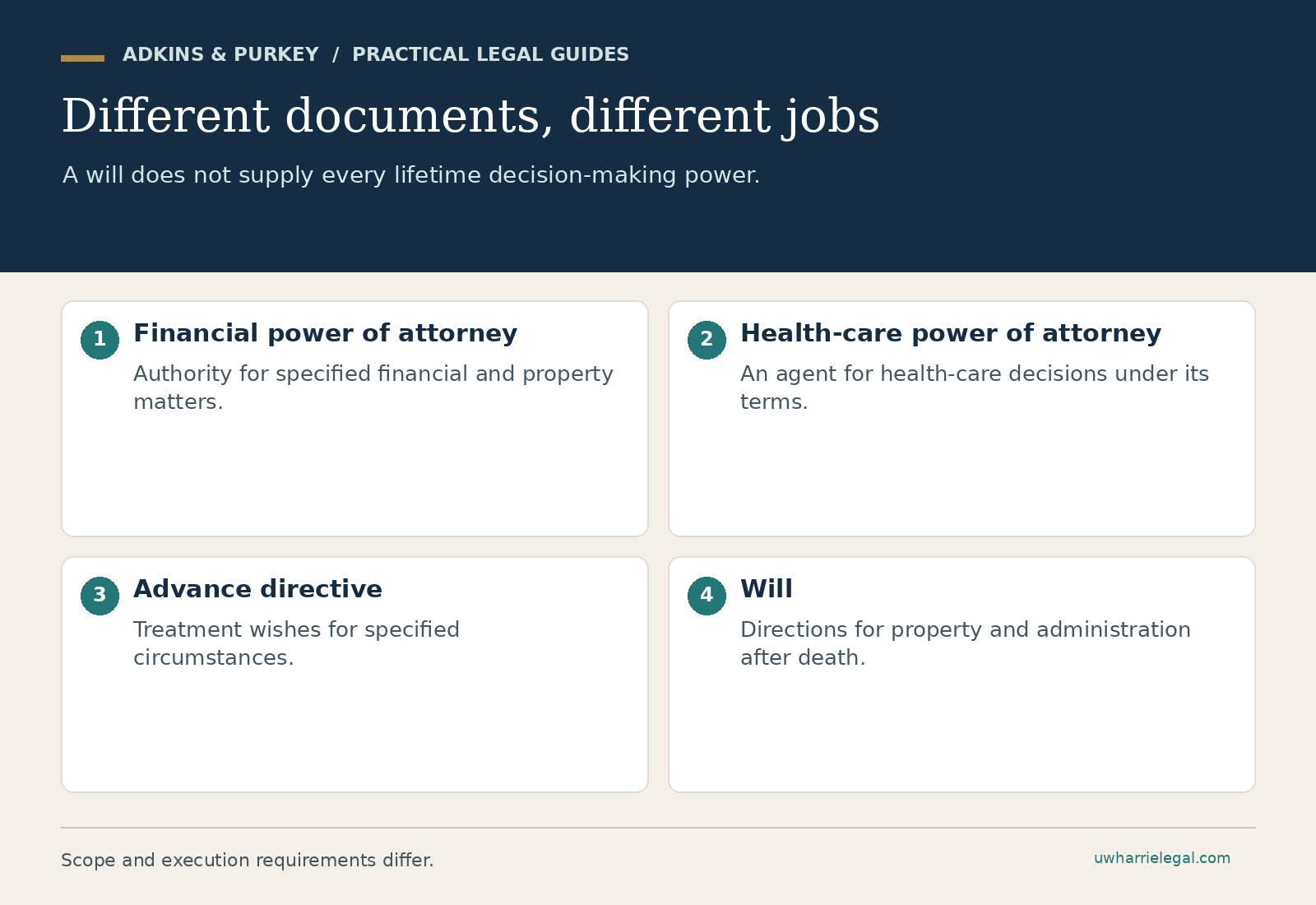
A family may know your wishes and still lack the legal authority needed to carry them out. If an illness or accident leaves you unable to handle decisions, someone may need to pay bills, communicate with a bank, manage property, or participate in medical decisions. A will does not supply all of that authority during your lifetime.
For adults in Locust, Albemarle, and Stanly County, incapacity planning is a practical part of estate planning at many stages of life. The work involves choosing reliable people, defining their authority, executing the right documents, and making the plan usable when it is needed.
Financial authority and health-care authority are different
North Carolina’s Uniform Power of Attorney Act governs many financial powers of attorney, but expressly excludes a power to make health-care decisions. Health-care powers of attorney are addressed separately. A document for banking and property should not be assumed to authorize medical decisions, and a health-care document should not be assumed to authorize a house sale.
The relevant starting points are Chapter 32C and Chapter 32A, Article 3. The actual language, execution requirements, and circumstances of use matter.
Choose the person before choosing the form
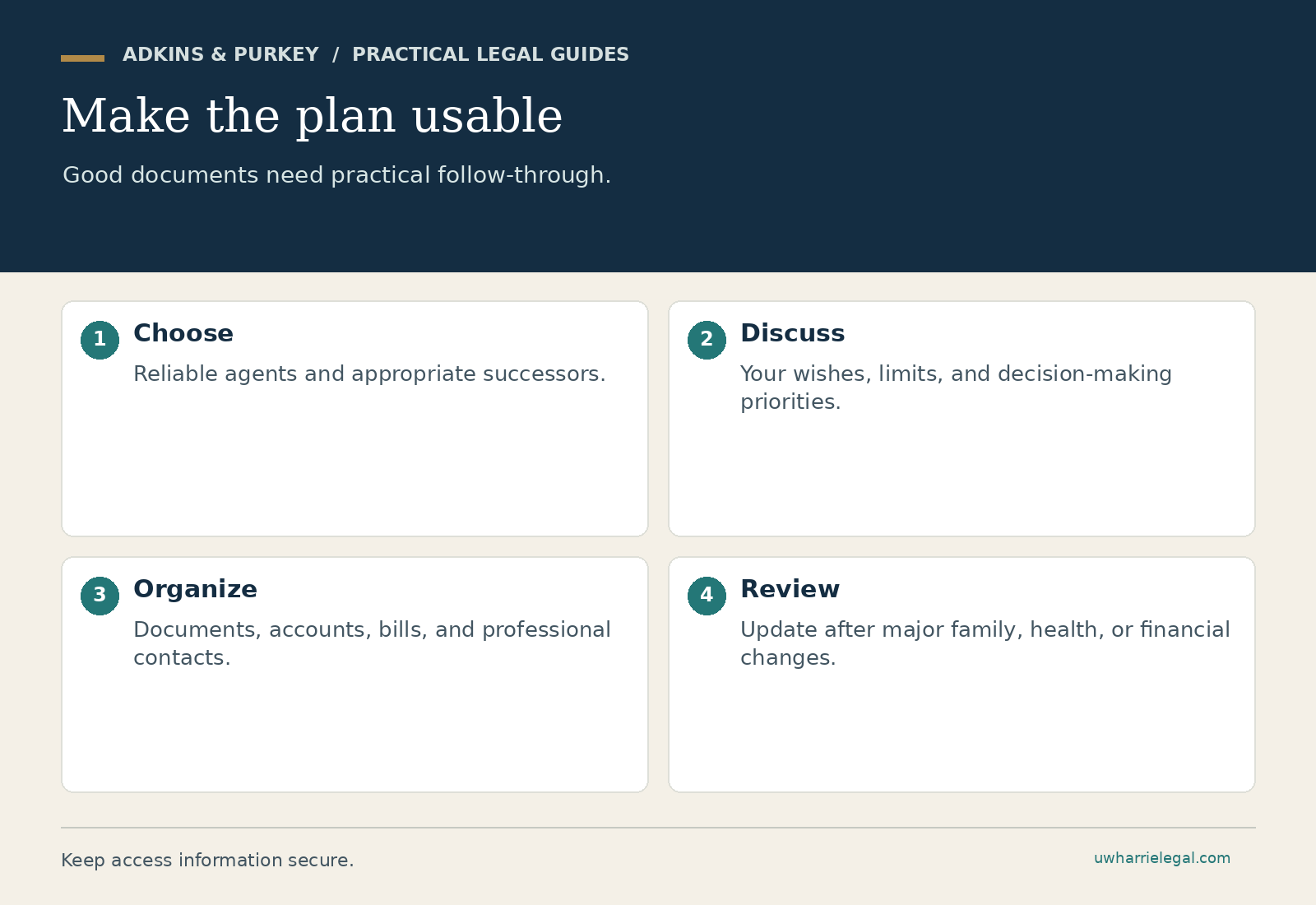
An effective agent needs judgment, reliability, availability, and the ability to communicate with professionals and family members. The nearest relative is not automatically the best choice for every role. The person who is excellent at discussing medical care may not be the person best suited to track accounts and property expenses.
Discuss the role with the proposed agent. Ask whether the person is willing to serve, understands your priorities, and can keep records. Name a suitable successor so the plan does not depend entirely on one person’s availability. If you are considering co-agents, discuss how disagreements and separate action would be handled.
Decide when financial authority should begin
Some documents provide immediate authority; others make authority depend on a future event or determination. Each approach has practical consequences. Immediate authority requires careful trust and safeguards. Conditional authority may require proof that the triggering condition has occurred before a bank or other institution will act.
A durable power of attorney can remain effective during incapacity under applicable law, but “durable” does not mean unlimited or permanent for every purpose. Financial authority generally ends at the principal’s death, and the document and statute identify other termination events. See § 32C-1-110. Estate administration after death is a different role.
Review sensitive powers explicitly
Gifts, beneficiary changes, trust actions, and other significant transactions should not be treated as routine boilerplate. Ask what authority is actually needed and what safeguards are appropriate. Broad powers can create opportunities for misuse if the agent is poorly chosen or the document does not fit the person’s circumstances.
Discuss financial institutions, business ownership, real estate, and digital access with counsel. The goal is authority that works for the assets you actually own. Do not assume that adding someone to an account is an equivalent substitute; ownership changes can create different consequences.
Give the health-care agent useful direction
A health-care power of attorney identifies an agent and addresses decision-making authority under its terms and the governing law. An advance directive can separately express treatment wishes in specified circumstances. These documents should be consistent with each other and with a conversation about your values.
Talk about what matters to you: communication with family, religious or personal preferences, important medical history, and the professionals who know your care. Avoid giving conflicting instructions to different people. The statutory health-care power of attorney form illustrates the scope and formalities that require attention; it should be adapted and executed appropriately.
Make the plan available without exposing sensitive information
Tell the agent where the documents are stored. Discuss how copies will be provided to medical providers and financial institutions when appropriate. Maintain a separate, secure list of accounts, insurance, recurring bills, medications, and professional contacts. A perfectly drafted document in an inaccessible location can be difficult to use during an emergency.
Use a secure method for passwords and sensitive access information. Do not put all credentials into a casually shared email or a public-facing document. The agent needs a workable plan for authorized access, not an invitation to bypass security controls.
Revisit the plan when life changes
Marriage, separation, divorce, relocation, a new diagnosis, a business transaction, or an agent’s death can justify review. Bring earlier documents rather than assuming they have all become invalid. Counsel can determine what remains useful, what should be replaced, and who needs notice of a change.
If capacity is already in question, obtain advice promptly. Signing a document is not a substitute for the legal capacity needed to execute it. A family may need to evaluate other lawful options if an appropriate power of attorney can no longer be made.
Prepare for the appointment
Bring existing estate documents, your preferred agents and successors, an asset list, medical and insurance contact information, and your questions about limits or safeguards. Adkins & Purkey helps clients consider how wills, incapacity documents, and beneficiary arrangements can work together.
For an unrelated driving concern requiring separate attention, visit the firm’s LKN DWI Defense resource library.
Attorney advertising. General North Carolina legal information as of September 22, 2026; not legal advice for a particular matter. Laws and procedures can change. Reading this article or contacting the firm does not establish an attorney-client relationship. Please do not send confidential information through an initial inquiry.


Leave a comment