
Family Law · Locust & Stanly County, North Carolina
In this guide- Read the order before recalculating the payment
- Look beyond one paycheck
- Understand the worksheet without treating it as a shortcut
- Connect each change to evidence
- A job loss is important, but it is not self-executing relief
- Keep support disputes separate from parenting disputes
- Questions to resolve before filing
A new job, reduced overtime, or a different parenting schedule can change a family’s finances quickly. The child support order usually does not change automatically with them. Parents in Locust, Albemarle, and Stanly County should separate two questions: what the current order requires today, and whether the facts support asking the court for a different amount.
Good preparation starts with complete financial information. A calculator can produce a number, but it cannot decide which income counts, whether a claimed expense is supported, or whether modification is legally available.
Read the order before recalculating the payment
Find the payment amount, due date, payment method, health-insurance provisions, uninsured medical expense allocation, and any other specific obligations. Locate later orders as well. A parent may be paying the correct monthly amount while overlooking a separate reimbursement requirement.
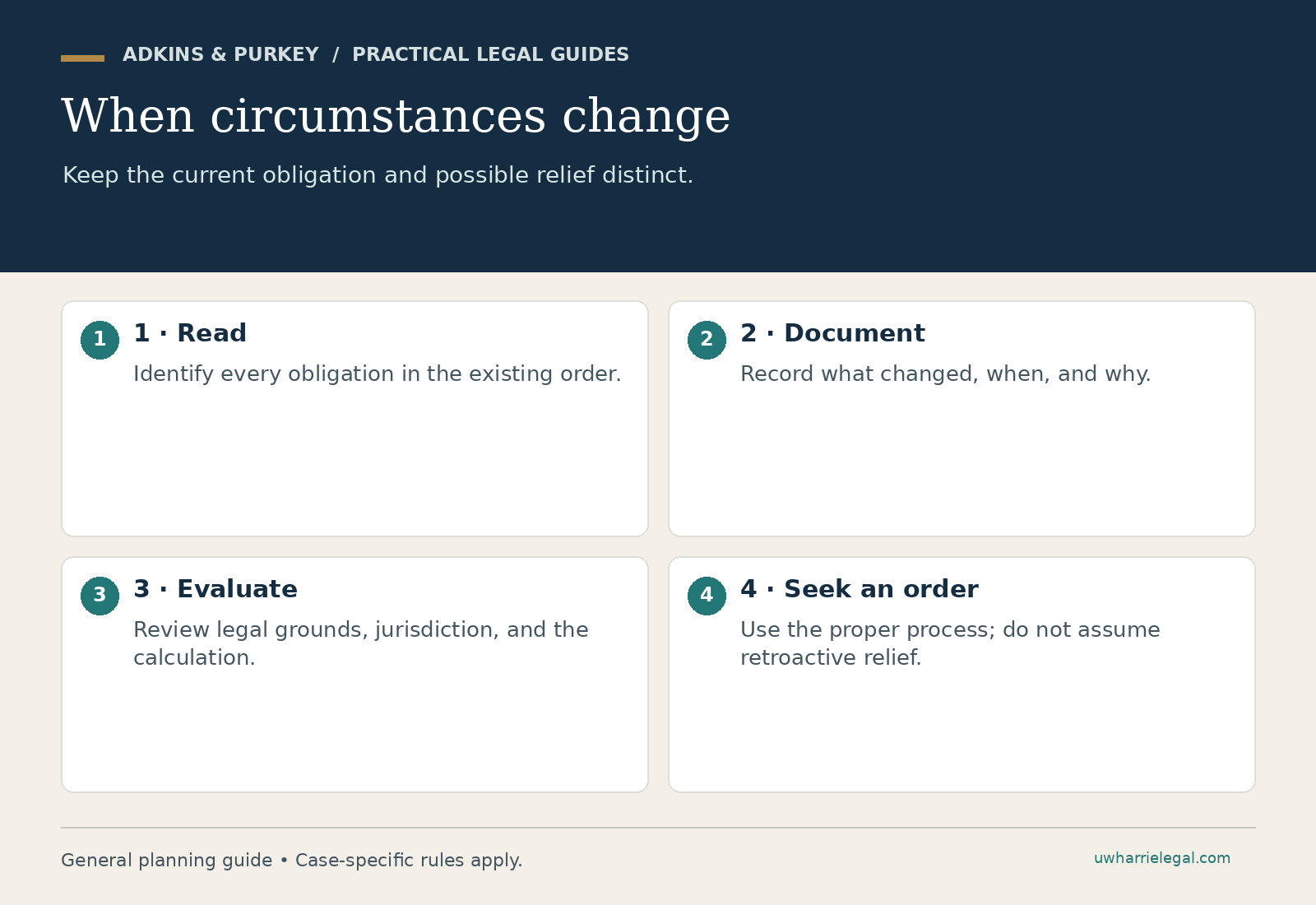
Do not rely on an informal agreement to reduce a court-ordered payment. North Carolina limits retroactive changes to accrued support. A motion can matter to the period for which relief is available, subject to statutory requirements and exceptions. Review § 50-13.10 with counsel rather than assuming a future order will erase an accumulating balance.
Look beyond one paycheck
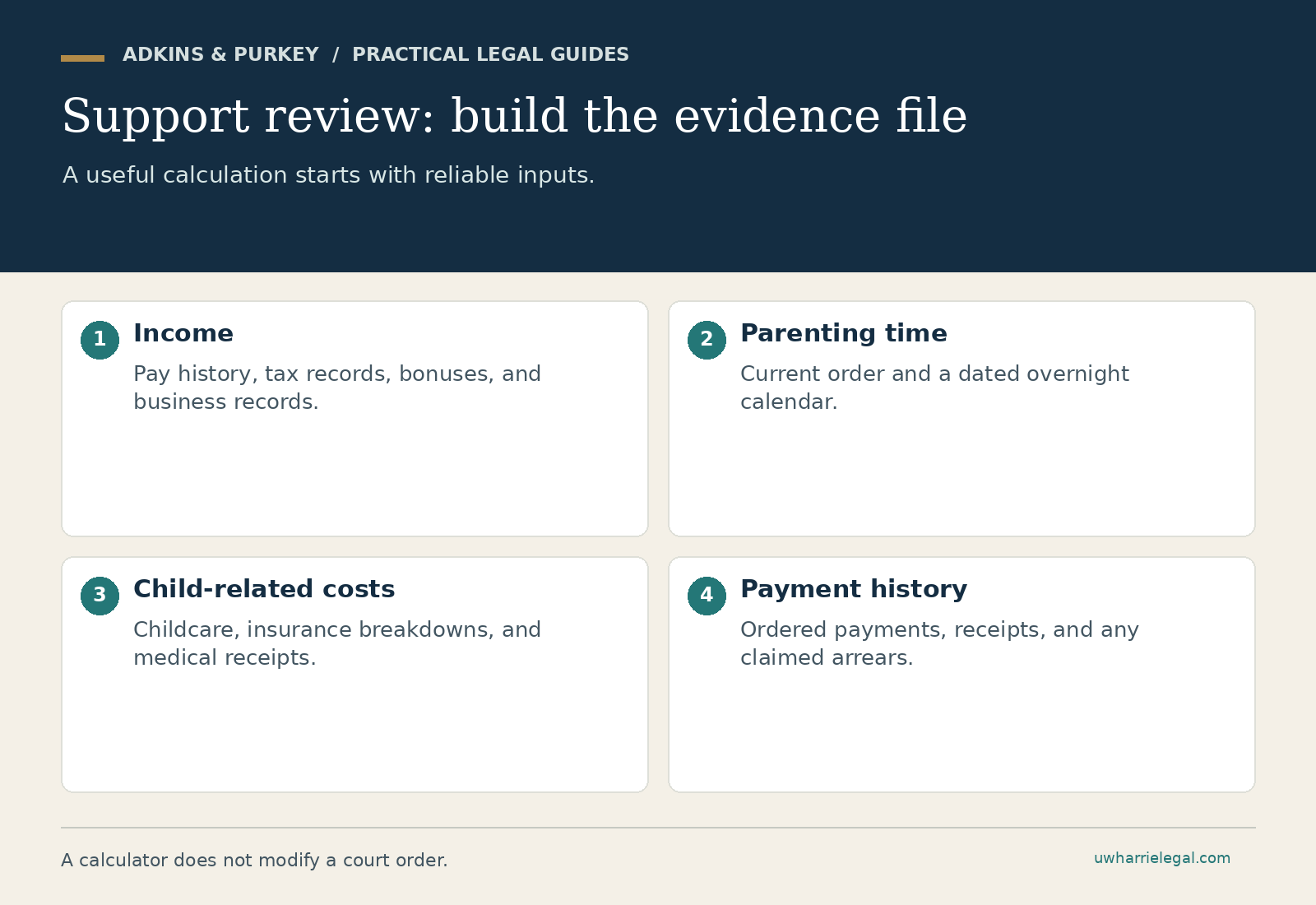
Collect enough records to show a reliable picture of income. Recent pay stubs help, but year-end statements, tax returns, bonus records, and information about self-employment may explain fluctuations. Identify when a change began, why it occurred, and whether it appears temporary or lasting.
If you operate a small business, separate revenue, ordinary business expenses, personal expenses paid through the business, and owner distributions. A tax return is important evidence; it is not necessarily the final answer to every child support income question. Do not omit irregular receipts just because they do not appear in a standard paycheck.
Understand the worksheet without treating it as a shortcut
The Judicial Branch currently links to guidelines effective January 1, 2023. Broadly, Worksheet A addresses primary physical custody, Worksheet B shared custody and certain mixed arrangements, and Worksheet C split primary custody of multiple children. For Worksheet B, the guidelines require at least 123 nights with each parent and each parent’s financial responsibility during that time. Equal time does not automatically mean zero support.
The guidelines also contain a modification presumption when an order is at least three years old and a current calculation differs by at least 15%. That is not a rule requiring every parent to wait three years. Other changed circumstances may warrant review. Consult the current official guidelines and worksheets for the full requirements, adjustments, and possible deviations.
Connect each change to evidence
| What changed? | Records worth gathering | Question for counsel |
|---|---|---|
| Employment or overtime | Pay history, employer notices, job-search records | How should recurring and irregular income be evaluated? |
| Childcare | Provider invoices, payment receipts, work schedules | Which expenses qualify and who actually pays them? |
| Health coverage | Premium breakdowns and plan documents | What is the child’s attributable coverage cost? |
| Parenting time | Current order and actual overnight calendar | Does the worksheet reflect the applicable arrangement? |
Keep an explanation beside every unusual entry. If a pay stub includes reimbursement rather than earnings, identify it. If childcare ended because school began, record the date. If an overnight calendar differs from the order, explain why instead of silently choosing the more favorable number.
A job loss is important, but it is not self-executing relief
A genuine loss of employment can create an urgent need for advice. Bring the termination or layoff notice, unemployment information, applications, interview records, and any new work. The court’s evaluation may include whether the income change was voluntary and the circumstances surrounding it. Do not assume every reduction in earnings produces a matching reduction in support.
The modification statute permits relief on a showing of changed circumstances, subject to other legal limits. An existing order from another state can introduce jurisdictional issues. See § 50-13.7. The first consultation should identify both the financial evidence and the correct court procedure.
Keep support disputes separate from parenting disputes
A missed payment does not authorize a parent to cancel visitation, and a missed exchange does not authorize the other parent to stop paying. Keep separate records for support and custody. That makes it easier to identify whether the next step involves enforcement, modification, or both. The North Carolina Judicial Branch child support guide provides a useful process overview.
If a traffic or DWI matter threatens the ability to drive to work, address that issue promptly alongside the support analysis. A license problem does not itself change the support order. Our LKN DWI Defense resource explains related driving and criminal-case questions.
Questions to resolve before filing
Can we simply agree to a new number?
Agreement can help, but a court order generally needs an appropriate court process to change it. Counsel should address the effective date, any arrears, health expenses, and the language of the proposed order.
Do I need to bring the other parent’s records?
Bring records you lawfully possess and identify what is missing. Your lawyer can discuss proper disclosure and discovery methods. Do not guess at earnings or obtain private information by entering someone else’s accounts.
What makes the first appointment productive?
Bring the existing order, payment history, income documents, a dated list of changed circumstances, and your actual questions. A short, accurate summary is more useful than an unsupported estimate of what you think support should be.
Attorney advertising. General North Carolina legal information as of September 22, 2026; not legal advice for a particular matter. Laws and procedures can change. Reading this article or contacting the firm does not establish an attorney-client relationship. Please do not send confidential information through an initial inquiry.


Leave a comment