
Family Law · Locust & Stanly County, North Carolina
In this guide- Postseparation support and alimony serve different roles
- Build a budget someone else can follow
- Distinguish need, ability to pay, and disputed assumptions
- Employment history matters as much as a current number
- Marital misconduct requires careful legal analysis
- Protect the claim before the divorce judgment
- Evaluate a settlement beyond the monthly payment
- Your first meeting: bring a workable financial story
After separation, the same income may need to support two households. That creates immediate questions about housing, insurance, transportation, debt, and everyday expenses. For spouses in Locust and Stanly County, a credible budget is one of the most useful tools for evaluating support. It should show real needs and resources, with records that explain the numbers.
North Carolina does not resolve every spousal support case with a simple percentage of income. The legal basis for support and the financial evidence both matter. A polished spreadsheet is helpful only if its assumptions can be explained.
Postseparation support and alimony serve different roles
Postseparation support addresses support needs under the statutory framework while the broader support dispute is being resolved. The court considers such matters as accustomed living standards, recurring earnings, earning ability, debt service, reasonable expenses, and other legal support obligations. Entitlement generally turns on inadequate resources for the dependent spouse’s reasonable needs and the supporting spouse’s ability to pay, with marital misconduct considered as the statute directs. See § 50-16.2A.
Alimony requires analysis of dependency, the supporting spouse’s status, and whether an award is equitable. Amount, duration, and payment structure depend on the relevant statutory factors. There is no universal rule that a marriage of a particular length produces a particular monthly payment or term.
Build a budget someone else can follow
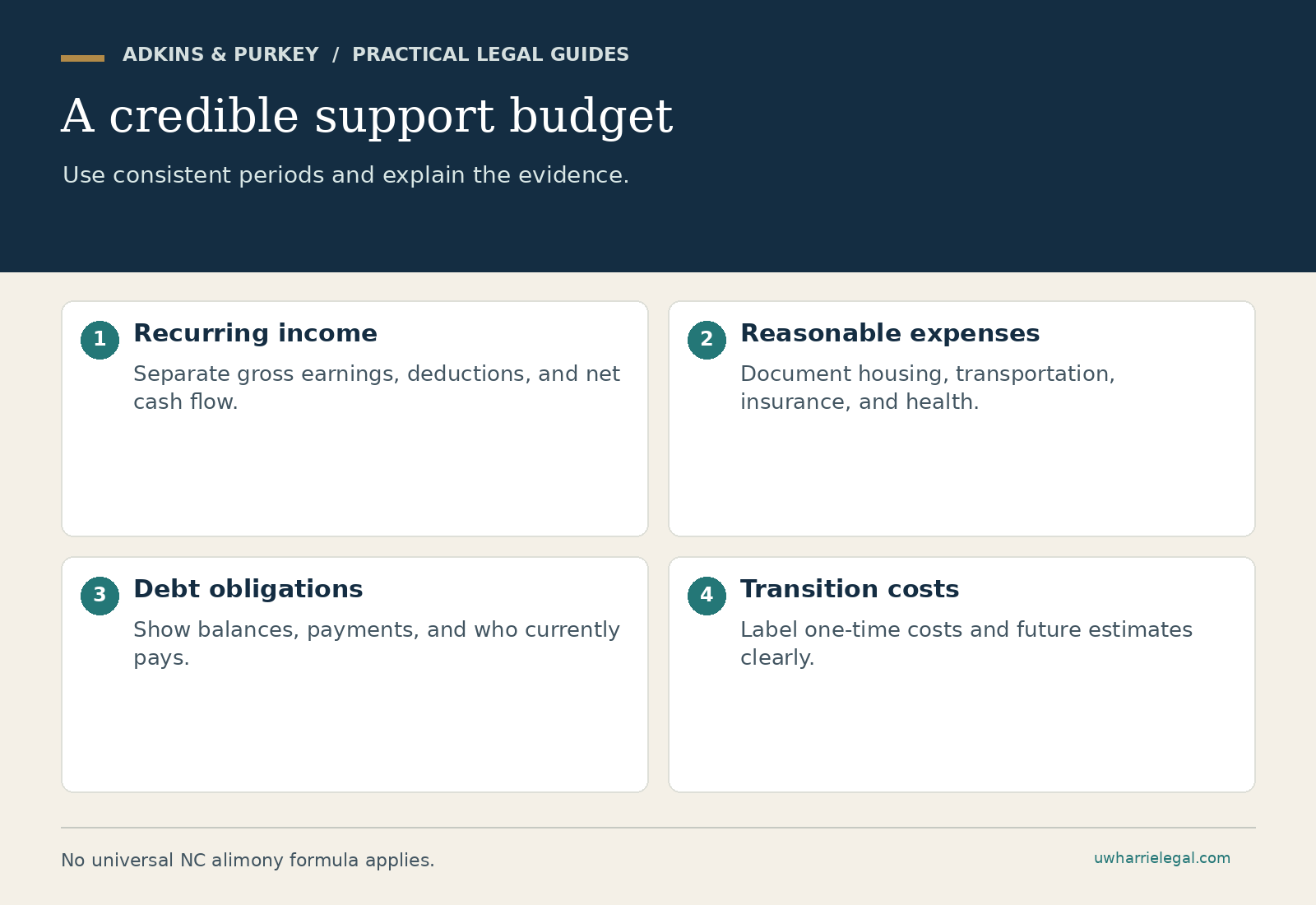
Start with the household as it operates now. List income separately from expenses, identify whether amounts are gross or net, and use a consistent monthly period. Convert annual or quarterly expenses carefully. If you estimate a future cost, label the estimate and explain its basis.
Separate recurring needs from one-time transition costs. A security deposit, furniture purchase, or moving expense may be real without being an ordinary monthly expense. Likewise, a shared mortgage payment should not accidentally appear twice in a combined financial picture.
Distinguish need, ability to pay, and disputed assumptions
| Budget area | Useful supporting record | Common problem |
|---|---|---|
| Housing | Lease, mortgage statement, utilities | Counting both current and replacement housing as permanent expenses |
| Income | Pay stubs, tax returns, benefit statements | Mixing gross earnings with take-home pay |
| Insurance and health | Premium notices and recurring bills | Ignoring coverage changes after divorce |
| Debt | Statements showing balance and minimum payment | Treating every debt as undisputed or permanently allocated |
For each major expense, ask who pays it now, who is expected to pay it after separation, and whether another request already includes it. When children are involved, coordinate the support analysis so the same expense is not presented inconsistently in different parts of the case.
Employment history matters as much as a current number
A spouse who left the workforce to raise children may need to explain education, previous employment, current responsibilities, and realistic retraining options. A spouse with irregular earnings should explain bonuses, commissions, seasonality, and the difference between a strong month and sustainable income.
Organize this history without exaggerating. Identify qualifications, applications, health limitations, and caregiving obligations that are actually supported by records. If a future income projection assumes a return to full-time employment, show how and when that could reasonably occur. Do not present an aspiration as guaranteed earnings.
Marital misconduct requires careful legal analysis
The alimony statute gives specific consequences to qualifying illicit sexual behavior before or on separation, including different treatment depending on which spouse engaged in it, whether both did, and whether it was condoned. It also directs consideration of other relevant factors and misconduct. The rule cannot responsibly be reduced to “cheating always means payment” without examining dependency and the statutory conditions. See § 50-16.3A.
Give counsel an accurate timeline and preserve lawfully obtained evidence. Do not publish allegations online, alter messages, or access private accounts. A budgeting conversation and an evidence conversation should support the same coherent understanding of the case.
Protect the claim before the divorce judgment
A pending or previously adjudicated support claim is treated differently from an unasserted claim when absolute divorce is entered. A divorce can extinguish rights that were not properly preserved. Limited statutory exceptions should never be treated as a planning strategy. Ask counsel to confirm the actual filings and orders before allowing a “simple divorce” to proceed. See § 50-11.
Negotiations are not a substitute for checking the record. Bring any separation agreement, release, or draft settlement to the meeting. Contractual support and court-ordered support can raise different enforcement and modification issues.
Evaluate a settlement beyond the monthly payment
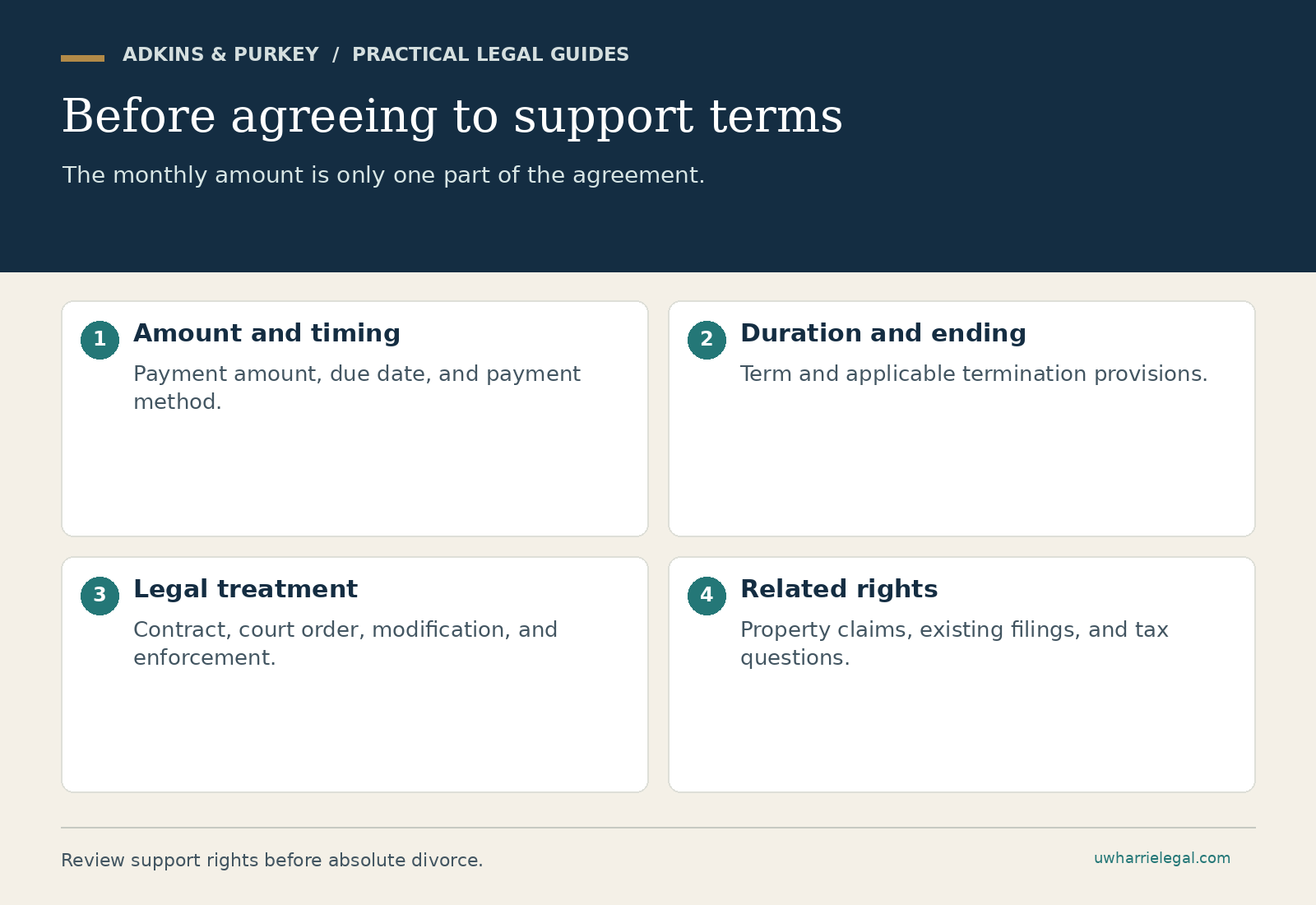
Discuss duration, due dates, payment method, termination provisions, security, enforcement, and how the agreement interacts with property division. Identify tax questions for appropriate advice, particularly if an older instrument or a proposed modification is involved. Avoid assuming that every support arrangement has the same tax treatment.
If a DWI or traffic matter affects work and transportation, discuss its practical impact without treating a charge as proof of misconduct or automatic financial relief. The firm’s DWI guide provides a separate starting point for those issues.
Your first meeting: bring a workable financial story
Bring a monthly budget, recent income records, several months of account statements, debt information, insurance details, the separation date, and existing agreements or pleadings. Mark uncertain figures. The objective is a realistic, supportable proposal that accounts for both households and preserves the legal issues that still need resolution.
Attorney advertising. General North Carolina legal information as of September 22, 2026; not legal advice for a particular matter. Laws and procedures can change. Reading this article or contacting the firm does not establish an attorney-client relationship. Please do not send confidential information through an initial inquiry.


Leave a comment