ADKINS & PURKEY · LOCUST & ALBEMARLE · NORTH CAROLINA
A practical guide from the firm of Christopher “Chris” Adkins and Christerfer “Chris” Purkey. Explore our practice.

Explore this guide
- The best-interests standard applies to both parents
- Confirm legal parentage when the parents were not married
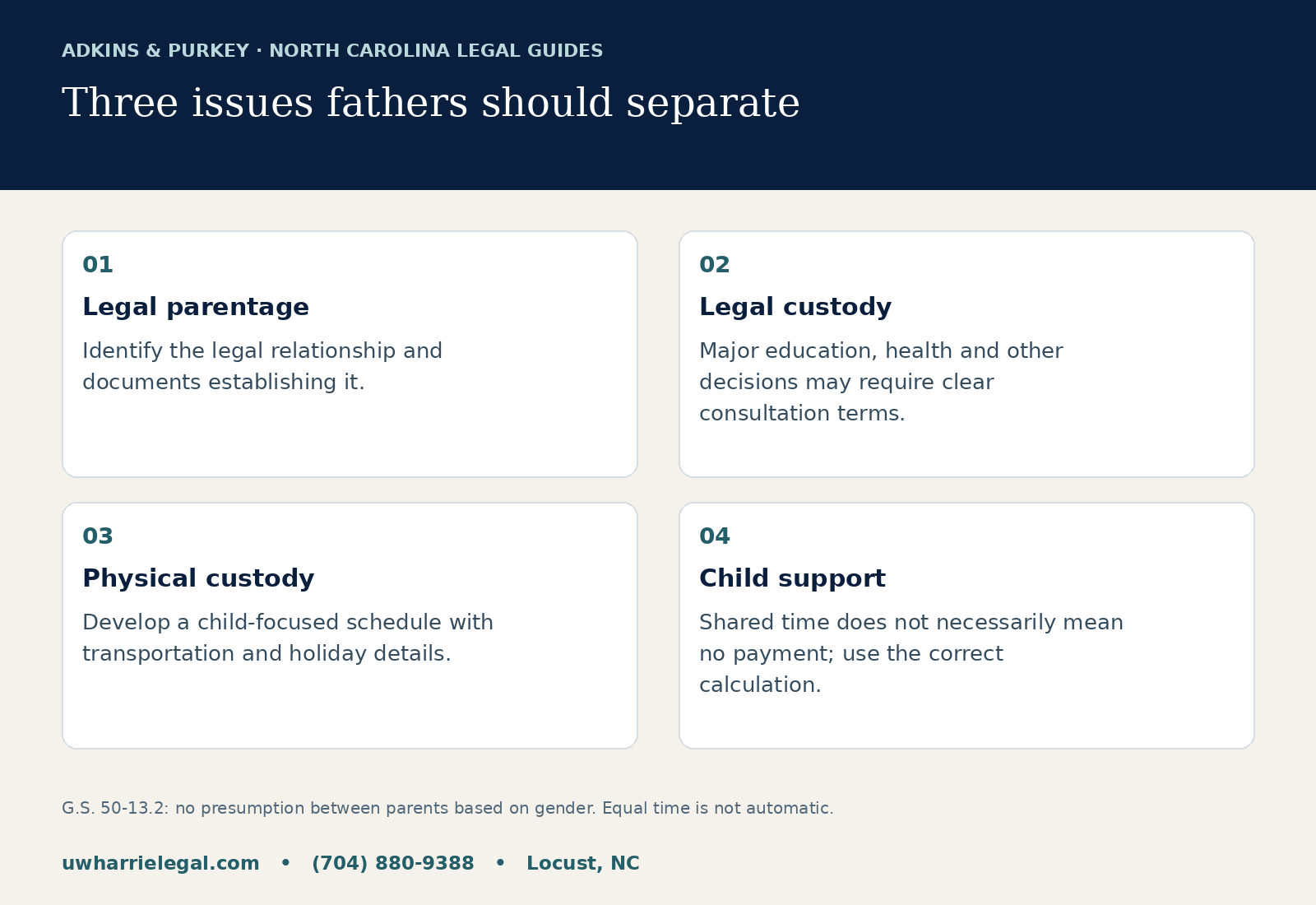
- Distinguish legal custody from physical custody
- Document the parenting you actually do
- Ask for a schedule that works for the child
- Child support and parenting time are different obligations
- Respond constructively to denied exchanges
- Address allegations with evidence and care
- Existing permanent orders require a different analysis
- Prepare for your first meeting
- Pursue an active role with a practical plan
“Do fathers have a fair chance at custody in North Carolina?” It is one of the most important questions a father can ask before making assumptions about his role after separation. North Carolina law does not create a preference between parents based on gender. The task is to establish the child's needs and show how the requested parenting arrangement serves them.
At Adkins & Purkey, PLLC in Locust, attorneys Chris Adkins and Chris Purkey help fathers evaluate custody, parenting schedules, parentage, support, and enforcement. A useful plan begins with the actual legal relationship and existing orders, then develops evidence about day-to-day parenting.
The best-interests standard applies to both parents
G.S. 50-13.2 directs the court to promote the child's interest and welfare and states that no presumption applies between natural or adoptive parents about who better serves that goal. Joint custody must be considered when either parent requests it. Consideration does not mean an automatic equal-time award.
A father's case should therefore focus on the child: consistent care, safety, school, health, emotional needs, and a workable schedule. The statute does not guarantee an outcome based on employment, home ownership, or the label “father's rights.” Those facts matter only in the context of the legal issues and the child's circumstances.
Confirm legal parentage when the parents were not married
An unmarried father should identify whether parentage has been legally established and what documents reflect that status. An affidavit of parentage, support order, judicial determination, or other record may matter. The appropriate process depends on the facts, and a name on paperwork should not be treated as a complete answer to every parentage issue.
If parentage is disputed, ask about the available legal procedures before relying on informal assumptions or a privately arranged test. Establishing parentage and obtaining a clear custody order are related but separate steps. Existing adoption proceedings or prior orders can materially change the analysis.
Distinguish legal custody from physical custody
Legal custody concerns major decisions such as education and significant health care. Physical custody concerns where the child spends time. Parents may share decision-making even when their physical schedule is unequal, or may require detailed provisions for resolving a particular category of disagreement.
Ask what consultation means in practice. How will parents exchange medical information? What happens when a school decision has a deadline? A vague promise to “agree on everything” may leave recurring conflict. A well-drafted order identifies responsibilities without turning every ordinary parenting choice into another legal dispute.
Document the parenting you actually do
Keep accurate records of caregiving: school transportation, homework, medical appointments, activity attendance, meals, bedtime routines, and care during illness. Preserve relevant messages and records in context. These details can demonstrate a sustained relationship more clearly than broad claims about being the better parent.
Do not create a log designed to exaggerate mistakes or provoke exchanges for evidence. Record important events objectively, including agreed changes and successful cooperation. If your work schedule changes, explain how transportation and child care will continue. A proposed arrangement needs a realistic foundation.
Ask for a schedule that works for the child
Alternating weeks, shorter rotations, extended weekends, and other schedules each have advantages and challenges. The right proposal depends on age, distance, school routines, parental availability, and safety. A parent should be able to explain the requested arrangement in the child's terms rather than only in percentages.
For parents living between Albemarle, Locust, and Cabarrus County, travel can affect school mornings and activities. Identify exchange locations, transportation duties, holiday priority, summer notice, and missed-time procedures. If a parent works evenings or weekends, propose a plan addressing those hours instead of ignoring them.
Child support and parenting time are different obligations
Paying child support does not purchase time, and missed support does not authorize the other parent to cancel court-ordered exchanges. Support is calculated and enforced under its own rules. Shared physical custody does not necessarily eliminate a support obligation when incomes or relevant expenses differ.
If access is being denied, document the events and seek advice about enforcement. If support is unaffordable because circumstances changed, seek an appropriate modification rather than stopping payments. Keeping these issues separate protects the child's needs and avoids turning one problem into two.
Respond constructively to denied exchanges
Read the order's exact language before concluding that a violation occurred. Record the scheduled exchange, your compliance with required notice, the communication received, and what actually happened. Remain calm and avoid confrontations at school, homes, or public exchange locations.
Whether contempt, clarification, modification, or another remedy is appropriate depends on the order and facts. Police do not replace the family court's role in interpreting every scheduling disagreement. If an emergency or crime creates immediate danger, contact emergency services; otherwise discuss a measured legal response with counsel.
Address allegations with evidence and care
Allegations involving violence, substance use, neglect, or inappropriate conduct deserve serious attention. Do not dismiss them as tactics without reviewing the available evidence. Preserve records, follow existing restrictions, and tell your attorney about parallel criminal or protective-order proceedings.
At the same time, an allegation is not a substitute for proof. Counsel can identify what is disputed, what records are needed, and what response is appropriate. Avoid social-media arguments, contacting protected people in violation of an order, or asking the child to investigate the allegation.
Existing permanent orders require a different analysis
If a father wants to change a permanent custody order, the ordinary modification inquiry includes whether a substantial change in circumstances affects the child. A new preference for a different schedule, standing alone, is not the same as establishing the required change.
Bring the original order, later amendments, and a timeline of developments. Changes involving school, health, relocation, safety, or the practical operation of the existing arrangement may require evaluation. Counsel should identify the correct procedural route and jurisdiction before deciding how to present the request.
Prepare for your first meeting
Bring parentage documents, all custody and support orders, served papers, a current calendar, a proposed parenting schedule, and focused examples of the issues needing resolution. Identify where the child has lived and whether another state or county has an existing case.
Fathers from Locust, Albemarle, Stanfield, Oakboro, Norwood, and surrounding communities can contact Adkins & Purkey to discuss the situation. You do not need to arrive with every answer. You do need to identify court dates, urgent concerns, and the documents already controlling the family's arrangements.
Frequently asked questions
Do mothers automatically receive custody?
No. G.S. 50-13.2 creates no presumption between natural or adoptive parents about which parent better promotes the child’s welfare.
Does asking for joint custody guarantee 50/50 time?
No. Joint custody must be considered when either parent requests it, but the arrangement depends on the child’s best interests and the facts.
Does shared time eliminate child support?
Not necessarily. The proper worksheet, incomes, expenses and actual parenting arrangement can produce an obligation even when parents share substantial time.
Pursue an active role with a practical plan
A productive father's-rights strategy combines an accurate understanding of the law with dependable parenting and a credible proposal. The objective is a stable, enforceable arrangement that serves the child and defines the father's responsibilities and opportunities clearly. That is a stronger starting point than assumptions about what courts always do.
Meet Chris Adkins and Chris Purkey

North Carolina attorney and certified mediator with a background as a Charlotte-Mecklenburg police officer and Army officer. His work includes family law, criminal defense and civil litigation.
Read the attorney profile →
Attorney whose practice includes family law, DWI and criminal defense, and civil litigation. His approach emphasizes preparation, clear communication and practical decisions based on the record.
Read the attorney profile →Continue with a related guide
- Child Custody Evidence in Stanly County: Build a Record That Focuses on Your Child
- North Carolina Child Support in 2026–2027: What Stanly County Parents Should Know
- When a Custody or Support Order Is Violated: A Stanly County Enforcement Guide
Official sources and further reading
- G.S. 50-13.2: no presumption between parents
- NC Judicial Branch: custody and parentage
- NC Judicial Branch: child support
General educational information checked November 2026. Laws and procedures may change. Attorney advertising; no result is guaranteed. This guide is not legal advice and does not create an attorney-client relationship.


Responses
[…] Fathers’ Rights in North Carolina: Custody, Parenting Time and Support […]
LikeLike
[…] Fathers’ Rights in North Carolina: Custody, Parenting Time and Support […]
LikeLike
[…] Fathers’ Rights in North Carolina: Custody, Parenting Time and Support […]
LikeLike