ADKINS & PURKEY · LOCUST & ALBEMARLE · NORTH CAROLINA
A practical guide from the firm of Christopher “Chris” Adkins and Christerfer “Chris” Purkey. Explore our practice.

Explore this guide
- Start with the actual order
- Document the event and the required performance
- Custody and support cannot be traded through self-help
- Contempt requires more than an accusation
- Clarification may address an ambiguous provision
- Changed circumstances may call for modification
- Police have a limited role in ordinary scheduling disputes
- Communicate without escalating
- Prepare a support payment history that can be checked
- Identify the relief that would solve the problem
- Bring the order, the record, and the deadline
A missed exchange, unpaid support installment, or repeated refusal to share required information can disrupt a family's routine. The first step is to identify exactly what the governing order requires. The next is to choose a response that addresses the problem without creating a new violation.
Adkins & Purkey, PLLC helps clients in Locust, Albemarle, and surrounding communities evaluate enforcement, clarification, and modification of family-court obligations. Attorneys Christopher Adkins and Christerfer Purkey can review the documents and help distinguish deliberate noncompliance from an unclear provision or a genuinely changed circumstance.
Start with the actual order
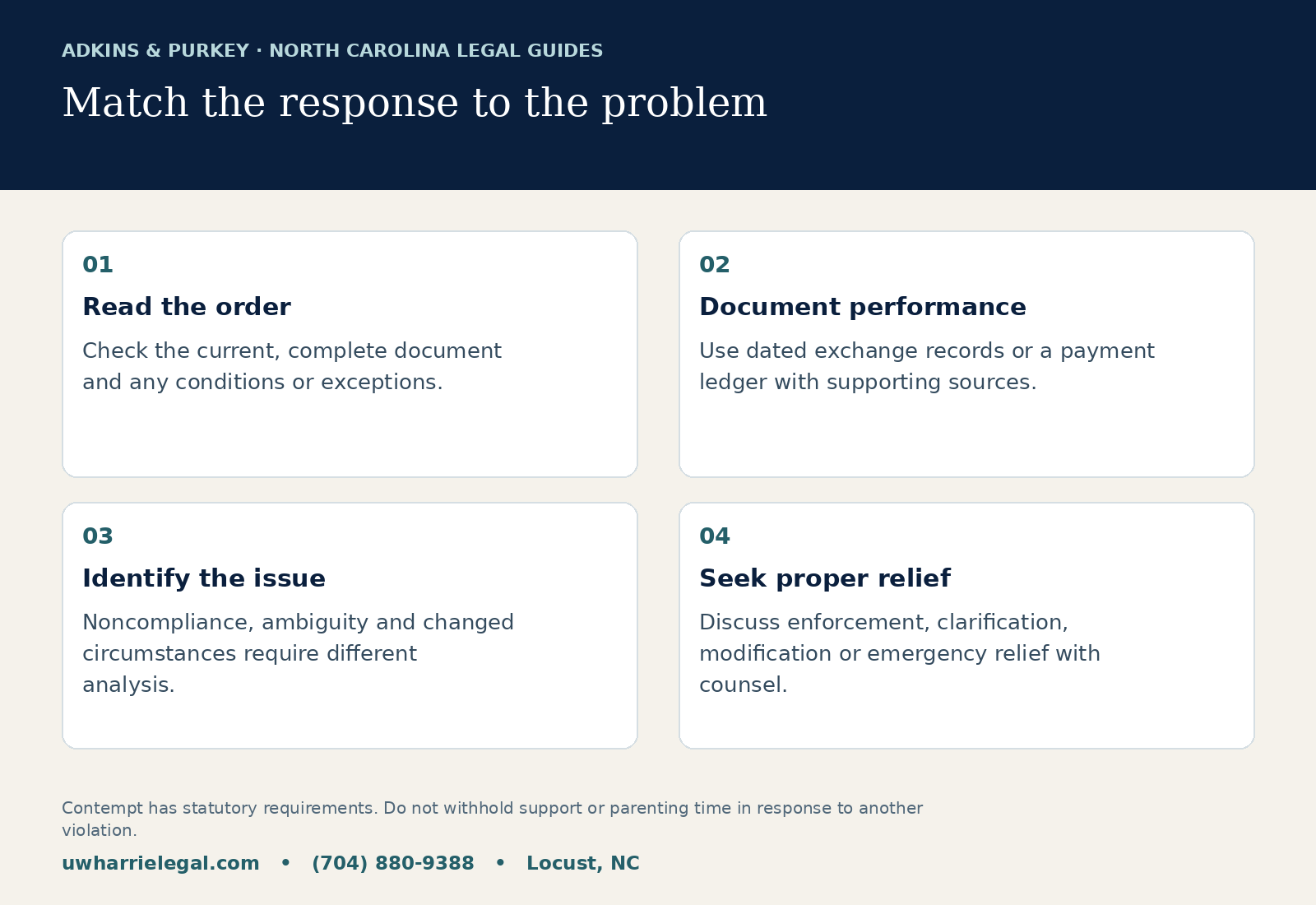
Obtain a complete, file-stamped copy of the current order and any amendments. Read the operative paragraphs, effective dates, exceptions, and conditions. An older draft, mediation proposal, or text-message summary may not reflect what the judge actually ordered.
A private separation agreement is not automatically enforced in the same way as a court order. Whether it was incorporated into a judgment can matter. Tell counsel which document creates the obligation before assuming that contempt is the correct remedy.
Document the event and the required performance
For a custody exchange, identify the ordered date, time, place, required notice, your preparations, and what occurred. Preserve relevant communications in context. For unpaid support, identify the amount due, payment date, amount received, and any official payment history.
Use a factual ledger rather than a collection of conclusions. “No payment received for the installment due October 1” is more useful than “never supports the child.” Keep receipts and bank records. If an obligation involves reimbursement, include the invoice and evidence that the required request or notice was provided.
Custody and support cannot be traded through self-help
One parent's failure to pay support does not permit the other to cancel ordered parenting time. A denied exchange does not authorize the paying parent to stop support. These obligations are addressed through their own legal processes.
Responding with another violation can complicate the case and increase the child's stress. Continue complying with clear obligations, preserve evidence, and obtain advice about relief. If compliance itself presents an immediate safety concern, explain the specific risk promptly rather than assuming the ordinary rule resolves an emergency.
Contempt requires more than an accusation
Civil contempt generally involves statutory requirements concerning a continuing order, its purpose, willful noncompliance, and the person's ability to comply or take reasonable measures toward compliance. The required procedure, notice, evidence, and available relief must be considered carefully.
An unpaid obligation does not automatically establish every element. A claim of inability to pay also requires factual examination. Courts distinguish genuine inability from other situations, and the relevant ability must be evaluated under the applicable standard. Bring financial records and a complete history rather than relying on either label.
Clarification may address an ambiguous provision
Some disputes arise because an order never defines exchange times, transportation, expense approval, or the method of notice. If reasonable people read a paragraph differently, counsel may need to evaluate whether clarification or other relief is more appropriate than treating every disagreement as willful disobedience.
That does not mean a parent may ignore an inconvenient order. It means the response should fit the actual legal problem. Identify the language creating uncertainty and the practical events it produces. A clearer provision can sometimes prevent repeated disputes more effectively than repeated accusations.
Changed circumstances may call for modification
Enforcement asks whether an existing obligation should be obeyed. Modification asks whether the obligation should change under the governing legal standard. A permanent custody order ordinarily requires a substantial change in circumstances affecting the child before its terms are revised.
Support modification involves different rules and limitations. Job loss, changed income, altered custody, or the child's needs may justify review. Filing and effective-date issues can matter, and accrued support generally cannot simply be erased by a later calculation. Do not wait indefinitely while assuming an informal understanding protects you.
Police have a limited role in ordinary scheduling disputes
A law-enforcement officer may not be able to decide what an ambiguous custody paragraph means at an exchange. Whether an order directs or permits assistance depends on the order and applicable law. A family-court dispute is not automatically a criminal offense.
If there is violence, an immediate threat, abduction-related concern, or another emergency, call 911 and provide accurate information. Keep protective orders and emergency orders available. For routine enforcement questions, seek a court-based strategy rather than repeated confrontations designed to force an officer to choose a side.
Communicate without escalating
When safe and permitted, a concise written message can identify the required performance and request compliance. State the date, the relevant provision, and the practical action needed. Avoid insults, threats, or lengthy arguments about the entire relationship.
An existing no-contact or protective order takes priority over a preference for direct communication. Do not contact someone in violation of a restriction, even to discuss a family-law obligation. Counsel can help identify an appropriate communication route and assess whether a formal demand is useful.
Prepare a support payment history that can be checked
List each required installment and credit each payment accurately. Distinguish child support, alimony, child-care reimbursement, uninsured medical expenses, and unrelated transfers. Identify the source for each entry. The person reviewing the ledger should be able to reproduce the balance.
If payments go through an official collection system, obtain that history rather than estimating from memory. Explain discrepancies and claimed direct payments. A purchase for a child or a transfer marked “gift” may not receive the same treatment as the ordered payment; the facts and order control.
Identify the relief that would solve the problem
A useful consultation includes the requested outcome: compliance with exchanges, payment of a documented amount, performance of a transfer, clearer terms, or a different order. Attorney's fees may be available in some circumstances, but they are not automatic in every enforcement dispute.
Ask about the likely procedure, evidence, hearing requirements, possible remedies, and cost. An enforcement strategy should be proportionate to the problem and attentive to repeated conduct affecting the child. It should also account for related proceedings in another county or state.
Frequently asked questions
Does a violation automatically mean jail?
No. The available remedy and contempt requirements depend on the type of order, procedure, facts and applicable statutory findings.
Can a judge change an unclear order?
The proper request may involve clarification, modification or another remedy. Bring the complete order and examples showing how the disputed provision operates.
What should I bring about unpaid support?
Bring the current order, payment history, a dated ledger, bank records, reimbursement requests and relevant notices. Separate different obligations and credit payments accurately.
Bring the order, the record, and the deadline
For a meeting at Adkins & Purkey's Locust office, gather current orders, amendments, a concise chronology, payment records or exchange logs, relevant messages, and any hearing notice. Tell the firm whether the case is in Stanly, Cabarrus, Montgomery, or another county. Clear documents make it easier to identify the appropriate next step and the information still needed.
Meet Chris Adkins and Chris Purkey

North Carolina attorney and certified mediator with a background as a Charlotte-Mecklenburg police officer and Army officer. His work includes family law, criminal defense and civil litigation.
Read the attorney profile →
Attorney whose practice includes family law, DWI and criminal defense, and civil litigation. His approach emphasizes preparation, clear communication and practical decisions based on the record.
Read the attorney profile →Continue with a related guide
- Child Custody Evidence in Stanly County: Build a Record That Focuses on Your Child
- North Carolina Child Support in 2026–2027: What Stanly County Parents Should Know
- Custody Mediation in Stanly & Cabarrus Counties: Prepare a Parenting Plan That Works
Official sources and further reading
- G.S. 5A-21: civil contempt
- G.S. 50-13.3: custody enforcement
- G.S. 50-13.7: modification
- G.S. 50-13.10: past-due support
General educational information checked November 2026. Laws and procedures may change. Attorney advertising; no result is guaranteed. This guide is not legal advice and does not create an attorney-client relationship.


Responses
[…] When a Custody or Support Order Is Violated: A Stanly County Enforcement Guide […]
LikeLike
[…] When a Custody or Support Order Is Violated: A Stanly County Enforcement Guide […]
LikeLike
[…] When a Custody or Support Order Is Violated: A Stanly County Enforcement Guide […]
LikeLike
[…] When a Custody or Support Order Is Violated: A Stanly County Enforcement Guide […]
LikeLike